Selective Outrage: Why The Left Protests Israel But Ignores Iran's Slaughter
 By PNW Staff January 12, 2026
Share this article:
Why is it that crowds gathered outside synagogues in New York last week to protest Israel's war with Hamas, yet the streets fall eerily quiet when Iran's own regime is accused of slaughtering its people? Where are the student encampments, the mass marches, the candlelight vigils in America's major cities when Iranians risk everything to overthrow a brutal theocracy? Why does outrage ignite only in one direction?
This is not a rhetorical trick. It is a moral question--one the modern political left must ask itself with honesty and courage. Why do I protest when Jews are involved, but remain silent when Muslims, Persians, women, and dissidents are being killed by an Islamic regime? Why does my conscience activate selectively?
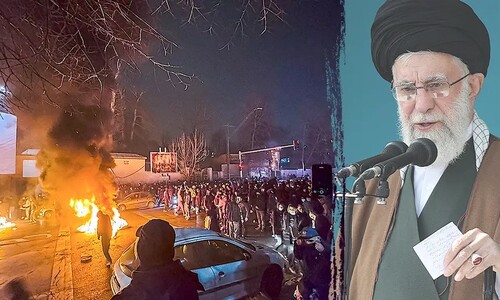
Reports emerging from Iran paint a grim and horrifying picture. Under a near-total communications blackout, the world is receiving only fragments--enough to suggest a tragedy of massacre proportions. Eyewitnesses describe hospitals overwhelmed, blood supplies critically low, bodies piling up, and snipers positioned on rooftops. Human rights groups report that casualties are rising by the hour. Some outlets claim that even conservative estimates suggest thousands of anti-regime protesters may have been killed within days.
The Iranian regime has reportedly shut down the internet, cut electricity, and unleashed security forces using live fire against civilians. Yet tonight, hundreds of thousands are said to be back in the streets of Tehran, waving the lights of their phones in the darkness--silent signals to a watching world that they are still there. In an extraordinary act of defiance, reports indicate that hundreds of mosques have been burned, a declaration by ordinary Iranians that they are done with clerical rule and religious tyranny.
And yet--silence.
Where is the Western outrage? Where are the campus protests? Where are the celebrities, the social media campaigns, the carefully worded condemnations? The contrast is impossible to ignore. Protesters who claim to stand for human rights seem energized only when Israel is the villain. When Jews are involved, outrage becomes a public ritual. When a radical Islamist regime kills its own people, the moral urgency evaporates.
This selective outrage demands self-examination. It exposes a worldview less concerned with justice than with ideology.
Part of the answer lies in the failure--perhaps refusal--of Western progressive culture to understand Islam as an ideology rather than a racial identity. In modern liberal discourse, Islam has been effectively racialized. Criticizing it is treated as an attack on "brown people," rather than as a critique of a belief system or a political structure. This confusion renders the Iranian uprising unintelligible. If Islam must always be defended as an oppressed identity, then Iranians rejecting Islamic rule break the narrative.
The Western press struggles with this reality. To explain Iran honestly would require acknowledging that millions of people are not rebelling against "Western imperialism," but against Islamism itself--a clerical system that has suffocated speech, crushed women, destroyed economic opportunity, and criminalized dissent. That story cannot be told without challenging sacred assumptions.
There is also an economic truth many prefer to ignore. Iran is not just a religious dictatorship; it is a centrally controlled, state-dominated economy where survival depends on loyalty to power. Decades of nationalization, price controls, and bureaucratic coercion have obliterated the middle class and entrenched corruption. Covering Iran honestly would require admitting that these systems--often romanticized in Western progressive rhetoric--have failed catastrophically.
Iran shatters the simplistic oppressor-versus-oppressed framework. Its people are not victims of Western capitalism; they are victims of authoritarianism enforced by ideology. That reality is deeply inconvenient.
As tensions rise, a massive military buildup in the Middle East suggests that U.S. strikes on Iran may be imminent--potentially in support of the Iranian people and against the regime brutalizing them. If and when that happens, the pattern is predictable.
The same activists silent today will flood the streets tomorrow to protest America. "Woke" demonstrators will chant against intervention, even as Iranians beg the world not to look away. Groups like "Queers for Palestine" will continue to excuse or ignore regimes that would imprison or execute them.
The silence over Iran is now deafening. And it reveals something uncomfortable: for many, outrage is not about human suffering. It is about who fits the narrative. Until that changes, justice will remain selective--and the cries from Tehran will echo unanswered.