
Russia's Hypersonic Warning Shot: Why The Oreshnik Strike Changes Everything
 By PNW Staff January 09, 2026
Share this article:
The war in Ukraine crossed a dangerous new threshold this week -- not because of territory gained or lost, but because of what Russia chose to fire.
Reports indicate that Moscow launched its Oreshnik hypersonic missile in a strike on Lviv, a city just 40 miles from NATO and the European Union. That geographic detail matters. This was not a random battlefield decision. It was a message -- aimed not just at Kyiv, but at Washington, Brussels, and every Western capital watching the conflict inch closer to a wider confrontation.
Hypersonic weapons are not just faster missiles. They are strategic disruptors. And Russia just demonstrated it is willing to use one in active combat.
What Makes the Oreshnik So Dangerous
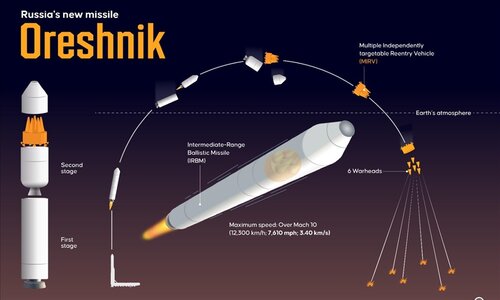
The Oreshnik is believed to be an intermediate-range ballistic missile equipped with hypersonic reentry vehicles. Once launched, it accelerates to Mach 10 or higher, separating into multiple warheads that descend toward their targets at blistering speed.
At that velocity, reaction time collapses. Radar detection windows shrink. Interceptors struggle to calculate trajectories that change mid-flight. Traditional missile defense systems -- built for slower, predictable ballistic arcs -- suddenly look outdated.
Russia claims that no existing missile defense system can stop Oreshnik. That statement is almost certainly exaggerated. No weapon is truly invincible. But the more uncomfortable truth is this: there is currently no reliable, proven defense against a full hypersonic strike of this kind, especially when multiple warheads are involved.
Even NATO's most advanced systems were not designed for this scenario at scale. And Ukraine, already stretched thin, has virtually no way to counter it.
That reality is what makes this moment so unsettling.
Why Strike Lviv -- and Why Now?
Lviv is not just another Ukrainian city. It is a logistical hub, a symbol of Western support, and a gateway between Ukraine and Europe. By striking so close to NATO territory, Russia was drawing a line -- deliberately and visibly.
This strike came amid rising tensions far beyond Ukraine's borders. The United States and Russia are increasingly at odds over oil shipments, sanctions enforcement, tanker seizures, and geopolitical maneuvering in places like Venezuela. At the same time, Western leaders have doubled down on long-term security guarantees for Ukraine, signaling that Kyiv will not be abandoned.
Moscow sees these moves as encirclement.
And it has responded accordingly.
Russian officials have now openly declared that any foreign troops or military units operating in Ukraine would be considered legitimate targets. That is not idle rhetoric. It is escalation language -- the kind that precedes decisions rather than follows them.
The Oreshnik strike fits perfectly into that posture.
The Bigger Picture: Escalation by Design
This war is no longer confined to tanks, trenches, and drones. It has become a contest of thresholds -- how far each side can go without triggering direct confrontation, and how much pressure can be applied before something breaks.
Russia is signaling that it is willing to:
Introduce strategic-level weapons into a regional war
Undermine confidence in Western defensive guarantees
Force NATO planners to confront uncomfortable new realities
The message is not subtle: your defenses may not be enough, and your proximity will not protect you.
For NATO, this presents a serious dilemma. Deterrence relies not just on military capability, but on credibility. If populations believe that advanced weapons cannot be stopped, public pressure to avoid escalation grows -- and that pressure can shape political decisions.
That is exactly the space Russia is trying to exploit.
A Feedback Loop with No Easy Exit
Every escalation creates momentum. Hypersonic weapons invite counter-development. Counter-development invites preemptive deployment. And preemptive deployment raises the risk of catastrophic miscalculation.
This is how arms races accelerate -- not in decades, but in months.
What makes this moment especially dangerous is how multiple global flashpoints are beginning to overlap. Ukraine, energy markets, sanctions, shipping lanes, and political instability in oil-producing nations are no longer separate issues. They are threads in the same strategic web.
Pull one too hard, and the entire structure shifts.
The Sobering Reality
The Oreshnik strike is not just about Ukraine. It is about the future of warfare -- and the fragile assumptions that have kept major powers from direct conflict for generations.
Speed changes everything. When weapons travel faster than diplomacy can respond, the margin for restraint narrows. When leaders openly label foreign forces as legitimate targets, ambiguity disappears. And when advanced systems are tested in live combat, what was once theoretical becomes precedent.
The world should take this moment seriously.
Not because war is inevitable -- but because the rules that once slowed escalation are eroding, one missile launch at a time.
The strike on Lviv was not just an attack.
It was a warning shot.
And history suggests that warning shots are rarely the last.