Archaeology Keeps Confirming the Bible - Caesarea And The World Of Acts
 By PNW Staff January 09, 2026
Share this article:
Every few years, archaeology delivers a quiet but powerful rebuke to modern skepticism. No press conference can silence it. No academic trend can erase it. From beneath the dust of centuries, stones speak—and once again, they tell the same story Christians have been reading for two thousand years.
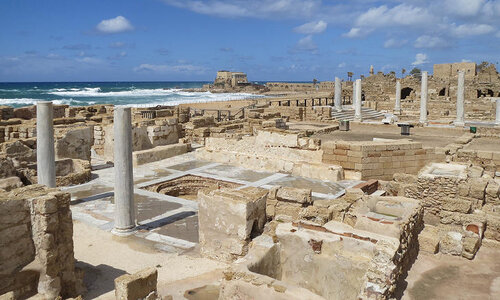
On Israel’s Mediterranean coast, just north of modern-day Tel Aviv, the ancient city of Caesarea Maritima stands as one of the most compelling intersections of archaeology, history, and faith ever uncovered. What archaeologists continue to reveal there is not merely a Roman ruin or a tourist attraction. It is the physical world of the New Testament—solid, measurable, and stubbornly real.
For believers, this matters deeply. Christianity is not a faith built on myth or metaphor alone. It is anchored in history, in people with names, in places you can stand in, and in events that unfolded under identifiable rulers at identifiable moments in time. Caesarea reminds us of that with remarkable clarity.
Built between 22 and 10 BC by King Herod the Great, Caesarea Maritima was a marvel of the ancient world. Josephus described it as a massive artificial harbor, complete with underwater breakwaters, towering statues, and a lighthouse that guided ships from across the Mediterranean. Archaeology confirms his account. The harbor remains one of the greatest feats of Roman engineering ever discovered.
But Caesarea was more than a port city. It was the seat of Roman power in Judea—the very place where imperial authority met local life. That is precisely how the Book of Acts describes it.
The New Testament mentions Caesarea around 15 times, portraying it as a hub of Roman governance and early Christian activity. Paul was imprisoned there for two years. He stood trial before Roman officials. Peter baptized the first Gentile believer there, opening the door for the gospel to move beyond Judaism and into the world. These are not small, symbolic moments—they are turning points in Christian history.
And now, the stones themselves testify.
Among the most famous discoveries at Caesarea is the Pilate Stone, uncovered in 1961 during excavations of a Roman theater. The limestone inscription names Pontius Pilate as “prefect of Judea” and references a dedication to Emperor Tiberius. Before this discovery, Pilate was known only from written sources—the Gospels, Josephus, and the Roman historian Tacitus. Skeptics once questioned whether he even existed.
The stone ended that debate.
Here was direct archaeological proof that the man who presided over Jesus’ trial was not a literary invention or theological symbol, but a real Roman official governing Judea during the exact period the Gospels describe. Luke’s careful historical framing—“Pontius Pilate being governor of Judaea”—suddenly stands not as pious storytelling, but as precise historical reporting.
This is where archaeology becomes something more than academic. It becomes personal.
Christian faith has always rested on the claim that God entered real history—not abstract philosophy, not timeless myth, but the gritty world of governors, prisons, trials, and public executions. Caesarea preserves that world. The governor’s palace, the praetorium, the judicial spaces—all align with the settings described in Acts. Paul did not defend himself in some vague “Roman court.” He stood in places like these.
Even more striking are discoveries pointing to early Christian life within the city itself. Archaeologists have uncovered mosaics bearing verses from Paul’s letters, including inscriptions believed to date back to the second century AD—among the oldest known New Testament texts ever found. One mosaic quotes Romans 13:3, a passage addressing authority and moral conduct, fittingly discovered in a city defined by Roman power.
These were not distant legends copied centuries later. These were believers living, worshiping, and preserving Scripture in the same city where the apostles walked.
Caesarea also connects us to the broader intellectual life of early Christianity. The third-century scholar Origen lived and worked there, compiling his monumental edition of the Old Testament in Hebrew and Greek. Long before Christianity became culturally dominant, it was intellectually serious, historically rooted, and deeply engaged with Scripture.
Critics often claim the Bible was written long after the fact, shaped by legend, or detached from real events. Caesarea answers that claim with stone, inscription, and architecture. It shows us that the New Testament writers knew their world—and recorded it accurately.
After the city’s destruction in 1265, Caesarea lay largely untouched for centuries, preserved like a time capsule beneath the sand. When modern excavations began in the 1950s, archaeologists did not set out to “prove the Bible.” Yet again and again, what they found aligned with it.
That pattern should give Christians confidence.
Archaeology does not replace faith—but it often removes unnecessary doubt. It reminds us that Scripture does not float above history; it moves through it. The God of the Bible acts in real places, among real people, under real rulers. And when we open Acts or the Gospels, we are not reading spiritual fiction. We are reading history charged with eternal meaning.
Jesus Himself said that if His followers were silent, “the stones would cry out.” At Caesarea Maritima, they are doing just that—declaring that the story Christians proclaim is grounded in reality, anchored in history, and worthy of trust.
Faith, once again, stands on solid ground.