Netflix's Narnia Has A New Aslan - And Christians Are Not Happy
 By PNW Staff September 18, 2026
Share this article:
For more than seventy years, readers of C.S. Lewis's Chronicles of Narnia have understood exactly who Aslan is supposed to represent.
He is not merely a magical talking lion. He is not simply the wise ruler of a fantasy kingdom. And he is certainly not a character whose identity was left deliberately vague for future filmmakers to reinvent.
Aslan is Lewis's unmistakably male Christ-figure.
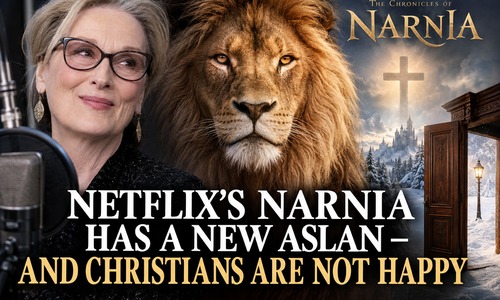
That is why the latest revelation about Netflix's coming Narnia adaptation is generating such a fierce reaction among Christian fans: Greta Gerwig has confirmed that Meryl Streep will voice Aslan in The Magician's Nephew.
The rumors had circulated for more than a year. Now they are confirmed.
And the question many Christians are asking is simple: Why?
Aslan Isn't Just Another Character
If this were merely a talking lion in an ordinary fantasy franchise, casting a woman to voice a male character might amount to little more than an unusual artistic decision.
But Narnia isn't an ordinary fantasy franchise.
Lewis built Christianity into the architecture of his fictional universe, and Aslan stands at its center. In The Lion, the Witch and the Wardrobe, Aslan gives himself willingly in the place of a condemned traitor, is killed, and rises again. In The Magician's Nephew, he sings Narnia itself into existence.
The parallels are hardly hidden.
Aslan is the sovereign creator, sacrificial redeemer and returning king of Narnia. Lewis did not make him an abstract deity stripped of identity. He consistently presented Aslan as male.
That makes Gerwig's casting decision more significant than simply choosing an unexpected celebrity voice.
Meryl Streep Is Not The Issue
The controversy isn't really about whether Meryl Streep can act.
Few serious critics would question that.
Gerwig herself explained that she wanted someone with gravitas, wisdom, depth, joy and a sense of wonder. She described Streep as possessing precisely those qualities.
But that explanation conspicuously avoids the question causing the controversy.
Why cast a woman as the voice of a specifically male character who represents Jesus Christ?
Current reporting indicates Gerwig has not actually transformed Aslan into a lioness. Empire and other coverage continue referring to Aslan as "he." In other words, this appears to be a male Aslan voiced by a woman rather than an explicitly female Aslan.
That distinction doesn't eliminate the concern for Christians. In some ways, it sharpens it.
Because it means the filmmakers apparently understood that Aslan remains male while nevertheless deliberately choosing a female voice for him.
Are They "Transing" Aslan?
That provocative accusation is already being thrown around by critics online.
Technically, based on what has been revealed so far, that description goes further than the known facts. Netflix has not announced a transgender Aslan, nor has Gerwig said Aslan has become female.
But it isn't difficult to understand why Christians are using such language.
Western entertainment has spent years deliberately challenging traditional distinctions between male and female characters. Audiences have watched familiar properties rewritten, gender-swapped and reinterpreted through contemporary cultural assumptions.
Now one of Christianity's most beloved literary representations of Christ will speak with the voice of a woman.
For Christians who have watched that larger cultural transformation unfold, this does not feel like an isolated casting curiosity.
It feels like another boundary being tested.
And The Changes Don't Stop There
There are additional reasons longtime Narnia readers are nervous.
Gerwig has moved the earthly setting of The Magician's Nephew from the early twentieth century to the 1950s. She has also described her creative vision in terms of a "rock opera," drawing heavily from figures such as David Bowie and other rock icons. Aslan himself reportedly has mismatched eyes and a red facial stripe inspired by Bowie.
Gerwig explained that because Narnia is sung into existence, rock music helped inspire her interpretation of a world created through music.
Any one of these changes might be defended as artistic license.
Taken together, however, they suggest Gerwig isn't approaching The Magician's Nephew primarily as a painstaking attempt to reproduce Lewis's world on screen. She is bringing a very distinctive creative interpretation to it.
And that is precisely what makes many Christian fans uneasy.
Christians Have Seen This Movie Before
Hollywood adaptations routinely arrive with assurances that filmmakers love and respect the source material.
Then comes the modernization.
Then the reinterpretation.
Then the explanation that beloved characters needed to be viewed through a contemporary lens.
Narnia presents an especially difficult test because Christianity isn't decorative scenery that can simply be separated from Lewis's fantasy universe. Christian theology runs through the story.
Remove enough of it and you may retain wardrobes, witches, talking animals and snowy forests.
But you increasingly stop having C.S. Lewis's Narnia.
Netflix's own announcement says the Lewis estate is enthusiastic about Gerwig's vision, describing her as having embraced Lewis's world with "joy, heart, and genuine love for the story." The film is scheduled for a theatrical release in February 2027 before arriving on Netflix in April.
Perhaps Gerwig's film will ultimately prove more faithful than worried Christians expect.
But skepticism is understandable.
Aslan is not simply another character available for creative experimentation. For millions of readers, he is one of the most recognizable representations of Jesus Christ ever created in modern fiction.
Lewis gave him a particular identity for a reason.
When filmmakers decide that even the voice of Aslan needs to be reinvented, Christian audiences are entitled to wonder what else about Lewis's Narnia they have decided needs changing.