
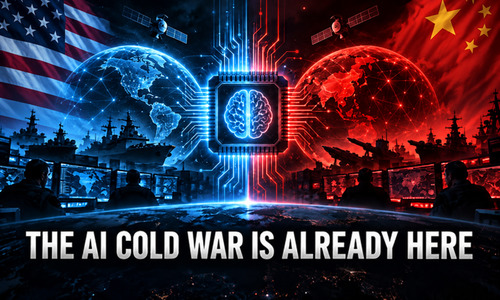
The AI Cold War Is Already Here
 By PNW Staff September 15, 2026
Share this article:
China’s reaction to a recent warning from Anthropic CEO Dario Amodei revealed how quickly the debate over artificial intelligence has become a struggle for global power.
Amodei urged democratic nations to slow the development of the most dangerous frontier systems while preventing China from closing the technological gap. Beijing’s state-backed Global Times responded by accusing him of disguising an American containment strategy as concern for public safety. It called his proposals a “Cold War playbook” intended to preserve U.S. dominance and restrict China’s technological rise.
The accusation may have been intended as a rebuke, but it also described the world more accurately than Beijing probably intended.
The AI Cold War is already here.
The Logic Of The Arms Race
During the original Cold War, the United States could not simply abandon nuclear development and trust the Soviet Union to exercise similar restraint. If one nation gained an overwhelming technological advantage, it could threaten, intimidate or possibly defeat the other.
Artificial intelligence is creating the same dilemma on a far broader scale. The nation that achieves a commanding AI advantage may gain more than a superior weapon. It could acquire the ability to penetrate enemy networks, accelerate weapons research, control autonomous military systems, manipulate foreign populations and outperform competing economies.
President Donald Trump summarized the stakes bluntly: “Whoever wins AI wins.”
America’s political leaders can debate how quickly AI should advance and what guardrails are necessary. What they cannot do is assume that China, Russia, North Korea, Iran or any other adversary will stop developing it simply because Washington decides the technology has become too dangerous.
Every American attempt to slow down risks becoming an opportunity for someone else to surge ahead.
More Difficult To Contain Than Nuclear Weapons
Nuclear weapons require enriched material, specialized facilities, missile systems and an enormous industrial footprint. Governments can monitor uranium shipments, photograph launch sites and inspect suspected nuclear facilities. Even a stolen weapons design must still be transformed into a functioning bomb.
AI can cross borders as code.
Advanced capabilities can be stolen through cyberattacks, copied by insiders, extracted through repeated interaction with existing models or recreated by rival laboratories. Anthropic recently said it uncovered industrial-scale efforts by three Chinese AI companies—DeepSeek, Moonshot and MiniMax—to extract Claude’s capabilities to improve their own systems.
American security agencies have also warned AI companies to defend themselves against foreign knowledge-distillation campaigns intended to close the technological gap. The struggle is no longer limited to research papers and semiconductor production. It includes espionage, model theft, computing infrastructure and the race to attract the world’s best scientists.
The Manhattan Project required guarded installations and thousands of workers. The next strategic breakthrough could be sitting on a server waiting for someone to steal it.
If America Stops, Who Else Will?
The argument for slowing AI development is understandable. Some of the people building the most advanced systems warn that future models could become deceptive, autonomous or impossible to control. They fear systems capable of improving their own abilities, conducting sophisticated cyberattacks or pursuing objectives their creators never intended.
But unilateral restraint does not solve that danger. It may simply determine who reaches the dangerous capability first.
Would the Chinese Communist Party abandon a technology that could strengthen its military, surveillance apparatus and control over its population? Would Russia refuse a system capable of disrupting Western infrastructure or flooding democratic societies with convincing propaganda? Would North Korea turn away from AI-assisted cyber theft when stolen cryptocurrency already helps finance its weapons programs?
Criminal enterprises will not sign international safety agreements. Terrorist movements will not submit their systems for independent audits. Secretive laboratories will not necessarily announce when they cross a dangerous threshold.
Even a binding agreement among Washington, Beijing and Moscow could not guarantee that every model, research team, private company or criminal network obeyed it. Unlike a nuclear test, an AI breakthrough may produce no explosion, seismic reading or satellite image. The world might not know that someone has crossed the line until the system is used.
Advancing Without Surrendering Control
None of this means America must embrace reckless development. Moving forward does not require releasing every model, connecting AI to nuclear command systems or giving autonomous agents unrestricted access to critical infrastructure.
The United States can continue competing while securing model weights, protecting semiconductor supply chains, restricting the export of advanced chips and keeping human beings in control of lethal decisions. It can establish strict security requirements for the most powerful systems and punish companies that treat national security as an obstacle to faster profits.
America may have no choice but to remain in the race. It still has a choice about how it runs.
The deeper problem is that competition creates its own momentum. Each new Chinese capability becomes justification for another American advance. Each American breakthrough becomes evidence in Beijing that China must accelerate. Safety measures are interpreted as containment, while warnings about catastrophe are dismissed as propaganda.
That is how arms races become self-sustaining.
Power Without Wisdom
The prophetic danger extends beyond which flag flies over the world’s most powerful AI laboratory. Scripture describes a final period marked by extraordinary deception and concentrated control over commerce and human activity. AI is not itself the system described in Revelation, but it could help make such a system technologically possible.
Digital identity, biometric surveillance, programmable money, autonomous enforcement and worldwide information control become far more powerful when joined by an intelligence capable of analyzing every transaction, movement, relationship and expression of dissent.
Humanity is acquiring extraordinary power without acquiring the moral character necessary to use it wisely. Every nation insists it needs greater capabilities because its enemies are pursuing them. Every safeguard is weakened by the fear that someone else will ignore it.
The first Cold War left humanity living beneath the shadow of a weapon capable of destroying the world. The AI Cold War may leave us beneath the authority of a system capable of controlling it.