
A Bizarre Alliance: When The Church Pulpit Becomes A Platform For Queer Islam
 By PNW Staff September 17, 2026
Share this article:
Christianity and Islam disagree about some of the most fundamental questions imaginable. Who is Jesus Christ? Is He God incarnate? Did He die on the cross? Did He rise from the dead? Is salvation found through Him alone?
Yet inside the modern progressive religious movement, those enormous theological divisions can suddenly seem remarkably unimportant.
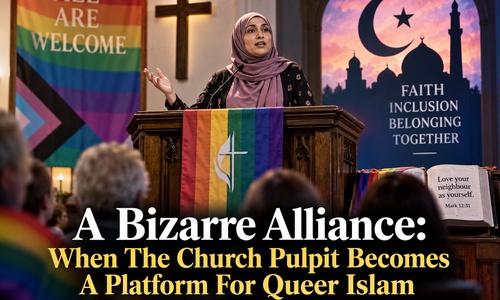
That strange convergence was on display at McDougall United Church in Calgary, where a Pride worship service featured Tahira Ebrahim, a Muslim speaker discussing the perspectives of queer Muslims and the attempt to reconcile LGBTQ identities with Islamic faith.
It was an extraordinary scene: a Christian sanctuary, a Muslim perspective and LGBTQ-affirming theology brought together under the banner of inclusion.
And perhaps that combination tells us something important about what is happening to parts of Western Christianity.
When Inclusion Becomes The Unifying Doctrine
McDougall makes no secret of its direction. The congregation identifies itself as an “Affirming” ministry and says it seeks inclusion regardless of sexual orientation, gender identity, gender expression, religious background and other differences. The church says it moved beyond merely being “welcoming” toward becoming an explicitly inclusive community.
Its Pride activities are similarly extensive. In September, McDougall hosted a joint Pride worship service with other United Church congregations. Days earlier, it hosted Calgary's Citywide Pride Interfaith Service, an annual gathering intended to bring together affirming religious communities and LGBTQ organizations.
And that is where the story becomes much bigger than one speaker or one Canadian congregation.
Christianity and Islam cannot both be correct about Jesus.
Historic Christianity declares Him the divine Son of God, crucified and resurrected, the only way to the Father. Islam rejects several of those foundational Christian claims.
Those aren't minor denominational disagreements.
Yet progressive religion has discovered something capable of bringing adherents of dramatically different faith traditions together: a shared understanding of identity, sexuality and inclusion.
A New Kind Of Interfaith Unity
For generations, interfaith gatherings generally focused on coexistence, religious liberty, community relationships or humanitarian causes. Christians could treat Muslims with dignity and friendship without pretending their theological differences didn't exist.
Something different is increasingly taking shape.
The objective isn't merely living peacefully beside someone who believes differently. Religious traditions themselves are increasingly being reinterpreted around a common progressive moral framework.
Christianity must become LGBTQ-affirming.
Islam must become LGBTQ-affirming.
Judaism must become LGBTQ-affirming.
And once that framework becomes the standard by which religion itself is judged, an extraordinary reversal occurs. Instead of Scripture defining which cultural ideas Christians accept, cultural ideas increasingly determine which interpretations of Scripture are considered acceptable.
The religions remain different, but the moral authority sitting above them begins to look remarkably similar.
What Exactly Is The Christian Pulpit For?
That raises an uncomfortable question churches eventually have to answer.
What is the pulpit actually for?
The New Testament presents Christian preaching as the proclamation of Christ, repentance, salvation and biblical truth. Paul told Timothy to “preach the word” and warned that a time would come when people would accumulate teachers who suited what they wanted to hear.
Paul's concern wasn't that Christians would fail to be sufficiently accommodating to every religious idea surrounding them. His concern was precisely the opposite: that the Church would gradually exchange truth for teaching more agreeable to its culture.
Christians can—and should—treat Muslims and LGBTQ people with compassion and dignity. Christians can defend their freedom, befriend them, work beside them and welcome them through the church doors.
But welcoming someone into a church is very different from giving competing religious beliefs authority within Christian worship.
The distinction becomes especially striking when the subject being presented is itself an attempt to reinterpret another religion's historic teachings about sexuality.
At that point, what exactly is the congregation being asked to affirm?
The Alliance That Should Make Christians Think
There is an irony here that shouldn't be overlooked.
Traditional Christianity and traditional Islam disagree profoundly about God and salvation, yet historically both have maintained restrictive teachings concerning same-sex sexual relationships. Progressive movements within both religions now seek to reinterpret those teachings.
Suddenly the progressive Christian and progressive Muslim may find themselves standing closer together on sexuality than either stands to historic teachings within his or her own religious tradition.
That is a remarkable realignment.
The deepest dividing line in modern Western religion may increasingly be less about whether someone identifies as Christian, Muslim or Jewish and more about whether ancient revelation is permitted to challenge modern cultural assumptions.
Once revelation must continually bend to contemporary definitions of identity and sexuality, the process rarely stops with a single doctrine.
Paul Already Warned The Church
If the Apostle Paul walked into many modern Pride-themed worship services, Christians don't have to speculate very hard about what he would say.
His letters already tell us.
“Preach the word,” he commanded Timothy. “Be ready in season and out of season; reprove, rebuke, and exhort.”
He warned the Galatians about accepting a different gospel. He warned the Romans against conforming themselves to the world. He repeatedly instructed churches that Christian teaching would sometimes collide sharply with the surrounding culture.
None of that requires hostility toward people.
It requires fidelity to Christ.
The Church's calling was never to discover the theological formula capable of affirming every identity, religion and cultural movement simultaneously. It was to proclaim a message so specific that the earliest Christians were willing to suffer rather than alter it:
Jesus Christ is Lord.
When a Christian pulpit instead becomes a platform for explaining how another religion can be reconciled with the sexual revolution, Christians should recognize that something fundamental has changed.
The bizarre alliance of Christianity, Islam and Pride may appear extraordinarily inclusive.
But the more important question for the Church is whether, in making room for everything else, it has slowly pushed the Gospel itself to the side.