Why Europe's Future May Already Be Written
 By PNW Staff July 17, 2026
Share this article:
There was a time when Europe's greatest threats came from outside its borders.
The Vikings sailed from the north. The Ottoman Empire advanced from the east. Napoleon marched across the continent. Hitler plunged Europe into war. Throughout history, Europeans feared invasion because they believed the greatest danger always came from someone else.
But what if Europe's greatest crisis isn't coming from outside at all?
What if it has already been set in motion from within?
That is the uncomfortable question increasingly being asked by economists, demographers, political analysts and historians alike. While election headlines dominate the news, the deeper forces shaping Europe's future are moving quietly beneath the surface—forces that no election cycle can easily reverse.
If those trends continue, Europe's future may already be written.
The First Clock: Demographics
Every civilization ultimately depends on one simple fact: someone has to replace the previous generation.
Across nearly every European nation, that isn't happening.
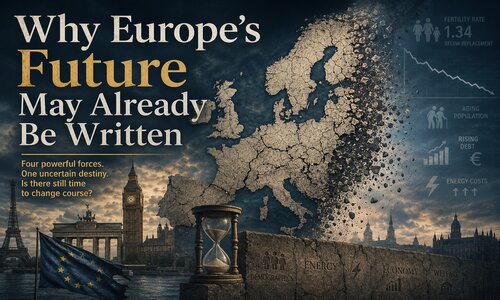
The European Union's fertility rate now sits around 1.3 children per woman—far below the 2.1 needed simply to maintain today's population. In many countries the native-born population has even lower birthrates.
The consequences stretch far beyond shrinking classrooms.
Every missing child today becomes a missing worker tomorrow.
A missing taxpayer.
A missing entrepreneur.
A missing nurse.
A missing engineer.
A missing parent raising the next generation.
No government stimulus package can manufacture twenty-five-year-olds overnight.
This isn't merely a social trend.
It's mathematics.
The Second Clock: Replacing Population Isn't Replacing Culture
Europe has attempted to compensate through immigration.
Millions have arrived over the past decade from Africa, the Middle East and South Asia.
Many contribute positively to their adopted countries, but immigration alone cannot solve a demographic collapse when assimilation itself becomes increasingly difficult.
Across portions of Europe, governments openly acknowledge the growth of parallel communities, rising social tensions, and neighborhoods where integration has stalled.
A nation is more than its GDP.
It is shared language.
Shared customs.
Shared civic identity.
Shared expectations.
Those things take generations to build—and can disappear surprisingly quickly.
History shows civilizations rarely survive if they lose confidence in their own cultural identity.
The Third Clock: Energy Is Civilization
Every great civilization has been powered by cheap, reliable energy.
Rome had grain.
Britain had coal.
America had oil.
Modern Europe increasingly has regulations.
In pursuit of ambitious climate goals, many European governments accelerated the closure of nuclear facilities while becoming increasingly dependent upon intermittent renewable energy and imported natural gas.
The result has been some of the world's highest industrial electricity prices.
Factories do not care about ideology.
They care about costs.
When energy becomes permanently more expensive than competing nations, industries gradually relocate.
Steel.
Chemicals.
Automobiles.
Manufacturing.
Jobs leave.
Investment follows.
Eventually tax revenue follows.
Industrial decline is rarely dramatic.
It is cumulative.
The Fourth Clock: The Welfare Equation
Europe built one of history's most generous social safety nets.
It worked remarkably well when there were many workers supporting relatively few retirees.
Today that equation is reversing.
Fewer workers must finance growing pension systems, expanding healthcare costs, rising public debt and increasingly complex welfare obligations.
Governments face only a handful of options.
Borrow more.
Tax more.
Cut benefits.
Inflate the currency.
None are politically popular.
But mathematics eventually ignores politics.
Why Elections May No Longer Be Enough
Across Europe, voters are increasingly turning toward parties promising stricter immigration controls, lower taxes and renewed national sovereignty.
Whether one agrees with those platforms or not, many voters believe change is finally coming.
But what if those governments inherit problems that have already become structurally irreversible?
A government cannot quickly reverse forty years of demographic decline.
It cannot instantly rebuild industrial capacity.
It cannot suddenly erase trillions in debt.
Nor can it easily escape the legal and regulatory framework created by the European Union itself.
This explains why many analysts argue Europe's greatest challenge is no longer ideological.
It is chronological.
Time itself has become the enemy.
Rome Offers An Uncomfortable Lesson
History rarely repeats itself perfectly.
But it often rhymes.
The Western Roman Empire did not collapse because one army suddenly appeared at its gates.
It weakened over centuries.
Birthrates declined.
Taxes increased.
Economic productivity slowed.
Political institutions became increasingly rigid.
Foreign populations entered the empire faster than they assimilated.
Eventually Rome simply became something else.
Most Romans never witnessed a single dramatic day when their civilization ended.
They lived through a long transition that only later generations recognized as decline.
History often looks obvious only in hindsight.
Could America Follow?
Perhaps the most important question isn't whether Europe can reverse course.
It is whether the rest of the West is paying attention.
The United States faces many of the same warning signs.
Birthrates have fallen below replacement.
Government debt continues climbing.
Political polarization deepens.
Faith continues to decline in many communities.
Housing costs increasingly discourage young families.
None of these trends guarantee America's future will mirror Europe's.
But they should prompt serious reflection.
The Deeper Problem
Beneath economics and politics lies something harder to measure.
Confidence.
Civilizations thrive when people believe their future is worth building.
They marry.
They have children.
They invest.
They innovate.
They sacrifice for future generations.
When that confidence disappears, decline often begins long before the statistics reveal it.
Scripture repeatedly reminds us that nations rise and fall.
Egypt.
Babylon.
Assyria.
Rome.
None imagined they were approaching their twilight years.
Psalm 33 declares, "Blessed is the nation whose God is the Lord," while Proverbs reminds us that "righteousness exalts a nation."
History suggests that prosperity alone cannot sustain a civilization indefinitely. Economic strength, military power and technological innovation matter greatly, but they cannot permanently replace the moral and cultural foundations upon which societies are built.
Whether Europe ultimately changes course remains to be seen.
But one reality is becoming increasingly difficult to ignore.
History is often written long before its final chapter is read.
The decisions made decades ago—in family life, energy policy, fiscal policy, immigration and cultural confidence—may already be shaping Europe's destination.
The question is no longer simply whether Europe can change.
It is whether enough time remains to write a different ending.