
Sued For Refusing To Abort A Baby?
 By PNW Staff July 16, 2026
Share this article:
The story almost sounds too unbelievable to be true.
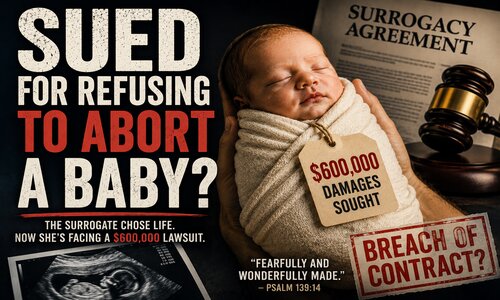
A homosexual couple is suing the surrogate mother they hired—not because she harmed their baby, but because she refused to abort him.
According to reports, prenatal testing suggested the child might be born with a cleft lip and other possible birth defects. The two men allegedly demanded that the surrogate terminate the pregnancy. She refused. Today, the child has been born with only a minor birth defect and is expected to live a healthy life.
Now the couple is seeking approximately $600,000 in damages.
Pause and consider what that means.
A healthy little boy entered the world, and the lawsuit argues that his birth itself was the injury.
That may be one of the clearest illustrations yet of how far our culture has drifted from viewing children as gifts and has begun treating them as products.
For generations, expectant parents understood that pregnancy carried uncertainty. Every child was welcomed with hope, not a guarantee. A baby might be born healthy, or face physical challenges, or require lifelong care. Love came first, and expectations followed.
Today, technology has changed more than medicine—it has changed expectations.
Through IVF, embryo screening, genetic testing, and commercial surrogacy, children are increasingly viewed through the lens of consumer choice. Prospective parents can now screen embryos for certain genetic conditions before implantation, and prenatal testing can reveal possible abnormalities months before birth. While many of these advances have legitimate medical benefits, they also tempt society to ask a dangerous question: **What level of imperfection is acceptable?**
That question becomes even more troubling when pregnancy itself becomes a commercial contract.
In this case, the surrogate apparently believed the child deserved to live regardless of his diagnosis. The intended parents believed the pregnancy should have ended. Once money, contracts, and competing moral convictions collide, whose conscience prevails?
Should a surrogate lose the right to refuse an abortion because she signed an agreement? Does accepting payment mean surrendering every moral conviction regarding the life growing inside her?
Those questions extend far beyond this single lawsuit.
If courts begin treating the birth of an unwanted child as a compensable injury, what comes next?
Could surrogates someday be compelled to undergo abortions against their convictions? Could doctors face lawsuits for failing to recommend abortion aggressively enough? Could IVF clinics be sued because an embryo later developed an unexpected disability? As genetic testing becomes more sophisticated, will parents claim damages because a child develops autism, hearing loss, or another condition that wasn't predicted?
These questions are no longer science fiction. They represent the logical tension created when reproduction is increasingly shaped by contracts, technology, and consumer expectations.
Around the world, we have already witnessed where the pursuit of "perfect" children can lead. In countries such as Iceland, the overwhelming majority of babies diagnosed prenatally with Down syndrome are aborted, leading many observers to describe the condition as being virtually eliminated—not through a cure, but through selective termination.
The danger is subtle but profound.
The standard quietly shifts from asking, "Can this child be loved?" to asking, "Does this child meet expectations?"
Christianity offers a radically different answer.
Scripture teaches that every human being bears the image of God—not because of intelligence, appearance, physical ability, or genetic perfection, but because each person is created by Him. Psalm 139 declares that God knits us together in our mother's womb. Throughout the Bible, God repeatedly works through people whom society might have overlooked or dismissed.
Moses struggled with speech. Mephibosheth lived with a disability. Paul carried what he described as a "thorn in the flesh." Even when Jesus' disciples encountered a man born blind and assumed his condition reflected sin, Christ rejected their thinking and revealed that God's purposes were greater than human assumptions.
God has never measured human worth by physical perfection.
Our culture increasingly does.
Perhaps the most heartbreaking part of this story is not the lawsuit itself, but what it says to the child at the center of it.
Imagine one day discovering that your existence became the basis for a legal claim. That adults argued they deserved hundreds of thousands of dollars because you were born instead of aborted.
No child should ever have to carry that burden.
This case is about far more than one family or one controversial lawsuit. It exposes a growing worldview that values control over compassion and perfection over personhood. Once children become products ordered through contracts, there will always be pressure to reject those who fail to meet expectations.
Christians should recognize this moment for what it is: another reminder that society is increasingly separating human value from God's design. When life is treated as something to be accepted only if it meets predetermined standards, we have crossed from medicine into manufacturing.
The little boy at the center of this lawsuit will likely grow up healthy. That should be a reason for celebration.
Instead, it has become the basis for litigation.
In a culture that increasingly measures human worth by convenience, cost, and genetic perfection, believers have an opportunity—and a responsibility—to proclaim a better message. Every child, whether healthy or disabled, planned or unexpected, reflects the image of God.
Human life is not a defective product to be returned because it failed an inspection. It is a sacred gift entrusted by the Creator, worthy of protection, dignity, and love from the very beginning.
That truth has never been more needed than it is today.