Amnesty International Just Declared Christian Beliefs 'Anti-Rights'
 By PNW Staff July 17, 2026
Share this article:
For decades, organizations like Amnesty International built their reputations defending prisoners of conscience, exposing torture, and standing up for people whose freedoms were being crushed by authoritarian governments. They championed the principle that no one should be persecuted simply for holding unpopular beliefs.
That is why its latest controversy has stunned so many observers.
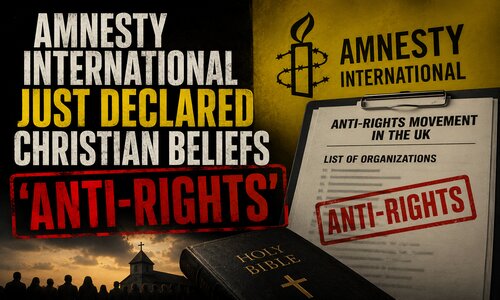
Last week, Amnesty International UK published a report titled "A Growing Threat: The Anti-Rights Movement in the UK," identifying 117 organizations it labeled "anti-rights." Among them were not only pro-life groups and organizations advocating gender-critical views, but a remarkable number of mainstream Christian ministries and institutions.
Within days, the report had been pulled from Amnesty's website after an extraordinary public backlash. But while the document disappeared, the questions it raised have not.
The real story isn't that Amnesty made an embarrassing mistake.
The real story is what this episode reveals about the changing definition of "human rights" in the modern West.
When Biblical Convictions Become "Anti-Rights"
Among the organizations listed were Christian Concern, the Christian Legal Centre, the Evangelical Alliance, The Christian Institute, Christian Medical Fellowship, Evangelicals Now, Premier Christian media, Christians in Parliament, Family Education Trust, the Conservative Christian Fellowship, and Billy Graham Evangelistic Association UK.
These are not fringe organizations. Many have served faithfully for decades, defending religious liberty, supporting families, promoting the sanctity of life, and articulating historic Christian teaching on marriage, sexuality, and biological sex.
Whether one agrees with every position they hold is beside the point.
The more important question is this:
When did holding historic Christian beliefs become grounds for being labeled "anti-rights"?
That represents a profound shift in public discourse.
For years, traditional Christians have grown accustomed to being called intolerant, outdated, or even hateful. Those labels, while damaging, still acknowledged that Christians had a legitimate place in public debate.
Calling them "anti-rights" is something altogether different.
It implies that biblical convictions are not merely mistaken—they are fundamentally incompatible with a free society.
The Escalating Language Of Exclusion
Notice how the vocabulary has changed over the past two decades.
Yesterday the accusation was:
"You're intolerant."
Later it became:
"You're spreading hate."
Now it is:
"You're anti-rights."
Those aren't simply stronger insults.
They represent an escalation in how traditional Christian beliefs are being reframed.
Once someone is labeled "anti-rights," it becomes much easier to argue that they should lose influence, funding, legal protections, or even the ability to participate fully in public life.
That concern became especially apparent because Amnesty's report reportedly urged the Charity Commission to review the charitable status of the organizations it identified.
Think about what that means.
This wasn't simply a disagreement over ideas.
It raised the possibility that organizations holding longstanding religious convictions could face pressure on their legal standing, charitable status, and public legitimacy.
That should concern anyone who values genuine freedom of belief—even those who disagree with these ministries.
A Remarkable Backlash
The reaction was swift and unusually broad.
Actor John Cleese, once a prominent fundraiser for Amnesty, publicly distanced himself from the organization, writing that Amnesty had once focused on preventing torture—not policing views on sexual identity.
J.K. Rowling also condemned the report after her organization, Beira's Place—which supports female victims of sexual violence—appeared on the list. She suggested donors should reconsider supporting Amnesty and later indicated her charitable fund would help support legal action by women's organizations affected by the report.
Legal commentators also noted that publicly branding charitable organizations as "anti-rights" while advocating scrutiny of their charitable status could potentially expose Amnesty to defamation claims if measurable financial harm resulted.
Within forty-eight hours, Amnesty withdrew the report.
Its explanation was that the document had been uploaded without completing the organization's normal internal review process and that its language did not reflect Amnesty UK's official position.
Many observers viewed the statement as less an apology than an attempt to distance the organization from the fallout.
An Uneven Standard?
Another aspect of the report has received surprisingly little attention.
Despite identifying 117 organizations it considered "anti-rights," not a single Muslim organization appears to have been included.
That omission is difficult to ignore.
Traditional Islam, like historic Christianity, holds conservative views on marriage, sexuality, and gender. On many of the very issues cited by Amnesty—including gender ideology and sexual ethics—orthodox Muslim organizations often hold positions that are as restrictive as, and in many cases even more restrictive than, those of the Christian ministries singled out in the report.
Yet the overwhelming focus fell on Christian organizations.
Whether that reflects intentional bias or some other rationale, Amnesty has offered no public explanation for the disparity.
The result is an unmistakable appearance of unequal treatment.
If two faith communities hold similar convictions but only one is branded "anti-rights," people are inevitably going to question whether the standard being applied is truly consistent.
Human rights organizations derive their credibility from impartiality.
Once they appear to apply different standards to different religious communities, that credibility begins to erode.
More Than One Bad Report
It would be easy to dismiss this as an isolated public relations failure.
That would be a mistake.
Viewed alongside other developments across the Western world, this report reflects a much broader cultural trend.
In Finland, former Interior Minister Päivi Räsänen has spent years defending herself in court after publicly expressing biblical views on sexuality.
Canada has expanded laws addressing online harms and hate speech, prompting ongoing debates about where the line lies between protecting vulnerable groups and safeguarding freedom of expression.
Scotland's hate crime legislation generated similar concerns among critics who feared legitimate religious speech could increasingly fall under legal scrutiny.
Across Europe and North America, Christian schools, adoption agencies, ministries, medical professionals, and churches have repeatedly found themselves navigating growing legal and regulatory pressure over longstanding biblical beliefs.
Each story can seem isolated when viewed alone.
Together, however, they reveal something much larger.
The debate is no longer simply over whether Christians are wrong.
Increasingly, the debate is whether historic Christianity itself is compatible with modern definitions of human rights.
That is a very different conversation.
The Irony Is Difficult To Ignore
Amnesty International rose to global prominence defending those whose beliefs placed them at odds with powerful governments.
Today, critics argue it risks contributing to a climate in which certain deeply held religious beliefs are themselves treated as suspect.
That irony should not be lost on anyone.
Human rights should protect people with whom we disagree.
If rights exist only for those holding culturally approved opinions, they are no longer universal rights—they become privileges extended only to those on the "correct" side of public opinion.
Christians have long argued that religious liberty exists precisely to protect unpopular beliefs.
If freedom extends only to fashionable convictions, it is no freedom at all.
A Warning For The Church
Christians should pay attention—not because one report briefly appeared on one website, but because of what it symbolizes.
Reports can be withdrawn.
Headlines fade.
Organizations issue revised statements.
But ideas have a way of lingering long after documents disappear.
The most significant development is not that Amnesty International briefly labeled dozens of Christian ministries "anti-rights."
It is that influential institutions increasingly appear willing to redefine historic biblical convictions as fundamentally incompatible with modern society.
Scripture has never promised believers cultural acceptance. Jesus warned His followers that faithfulness would often place them at odds with the world. Throughout history, the Church has repeatedly faced seasons when obedience to God's Word carried social, professional, and even legal consequences.
Perhaps that is the greatest lesson from this episode.
The question is no longer whether biblical Christianity will face increasing pressure in the West.
The question is whether Christians will continue speaking the truth with courage, conviction, and grace when the cost of doing so continues to rise.