
China's War On Christianity: Why Xi Jinping Fears The Cross
 By PNW Staff July 14, 2206
Share this article:
For years, China has tried to convince the world that it respects religious freedom. Officially, the Chinese Communist Party recognizes Christianity as one of the country's approved religions. But behind the carefully crafted propaganda lies a far darker reality.
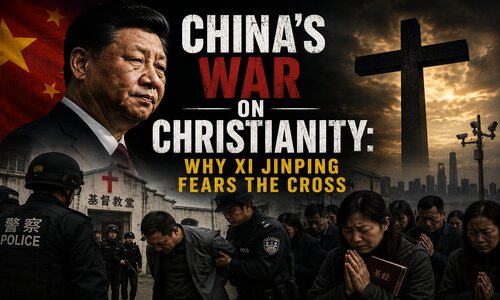
Across China today, Christians are being arrested, churches are being demolished, pastors are disappearing, children are being separated from believing parents, and an entire faith is being reshaped to serve not Christ--but the Communist Party.
The latest reports coming out of China paint a chilling picture of a government that has become increasingly determined to eradicate any authority greater than the state itself.
One Christian identified only as "TJ" described hearing his electricity suddenly fail before police smashed through his front door in the middle of the night. His wife and three-year-old daughter were dragged into another room while officers restrained and interrogated him. His wife was later taken away and has still not been released. Their crime? Worshipping Jesus in a church not controlled by the Chinese government.
That story is no longer unusual.
It is becoming the new normal under Xi Jinping.
China officially allows worship only within state-approved churches--the Protestant Three-Self Patriotic Movement and the Chinese Patriotic Catholic Association. These churches operate under strict Communist Party oversight. Portraits of Xi Jinping hang prominently inside sanctuaries. Patriotic songs are often sung before worship services. Sermons are expected to reinforce Communist ideology, and pastors are forbidden from teaching anything that challenges Party authority.
For millions of believers, these are churches in name only.
Instead, they choose to gather quietly in homes, apartments, warehouses, or secret meeting places where Scripture--not the Communist Party--is treated as the highest authority. These "house churches" have existed for decades, but under Xi Jinping they have become primary targets of one of the most systematic crackdowns on Christianity in modern history.
Since taking power in 2012, Xi has accelerated what Beijing calls the "Sinicization of religion." The goal is not merely to regulate religion but to transform it into something that serves socialism and absolute loyalty to the Communist Party.
That campaign has touched nearly every aspect of Christian life.
Crosses have been ripped from church buildings. Congregations have been forced to install surveillance cameras inside sanctuaries. Churches have been demolished with bulldozers. Bibles have faced increasing censorship and restrictions. Sunday schools and youth ministries have been shut down in many regions because authorities want children educated first in Communist ideology before learning about Christianity. Seminaries are expected to incorporate "Xi Jinping Thought" into ministerial training, while new Bible translations have been promoted that emphasize socialist values over traditional Christian teaching.
ChinaAid, an organization that monitors religious persecution, estimates that more than 10,000 Christians have been arrested during Xi's tenure as authorities steadily intensify enforcement against unregistered churches.
Perhaps even more disturbing is how China's legal system has become a weapon.
Pastors and church leaders are frequently charged with vague crimes such as "using superstition to undermine the law," "illegal business operations," fraud, or misuse of information networks. Human rights lawyers willing to defend Christians have themselves been disbarred, detained, or imprisoned. Justice has become whatever the Communist Party declares it to be.
None of this should surprise us.
Authoritarian governments have always viewed Christianity with suspicion because Christianity recognizes a King higher than Caesar.
The early Roman emperors demanded worship of the emperor.
The Soviet Union sought to replace faith with Marxism.
North Korea requires absolute devotion to the Kim dynasty.
Modern China is simply following the same pattern.
As Bob Fu of ChinaAid observed, Xi Jinping seeks exclusive loyalty. No authority--religious or otherwise--is permitted to rival the Communist Party.
Ironically, history repeatedly demonstrates that persecution rarely destroys Christianity.
It often strengthens it.
Despite decades of government suppression, scholars estimate that China may now have well over 100 million Christians, with some estimates placing the underground church population far above the officially registered churches. Several demographic studies have suggested that China could eventually become home to one of the world's largest Christian populations if current long-term trends continue.
That reality helps explain why Beijing appears increasingly alarmed.
The Communist Party understands something many Western governments have forgotten: ideas are powerful.
Faith shapes culture.
Worldviews shape nations.
People whose ultimate allegiance belongs to Christ become difficult to intimidate.
This is why China's persecution extends beyond churches. Advanced surveillance technology, facial recognition systems, digital monitoring, social credit mechanisms, and artificial intelligence increasingly give authorities unprecedented ability to identify religious gatherings and track believers. The same technological infrastructure developed to monitor political dissent can easily be directed against churches.
For Christians living comfortably in the West, these stories should serve as more than headlines.
They should be reminders.
The freedoms many believers enjoy today are neither universal nor guaranteed forever.
The Chinese church asks for prayer far more often than political intervention. They understand what the Apostle Paul understood--that the Gospel advances even through suffering.
History has shown that prisons cannot chain God's Word.
Empires rise and fall.
Dictators come and go.
The Roman Empire tried to crush Christianity. It failed.
The Soviet Union tried. It failed.
Mao Zedong tried. He failed.
Xi Jinping is trying now.
He may imprison pastors, demolish church buildings, censor Bibles, and silence public worship. But Christianity has never depended upon government approval. It has always flourished wherever ordinary believers have been willing to stand faithfully for Christ regardless of the cost.
That may ultimately be the lesson China teaches the rest of the world--not about the power of authoritarianism, but about the remarkable resilience of a faith that no government has ever been able to extinguish.