
AI Is Coming For Both Blue-Collar And White-Collar America
 By PNW Staff May 19, 2026
Share this article:
The warnings are no longer coming only from science fiction movies or fringe commentators. Increasingly, they are coming from the very executives building the artificial intelligence systems reshaping the global economy. And if even half of their predictions prove accurate, the world may be heading toward one of the largest labor disruptions in modern history.
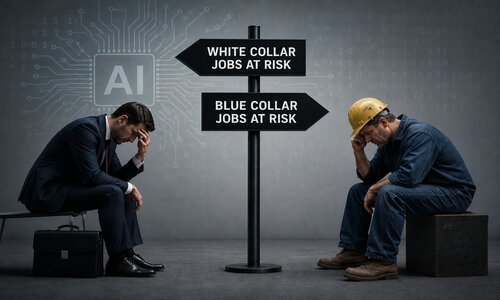
For decades, Americans were told automation would mostly threaten repetitive factory work while white-collar professionals remained relatively safe. That assumption is rapidly collapsing. AI is now coming for both the office cubicle and the warehouse floor — and the speed of the transition may leave societies dangerously unprepared.
At the center of the latest debate is Mustafa Suleyman, the CEO of Microsoft AI, who recently warned that within 12 to 18 months, artificial intelligence could perform most professional white-collar tasks at human levels. His comments sent shockwaves through industries once viewed as stable career paths: accounting, legal analysis, project management, software development, customer service, and marketing.
The implications are staggering.
For years, college degrees were presented as protection against economic instability. Parents encouraged children to avoid manual labor and pursue “knowledge work” because those careers were supposedly future-proof. But AI systems are rapidly learning to draft contracts, analyze financial reports, write code, create advertising campaigns, summarize meetings, and even generate strategic business recommendations.
Large law firms are already using AI tools to conduct legal discovery and contract review tasks that once required teams of junior associates billing hundreds of hours. Accounting firms are deploying AI systems capable of auditing transactions, spotting irregularities, and preparing financial summaries in seconds. Marketing departments increasingly rely on generative AI to create ad copy, social media campaigns, graphics, and customer analytics with minimal human involvement.
Even software engineers — long considered among the safest professions in the digital age — are now under pressure from AI coding systems. GitHub Copilot, ChatGPT-based coding assistants, and autonomous AI agents can already generate large blocks of functioning code, debug software, and assist with app development. Some companies have begun reducing entry-level coding hires altogether because AI can now handle much of the routine work previously assigned to junior developers.
The threat extends into customer support as well. Klarna, the Swedish fintech giant, revealed that its AI assistant was handling work equivalent to hundreds of customer service agents. IBM has also openly discussed slowing hiring for back-office roles that AI may soon replace.
But while white-collar workers are only beginning to feel the pressure, blue-collar industries are also undergoing a revolution that could fundamentally alter employment.
One of the clearest examples came recently from viral demonstrations involving robotic warehouse systems competing directly against humans in package sorting and fulfillment tasks. Videos circulated online showing AI-powered robotic arms rapidly identifying, grabbing, sorting, and packing packages with incredible speed and consistency. Unlike human workers, the machines do not tire, require breaks, call in sick, or demand overtime pay.
Amazon has become a major symbol of this transformation. The company has deployed hundreds of thousands of robots throughout its fulfillment network, including systems capable of lifting heavy inventory, transporting shelves autonomously, and sorting products at high speed. New AI vision systems allow robots to identify damaged products, track inventory movement, and optimize warehouse flow faster than human supervisors.
The automotive service industry is also being transformed. Companies like Automated Tire Inc. and RoboTire are already operating robotic tire-changing systems that can replace and balance four tires in around 23 minutes — roughly twice as fast as experienced human technicians. One technician can now oversee multiple robotic bays simultaneously, dramatically increasing productivity while reducing labor requirements.
And the transportation industry may face even greater disruption. Autonomous trucking technology continues advancing rapidly, with companies testing AI-guided freight systems capable of operating long-haul routes with minimal human input. Considering trucking remains one of the largest employment sectors for American men without college degrees, widespread automation there could devastate entire communities.
Fast food is another frontline. Chains such as McDonald's, Wendy's, and Chipotle have experimented with AI drive-thru systems, robotic fry stations, automated beverage dispensers, and AI scheduling tools. Some restaurants are testing fully automated kitchen operations where machines prepare meals with little human involvement.
Supporters argue these changes will increase efficiency, reduce costs, and solve labor shortages. And in some cases, that is true. But history shows that societies become unstable when large numbers of people suddenly feel economically discarded.
The Industrial Revolution created extraordinary wealth, but it also triggered riots, worker uprisings, and decades of painful social adjustment. Entire populations saw their livelihoods disappear almost overnight. The difference today is speed. AI is not evolving over generations. It is evolving monthly.
If millions of both blue-collar and white-collar workers begin losing jobs simultaneously, the political and cultural consequences could become explosive. Rising unemployment combined with inflation, housing shortages, and declining faith in institutions could create fertile ground for growing civil unrest.
What happens when a 45-year-old accountant discovers his career has been automated? What happens when warehouse workers, truck drivers, customer service agents, and retail employees all compete for a shrinking pool of human jobs? What happens when young people spend tens of thousands on degrees only to discover AI can perform much of the work cheaper and faster?
The danger is not merely economic. It is psychological and societal. Work provides purpose, structure, dignity, and stability. Remove that too quickly from millions of people, and societies begin to fracture.
Artificial intelligence will undoubtedly bring enormous breakthroughs in medicine, logistics, research, and productivity. But America may be dangerously underestimating the human cost of the transition already underway.
The conversation can no longer be limited to whether AI is impressive. The far more urgent question is whether society is prepared for what happens when millions of people realize the machines are no longer just assisting workers — they are replacing them.