
Drone Supremacy: The New Arms Race Emerging From The Ukraine War
 By PNW Staff May 12, 2026
Share this article:
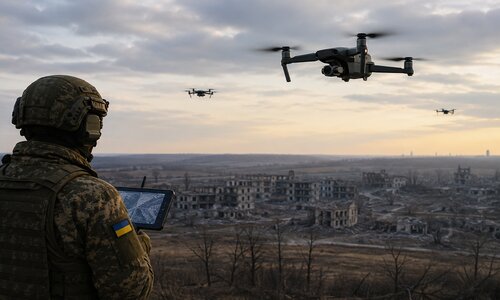
Drone warfare has become one of the defining forces of the Russia–Ukraine war, reshaping not only how battles are fought but also how territory is contested, held, and even denied without traditional infantry engagement. What began as a supporting capability has evolved into a central pillar of modern warfare—so much so that analysts increasingly describe the front lines in Ukraine not as trenches alone, but as layered “kill zones” dominated by persistent aerial surveillance and strike drones.
One of the most striking developments is the sheer scale of drone deployment. Across the battlefield, Ukrainian forces are believed to be operating tens of thousands—possibly hundreds of thousands—of drones in circulation, supported by decentralized production and rapid frontline distribution. This has enabled what military observers often refer to as a “drone wall”: a dense, overlapping network of reconnaissance and attack systems that can detect, track, and strike targets in real time. In practice, this means Ukrainian units can monitor large stretches of territory continuously, making traditional troop movements far more dangerous and expensive.
This shift has helped stall aspects of Russia’s invasion strategy in several ways. Even when Russia maintains advantages in manpower and artillery, its ability to maneuver large formations has been constrained by constant aerial observation and precision strikes. Infantry advances that once relied on surprise or massed concentration are now exposed almost instantly. As a result, some positions are effectively held or denied not by soldiers alone, but by drones that function as eyes, scouts, and strike platforms simultaneously.
In some sectors of the front, drones are even being used to assist in taking or holding territory with minimal direct infantry engagement. Small unmanned systems can drop explosives into trenches, disrupt supply lines, and force withdrawals from positions that would previously require costly ground assaults. The battlefield has become increasingly asymmetric—not in terms of armies, but in terms of visibility and reaction time.
Russia, for its part, has also invested heavily in drone warfare, but reports suggest a different strategic posture. Rather than committing all available systems to Ukraine, there are claims that Moscow is stockpiling large quantities of next-generation drones, potentially for future operations. Among the most discussed are fibre-optic FPV drones, which rely on physical cable links rather than radio signals. This makes them far more resistant to electronic warfare, a domain in which Ukraine and its allies within NATO have developed significant defensive capabilities.
According to Ukrainian and Russian intelligence reporting cited in open analysis, Russia may have diverted large numbers of these fibre-optic systems into rear depots since late 2025. Estimates suggest stockpiles could already reach around 130,000 units, with potential to grow toward 200,000 within months. In theoretical planning scenarios, some analysts have even suggested that in a Baltic theater conflict, there could be as many as four drones per NATO soldier—a figure intended to illustrate saturation rather than literal battlefield deployment ratios.
These concerns are particularly focused on the Baltic states—specifically Estonia, Latvia, and Lithuania—which some defense analysts argue could be vulnerable to rapid, high-intensity drone saturation due to their geography and proximity to Russia. The logic behind such speculation is not that drones alone could win a war, but that massed swarms could overwhelm early warning systems, disrupt command-and-control, and create shock conditions before conventional forces fully mobilize.
Reports attributed to groups such as Volya—a political analysis organization—have even suggested that elements within the Russian defense establishment view such a strategy as a way to exploit perceived hesitation among European states. These claims remain unverified, but they reflect a broader anxiety in European security circles about the pace at which drone warfare is evolving compared to defensive adaptation.
At the center of these developments is the question of where drone warfare goes next. The war in Ukraine has already demonstrated that drones can function as persistent artillery, reconnaissance networks, and psychological tools of attrition. The next phase is likely to be defined by autonomy, swarming algorithms, and counter-drone escalation cycles that evolve almost monthly.
This is where fibre-optic systems could become strategically significant. Unlike conventional drones, which rely on radio-frequency links that can be jammed or spoofed, fibre-optic FPV drones are physically tethered, allowing operators to maintain control in heavily contested electronic warfare environments. In a battlefield increasingly defined by signal disruption, that single design change can restore a decisive advantage.
One of the main reasons Russia has struggled to fully capitalize on its advantages in manpower and industrial capacity is precisely because of Ukraine’s drone-centric defensive model. Even with superior resources in some categories, Russian forces have repeatedly encountered a battlefield where visibility equals vulnerability.
Yet the evolution of drone warfare is far from settled. It is not just changing how wars are fought—it is changing what it means to hold territory at all. And as both sides accelerate production, stockpiling, and innovation, the war in Ukraine may be remembered less as a traditional conflict and more as the moment modern drone warfare became the dominant language of the battlefield.