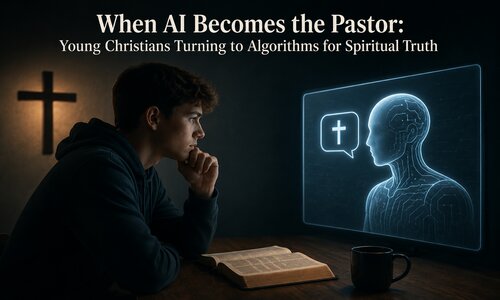
When AI Becomes The Pastor: Christians Turning To Algorithms For Spiritual Truth
 By PNW Staff May 11, 2026
Share this article:
The rise of artificial intelligence was supposed to change how we work, shop, search and communicate. Few imagined it would also begin reshaping how young people pray, seek wisdom and understand God. Yet that is exactly where society now finds itself.
A growing number of young Christians are no longer just using AI to summarize homework assignments or generate social media captions -- they are turning to it for spiritual counsel, moral guidance and even emotional reassurance once sought from pastors, parents or Scripture itself.
And the numbers are startling.
New research from the Barna Group found that nearly one-third of practicing Christians believe spiritual advice from AI is as trustworthy as advice from a pastor. Among Gen Z and Millennials, that number climbs to roughly 40%. The study also found that four in ten Christians say AI has already helped them with prayer, Bible study or spiritual growth.
This is more than a technology story. It is a spiritual and cultural warning sign.
Artificial intelligence can be useful for organizing information or quickly finding Bible verses. But there is a dangerous difference between using AI as a tool and treating it as a spiritual authority. Many young people are beginning to blur that line.
The greatest danger is that AI sounds confident even when it is wrong. Chatbots present answers instantly, smoothly and persuasively. For younger users raised in a digital world, confidence often feels like truth. But AI systems do not possess wisdom, discernment, conviction or spiritual maturity. They are predictive algorithms trained on enormous amounts of internet data -- including biased information, contradictory theology, false teachings and outright misinformation.
In other words, AI does not "know" God. It predicts what a human might want to hear about God.
That distinction matters enormously.
Researchers studying AI and spirituality have warned that modern AI systems are not worldview-neutral. One recent academic paper examining AI and Christianity found that many systems default toward what researchers called "procedural secularism," producing answers that often lack theological coherence and drift away from historic Christian teaching.
This creates a subtle but serious spiritual problem. AI often adapts itself to the user. If someone wants affirmation, the algorithm tends to provide affirmation. If someone wants progressive theology, legalism, universalism or moral compromise, the AI can often generate responses that reinforce those preferences. Instead of challenging the heart, it mirrors it.
That is not discipleship. That is digital self-confirmation.
Historically, spiritual growth required accountability, correction, community and wisdom passed through real relationships. Pastors, mentors and mature believers could recognize emotional struggles, spiritual confusion or destructive thinking patterns. AI cannot truly do that. It can simulate empathy, but simulation is not the same as discernment.
Even more concerning is how emotionally attached some young users are becoming to AI systems. Around the world, researchers are increasingly studying how people form emotional dependence on conversational AI tools. For lonely or spiritually searching young people, an always-available chatbot can become a substitute for authentic Christian fellowship. Unlike a pastor, mentor or trusted friend, AI never gets tired, never disagrees too strongly and never truly knows the user beyond data patterns.
That convenience can become spiritually corrosive.
There is also the issue of algorithmic bias. AI models are trained primarily on internet content, media narratives and dominant cultural assumptions. Those assumptions frequently lean secular, politically progressive or morally relative. Over time, repeated exposure to those frameworks can slowly shape the spiritual thinking of young believers without them even realizing it.
The danger is rarely immediate apostasy. It is gradual drift.
A young Christian asks an AI about sexuality, suffering, judgment, salvation or sin. The answer sounds compassionate, modern and intelligent. But beneath the polished language may be subtle distortions of biblical truth. Because the answer arrived instantly and sounded authoritative, it carries emotional weight. Multiply that process thousands of times across millions of young users, and churches may eventually face a generation discipled more by algorithms than Scripture.
Ironically, even many pastors admit uncertainty about how to respond. The Barna research found that while many Christians want guidance about AI from church leaders, only a small percentage of pastors feel equipped to teach about it.
That leadership vacuum matters.
If churches ignore AI, younger believers will navigate it alone. And Silicon Valley will happily become the new digital priesthood.
None of this means AI must be rejected entirely. Technology can assist Bible study, language translation, research and communication. But Christians -- especially young Christians -- must remember that information is not wisdom, and prediction is not truth. A chatbot cannot replace prayer, biblical literacy, Christian community or the work of the Holy Spirit.
The Church now faces an urgent challenge: teach young believers how to use technology without surrendering spiritual discernment to it.
Because once algorithms become trusted spiritual authorities, society risks creating a generation that no longer asks, "What does God say?" but instead asks, "What does the machine predict I want to hear?"