
Unprecedented Disruption Is Coming With Mass Production Of Humanoid Robots
 By PNW Staff May 05, 2026
Share this article:
The future has a way of arriving quietly--until suddenly, it doesn't. And with the announcement of a full-scale humanoid robot factory in California set to produce up to 100,000 units by the end of 2027, that future is no longer theoretical. It is being assembled, tested, and prepared for delivery into American homes.
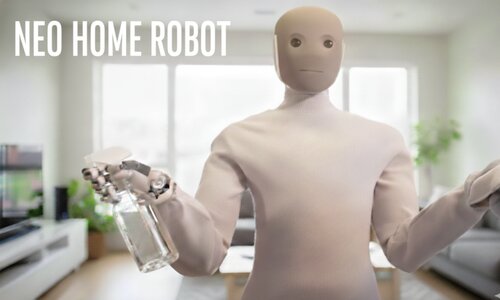
U.S.-based company 1X has taken a decisive step forward with its new facility in Hayward ( a 2nd facility in San Carlos is coming online later this year), aiming to mass-produce its humanoid robot, NEO. These machines are not specialized industrial arms hidden away in factories. They are designed to walk among us--inside homes--assisting with everyday tasks, interacting with people, and learning in real time.
Powered by advanced AI systems from NVIDIA, including the Jetson Thor platform and Isaac simulation tools, NEO represents a merging of robotics and artificial intelligence that has long been promised but never fully realized at scale.
And yet, the question is no longer whether humanoid robots are coming. The question is: what happens when they arrive?
From a technological standpoint, this leap is staggering. The robots are being trained in virtual environments through reinforcement learning, enabling them to adapt, improve, and respond dynamically to real-world conditions. Their ability to process information locally--without relying heavily on cloud systems--means they can react in real time, making them more autonomous and more capable than previous generations of machines. This is not automation as we have known it. This is embodiment--intelligence placed into physical form.
But the deeper story is not about what these robots can do. It is about what their presence will change.
Start with work.
For decades, automation has chipped away at repetitive and industrial jobs. But humanoid robots introduce a new variable: flexibility. A robot that can move like a human, adapt like a human, and learn like a human is no longer confined to one task. It can clean, assist the elderly, stock shelves, deliver packages, and even perform basic caregiving functions. The implications are immediate and profound. Entire sectors--home health care, retail support, logistics, and even entry-level service jobs--could face unprecedented disruption.
The economic argument will be familiar: increased efficiency, reduced labor costs, and higher productivity. Companies will embrace humanoid robots because they do not call in sick, demand wages, or require benefits. But beneath that efficiency lies a more unsettling question--what happens to the millions of people whose roles become optional?
History shows that technological revolutions often create new jobs even as they eliminate old ones. But this time may be different. When the machine is no longer just a tool but a general-purpose worker, the scope of displacement expands dramatically. The speed of this transition--accelerated by AI learning and mass production--may outpace society's ability to adapt.
Then there is the cultural shift.
For the first time, machines will not just be tools we use--they will be entities we live alongside. A humanoid robot in the home is not like a dishwasher or a smartphone. It moves, responds, and interacts in ways that mimic human behavior. Over time, people may begin to form attachments, dependencies, or even emotional connections. This raises difficult questions about identity, relationships, and what it means to be human in a world where imitation becomes increasingly convincing.
Will children grow up seeing robots as companions? Will the elderly rely on machines for comfort and care instead of human interaction? Will society slowly trade authentic relationships for convenient ones?
There is also the question of control.
With vertically integrated manufacturing and AI systems that continuously learn and update, companies like 1X are not just building hardware--they are building ecosystems. The data collected, the behaviors learned, and the decisions made by these machines will all be shaped by the entities that design them. That raises concerns about privacy, influence, and the potential centralization of power in the hands of a few tech companies.
And yet, despite these concerns, demand is already surging. The company reports that its first-year production batch of 10,000 sold out in just five days. That kind of response suggests something deeper than curiosity--it suggests readiness. Or perhaps, inevitability.
Because at its core, this is not just a technological development. It is a turning point.
Humanoid robots represent the convergence of decades of innovation into a single, tangible reality. They promise convenience, efficiency, and a new standard of living. But they also challenge long-standing assumptions about work, value, and human uniqueness.
By the end of 2026, the first of these machines are estimated to begin entering homes and while the world may not look dramatically different overnight, the trajectory will be set. A society that once revolved around human labor will begin to reorganize itself around artificial capability.
And the most important question will not be how advanced these robots become.
It will be whether we have fully considered what we are becoming alongside them.