Texas Judge Allows Muslim City - Islam's Growth And America's Future
 By PNW Staff May 02, 2026
Share this article:
A quiet legal ruling in Texas has opened the door to a much louder national conversation. When Amy Meachum ordered the state to allow construction of a 400-acre Muslim community—complete with homes, a mosque, schools, and businesses—it wasn’t just a zoning decision. It was a window into a deeper reality: Islam is growing in the United States, and with that growth comes both opportunity and tension that Americans can no longer ignore.
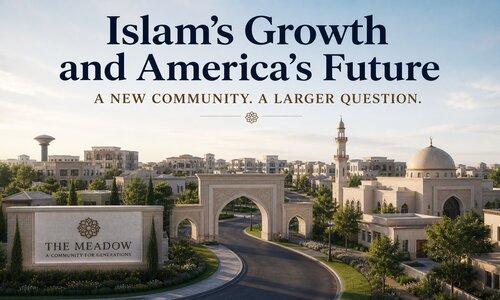
The development, formerly known as Epic City and now called “The Meadow,” represents a vision of communal life shaped around Islamic faith and culture. Backed by developers and supported through a legal agreement with the Texas Workforce Commission, the project moved forward despite opposition from figures like Greg Abbott and Ken Paxton.
Their concerns centered on legality, transparency, and whether such a community could operate in full alignment with American law. The court’s ruling effectively settled the legal question—for now. But it leaves unanswered a much larger one: what does the continued growth of Islam mean for American society?
Islam is one of the fastest-growing religions in the United States. Immigration, higher birth rates, and conversions have steadily increased the Muslim population over the past two decades. In many ways, this growth reflects the very principles America was built on—religious liberty, pluralism, and freedom of association. Muslims, like all Americans, have the right to build communities, worship freely, and participate in public life.
But growth is not just about numbers. It’s about ideas, beliefs, and how those beliefs interact with the broader culture. And here is where the conversation becomes more complex—and more uncomfortable.
At the center of concern for many is the concept of Sharia Law, a moral and legal framework derived from Islamic teachings. While many American Muslims interpret Sharia in a personal and spiritual sense, focusing on prayer, charity, and ethical conduct, others see it as a comprehensive system governing all aspects of life, including law, politics, and social order. That distinction matters.
There are at least five aspects of traditional interpretations of Sharia that raise serious questions about compatibility with Western values:
First, freedom of religion. In some interpretations of Sharia, leaving Islam—apostasy—is considered a grave offense, even punishable by death in certain countries. This stands in direct conflict with the American principle that individuals are free to choose, change, or reject their faith without fear. It raises difficult questions about how communities handle internal dissent and whether individuals truly feel free to explore belief without social or legal pressure. Even where not enforced by law, the cultural weight surrounding apostasy can create an environment where freedom exists in theory but not always in practice.
Second, freedom of speech. Blasphemy laws in parts of the Islamic world criminalize criticism of Islam or the Prophet Muhammad. In contrast, the United States protects even offensive or controversial speech as a fundamental right. The tension becomes especially visible in global incidents where speech leads to threats or violence, raising concerns about whether deeply held religious sensitivities can coexist with an absolutist view of free expression. It forces a broader question: can a society remain fully free if certain ideas are considered too dangerous to question?
Third, gender equality. Traditional Sharia interpretations often prescribe different legal rights and roles for men and women, particularly in areas like inheritance, testimony, and family law. These distinctions clash with modern Western commitments to equal rights under the law. Critics argue that such frameworks can limit women’s autonomy and opportunity, especially in more conservative settings. Supporters may view them as divinely ordained roles, but the debate highlights a fundamental divide over whether equality means sameness under the law or complementarian difference.
Fourth, criminal justice practices. Hudud punishments—such as amputation for theft or corporal punishment for certain offenses—are deeply at odds with American legal standards, which emphasize due process, proportionality, and humane treatment. While rarely implemented in many parts of the world, their presence in traditional legal texts raises concern about what justice should look like in principle. The contrast underscores two very different philosophies: one rooted in deterrence through severity, the other in rehabilitation and constitutional protections.
Fifth, the relationship between religion and state. Sharia, in its more comprehensive forms, does not separate religious authority from political governance. The American system, by contrast, is built on a clear division between church and state, ensuring that no single religion dominates public law. This difference goes beyond policy—it reflects competing visions of authority itself: whether ultimate sovereignty belongs to divine command as interpreted by religious scholars, or to a constitutional system shaped by the will of the people. Navigating that divide is one of the most significant challenges in any pluralistic society.
The Muslim community in America is diverse with varying views on how faith should influence public life but it would be unwise to ignore the ideological dimensions that shape millions. Ideas have consequences. Belief systems shape communities, influence laws, and ultimately affect the direction of a nation. The challenge for America is not simply to tolerate diversity, but to thoughtfully engage with it—honestly, respectfully, and without naïveté.
The Texas case is a reminder that these questions are no longer theoretical. As communities like The Meadow emerge, Americans will increasingly encounter spaces where religious identity plays a central organizing role. That reality demands both vigilance and humility: vigilance in upholding constitutional principles, and humility in recognizing the rights of others to live according to their convictions.
For Christians, this moment presents both a challenge and an opportunity. It is easy to respond with fear, suspicion, or withdrawal. But the Gospel calls for something deeper. The growth of Islam in America is not just a cultural shift—it is a mission field at our doorstep. Muslim neighbors are not abstract ideas or political issues; they are individuals made in the image of God, deserving of love, respect, and genuine relationship.
At the same time, love does not require blindness. Understanding the differences between worldviews is not an act of hostility—it is an act of wisdom. Christians are called to be both compassionate and discerning, to extend grace while standing firm in truth.
America has always been a nation shaped by competing ideas. The question is not whether Islam will grow—it already is. The question is how that growth will interact with the foundational values that define the country. The answer will depend not only on Muslims, but on how all Americans choose to engage—with clarity, courage, and conviction.