The United Nations Just Handed Iran A Seat At The Women’s Rights Table
 By PNW Staff April 14, 2206
Share this article:
The United Nations Just Handed Iran A Seat At The Women’s Rights Table
Read that title again.
Not a typo. Not satire. Iran -- the regime whose morality police beat a 22-year-old woman named Mahsa Amini to death for a loose headscarf -- has just been elevated to a role within a key United Nations body shaping global policy on women's rights, disarmament, and terrorism prevention.
Let that land.
A Record Written in Blood
This isn't a country with a complicated human rights profile. This is a regime that just slaughtered thousands of it's own citizens and conducted public executions for those who it deemed not in support of the regieme. It has fired missiles at most of it's neighboring countries and has bankrolled terrorist militias across the Middle East - exporting violence as foreign policy.
Then there is the particular obscenity of Iran holding any role connected to women's rights. This is a country whose morality police -- the Gasht-e Ershad -- patrol the streets punishing women for showing too much hair. Women have been beaten, detained, and in Mahsa Amini's case, killed for it. Female protesters have been arrested and sentenced for the act of removing their hijabs in public. Girls as young as seven are legally required to cover themselves or face state punishment.
Iran doesn't just oppose women's rights. It institutionalizes their oppression -- enforcing it with batons, prison cells, and when it deems necessary, a noose.
And the United Nations just handed it a seat at the table to help shape global policy on the matter.
How the Machine Works
The U.N. will explain this away with procedure. ECOSOC operates through regional blocs and quiet diplomatic horse-trading. Countries don't get elevated because they've earned it -- they get elevated because it's their turn and no one raised their hand to stop it.
That explanation is accurate. It is also a confession.
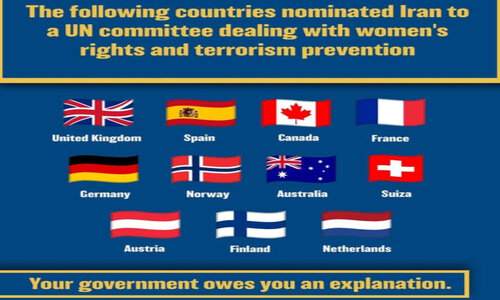
Because the nations that rubber-stamped this appointment weren't backroom autocracies. The ECOSOC members who waved it through included Britain, Spain, Canada, France, Germany, Norway, the Netherlands, Australia, Switzerland, Austria, and Finland. Countries that will stand at podiums and speak passionately about gender rights -- and then, when it actually mattered, said nothing.
Diplomatic silence is still a vote.
The Part That Makes It Worse
If this were an isolated embarrassment you could file it under dysfunction and move on. It isn't. It's a symptom of something far more deliberate -- a pattern of selective outrage that has quietly hollowed out the U.N.'s moral authority for years.
Between 2015 and 2022, the UNGA passed more resolutions condemning Israel than it did against Syria, Russia, North Korea, Iran, and China combined. In one single year: 17 resolutions against Israel, 6 against the entire rest of the world. During that same period, Syria was massacring its own population, China had placed over a million Uyghurs in detention camps, and Russia had annexed Crimea.
The U.N. Human Rights Council had, as of 2022, issued more condemnations of Israel than of every other country on Earth combined. Saudi Arabia holds a seat on that council. Russia sat on it until 2022. Iran has repeatedly been considered for it.
Israel -- a democracy with an independent judiciary, a free press, and Arab citizens in its parliament -- remains the most scrutinized nation in U.N. history. The regimes that stone women and silence dissent at gunpoint are handed committees.
At some point, a pattern this consistent stops being accidental. It starts looking like a system.
The Real Crisis
Rules were followed. Forms were filled. Boxes were checked.
And a regime that murders women for showing their hair now helps shape international policy on women's rights.
The United Nations was built on the wreckage of a world that failed to hold tyranny accountable early enough. Its founding documents read like a direct rebuke of exactly the moral cowardice on display right now.
The question is no longer whether the gap between the U.N.'s ideals and its actions is growing. It is whether anyone with the power to close it still has the will to try.