
Turkey Threatens To Invade Israel - A Prophetic Strom Is Brewing
 By PNW Staff April 14, 2026
Share this article:
The words were not whispered. They were not vague. They were not misunderstood. In a moment that sent shockwaves through geopolitical circles, Recep Tayyip Erdoğan stood before an international audience in Istanbul and issued one of the most direct threats yet against Israel: "There is nothing to prevent us from doing it."
That "it," as he made unmistakably clear, was military intervention--an invasion.
For years, rhetoric between Turkey and Israel has fluctuated between tense and hostile. But this was different. This was not merely criticism. This was not diplomatic posturing. This was a sitting leader of a NATO member openly invoking military action against a U.S.-backed ally--and doing so while referencing past Turkish military interventions as precedent.
A Threat That Crosses a Line
Speaking at the International Asia-Political Parties Conference, Erdoğan drew direct comparisons between Israel and previous theaters where Turkey projected power. He pointed to operations in Libya and the Nagorno-Karabakh, declaring: "We will do the same to them."
That statement alone would have been enough to spark alarm. But Erdoğan went further--launching a personal and inflammatory attack against Benjamin Netanyahu, accusing him of being "blinded by blood and hatred" and running what he described as a "blood-stained genocide network."
Turkey's Foreign Ministry escalated even more, labeling Netanyahu "the Hitler of our time"--a comparison that all but ensures diplomatic relations will remain deeply fractured, if not beyond repair.
The rhetoric was matched with legal escalation. A Turkish court has reportedly issued indictments against Netanyahu and dozens of Israeli officials tied to the interception of a Gaza-bound flotilla--seeking extreme cumulative prison sentences. Symbolic or not, it underscores a broader shift: Turkey is no longer content with verbal opposition--it is building a narrative framework for confrontation.
Israel, for its part, did not stay silent. Netanyahu fired back, accusing Erdoğan of enabling Iran's terror network while brutalizing his own Kurdish population. Other Israeli leaders went further still, describing Erdoğan as a power-hungry authoritarian clinging to imperial fantasies.
The result? Not just tension--but open hostility, with both sides speaking as if conflict is no longer unthinkable.
The Reality: More Talk Than Action--For Now
Let's be clear. A Turkish invasion of Israel is highly unlikely in the near term. The geopolitical, military, and strategic consequences would be catastrophic. Israel is widely understood to be a nuclear-armed state with overwhelming military capabilities and deep backing from the United States.
For Turkey--a NATO member--to initiate such a conflict would not just be risky. It would be existential.
But dismissing Erdoğan's words as mere bluster would be a mistake.
Because rhetoric like this does not emerge in a vacuum. It reflects mindset. It signals direction. And increasingly, it reveals ambition.
Turkey's Quiet Expansion Across the Region
While the headlines focus on fiery speeches, the more consequential story has been unfolding quietly over the past several years: Turkey's steady and strategic expansion of influence across the Middle East and beyond.
In Syria, Ankara has entrenched itself militarly and politically, backing opposition factions and maintaining a significant troop presence in the north. In Libya, Turkish intervention reshaped the balance of power, giving Ankara long-term influence in a country that sits at the crossroads of Africa, Europe, and the Mediterranean.
Beyond those flashpoints, Turkey has extended its reach into Somalia, Qatar, and northern Iraq--building military bases, forging economic ties, and positioning itself as a dominant Sunni power broker in a region long shaped by Iran's Shia axis.
This is not accidental. It is doctrine.
Often referred to as a neo-Ottoman strategy, Turkey's approach blends military force, political alliances, economic investment, and ideological messaging. Unlike Iran's reliance on proxy militias, Turkey is building state-level partnerships and embedding itself into the infrastructure of multiple regions.
And now, as Iran's influence has been weakened in recent conflicts, a vacuum is forming.
Turkey appears more than ready to fill it.
A Dangerous Alignment Taking Shape
Here is where the situation becomes even more concerning.
Despite competing interests, Turkey has increasingly found itself aligned--at least tactically--with powers like Iran and Russia in key regional theaters. In Libya, Turkish influence has grown significantly, placing it in a strategic position along the Mediterranean with access to routes and leverage that extend toward Israel's sphere of interest.
This is not a formal alliance in the traditional sense--but it is a convergence of interests. And in geopolitics, that can be just as powerful.
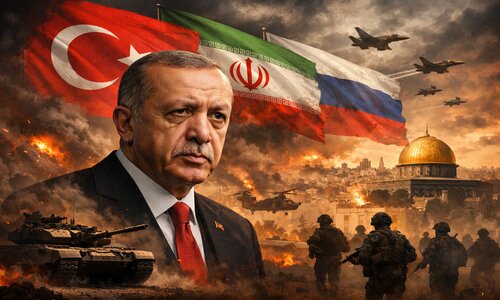
The idea of Turkey, Iran, and Russia operating in overlapping spheres--while Turkey simultaneously expands into places like Libya--should not be ignored. It represents a shifting balance of power that could redefine the region in the years ahead.
Words Today--War Tomorrow?
Right now, Erdoğan's threats are just that--words. Dangerous, inflammatory, and destabilizing words--but still words.
Yet history has shown that rhetoric often precedes reality.
Leaders rarely wake up one day and act completely out of character. They move in the direction they have been signaling all along.
And what Erdoğan is signaling is unmistakable: a vision of Turkey as a dominant regional power, unafraid to confront Israel, willing to challenge the West, and increasingly comfortable projecting force far beyond its borders.
For many observers, this is where geopolitics ends. But for others--particularly those familiar with biblical prophecy--it may be where another layer of meaning begins.
In Ezekiel 38, an ancient prophecy describes a future coalition of nations that will come against Israel in the latter days. Among the names listed is "Magog," along with allies such as Persia--widely understood to represent modern-day Iran--and other regions that many scholars have long associated with areas that include parts of modern Turkey. The passage outlines not just hostility, but a coordinated invasion from the north--an event that has intrigued theologians and geopolitical analysts alike for generations.
For decades, such alignments seemed distant, even unlikely. But today, the landscape is shifting. Turkey is expanding. Iran may be signfigantly weakened but still posses a large army and has already shown how fast they can rebuild. Russia is increasingly active in the region depsite being dragged down in Ukraine. Libya--now heavily influenced by Ankara--adds another layer to a growing web of strategic positioning.
The current geopolitical situations would suggest the Ezekiel 38 scenario is years away but the stage is slowly taking shape.
For now, the world may dismiss Erdoğan's statements as political theater. And perhaps, in the immediate sense, that's all they are.
But theater has a way of becoming reality when the script has been rehearsed long enough.
Because when a leader says there is "nothing to prevent" an invasion, the real question is no longer if it happens tomorrow.
It's whether the mindset behind those words is aligning--step by step--with something far bigger than politics alone.