
Meanwhile in Gaza... Eight Months To Disarm Hamas?
 By PNW Staff March 30, 2026
Share this article:
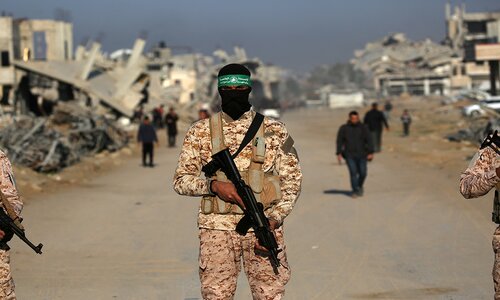
While all eyes are on Iran, Gaza is being pushed to the side -- not because it has been solved, but because it has become politically inconvenient. It is still there, still burning beneath the surface, still unresolved, still deadly. And now, as attention drifts elsewhere, a so-called peace process is taking shape in the background that may do the opposite of what it promises.
On paper, the latest Gaza framework sounds structured and responsible. Committees. Stages. Verification. Security transitions. Demilitarized zones. Timelines. But buried inside the language is the kind of detail that should stop everyone cold: Hamas could have up to eight months to disarm.
Eight months.
That is not a short bridge to peace. That is an eternity in a war zone.
And in Gaza, time is not neutral. Time is a weapon.
Every extra week gives Hamas more opportunity to do what terror movements have always done best: adapt, disappear, reorganize, deceive, and survive. Eight months is enough time to move weapons into civilian neighborhoods, divide stockpiles into smaller hidden caches, recruit fresh operatives, rebuild communications channels, hide explosives in schools or mosques, deepen ties with local clans, and relocate command structures into places that will be politically or militarily costly to strike later.
That is the first and most obvious problem with this process: it assumes Hamas will disarm like a defeated government army rather than a deeply embedded terror network.
But Hamas is not some conventional force waiting for paperwork and pickup schedules. It is an organization built on secrecy, deception, and ideological endurance. It has spent years turning Gaza into a maze -- not just of tunnels, but of divided loyalties, hidden infrastructure, civilian shielding, and underground logistics. The idea that such a movement will hand over its military backbone in carefully supervised phases should be treated with deep skepticism.
And that leads to the real fear: this may not end the status quo at all. It may preserve it.
Because what happens if Hamas "complies" just enough to keep the process alive, but not enough to actually lose power?
What happens if it hands over old rifles while keeping the real weapons buried?
What happens if tunnels are "destroyed" in one area while new routes are quietly preserved elsewhere?
What happens if heavy weapons disappear before inspectors arrive?
What happens if one faction plays along while another refuses -- giving everyone plausible deniability and no one real accountability?
What happens if the entire process becomes a shell game?
That is not paranoia. That is how insurgent and terror movements survive.
And the worst-case scenarios get darker from there.
The Most Dangerous Outcome May Be the One That Looks Like "Progress"
The greatest risk is not necessarily a dramatic collapse of the plan. In some ways, that would at least be honest.
The more dangerous scenario is a slow-motion fake peace -- one where the world is told things are improving while the underlying threat quietly mutates.
Imagine this:
Israel begins pulling back in phases under international pressure. Reconstruction money starts flowing into "approved" zones. New local administrators are installed. Foreign diplomats declare cautious optimism. The media moves on. The crisis loses urgency.
But beneath the surface, Hamas is still there.
Not necessarily marching openly in formation. Not necessarily flying flags from rooftops. But present. Embedded. Surviving. Watching. Waiting.
That is how this can go from a failed disarmament process to something worse: a re-legitimized underground Hamas that is harder to target because it now exists under the cover of diplomacy, humanitarian rebuilding, and political ambiguity.
In that scenario, Gaza does not become peaceful. It becomes frozen -- a place where everyone pretends the war is ending while everyone on the ground knows it is only pausing.
And frozen conflicts are often the most dangerous of all, because they create the illusion of stability while preparing the conditions for the next explosion.
Worse-Case Scenario #1: Hamas Uses the Delay to Prepare for Round Two
If Hamas concludes that this process is mostly about buying time and managing optics, it may use the eight-month window not to surrender, but to prepare for the next war.
That means:
dispersing fighters into civilian structures,
reengineering tunnel access points,
building sleeper cells,
preserving bomb-making materials,
hiding anti-tank weapons and explosives,
and ensuring that if war resumes, Israel will once again face an enemy that appears "weakened" on paper but remains lethal in reality.
If that happens, this plan will not be remembered as a peace process.
It will be remembered as the interval that allowed Hamas to survive what should have been its collapse.
Worse-Case Scenario #2: Gaza Becomes Ungovernable
There is another nightmare possibility few people want to discuss openly: what if Hamas partially recedes, but no credible authority is actually strong enough to replace it?
Then Gaza does not become peaceful. It becomes fragmented.
Not one ruler, but many.
Not order, but competing armed factions.
Not reconstruction, but extortion rackets.
Not security, but neighborhood warlords, clan militias, black markets, revenge killings, and localized terror cells.
That kind of collapse would create a Somalia-style vacuum inside Gaza, where every block becomes a micro-territory and every aid convoy becomes a prize to be fought over.
In that scenario, Hamas may weaken as a formal organization while the security nightmare actually gets worse.
Because a fractured Gaza full of smaller armed groups is not safer for Israel, not safer for civilians, and not easier to rebuild. It is simply more chaotic, more criminal, and harder to contain.
Worse-Case Scenario #3: Reconstruction Becomes the Next Battlefield
If money does begin flowing before real disarmament is complete, another danger emerges: the rebuilding effort itself can be exploited.
Construction materials can be diverted.
Machinery can be used to conceal or repair tunnel systems.
Aid networks can be infiltrated.
Corruption can flourish.
Political loyalty can be bought through food, shelter, and access.
In other words, the very resources meant to stabilize Gaza could become the infrastructure of the next conflict.
Meanwhile, Israel Risks Getting Trapped in the Gray Zone
This plan is also dangerous for Israel, because it risks pulling the country into the worst possible military position: not fully at war, but never truly at peace.
That means a long-term half-occupation, half-withdrawal environment where:
Israeli troops remain exposed in sensitive perimeter zones,
rocket or sniper incidents can reignite fighting at any moment,
political pressure grows at home and abroad,
and military restraint is constantly demanded even while the threat remains unresolved.
This is the kind of environment where one tunnel discovery, one ambush, one kidnapping, one rocket volley, or one massacre can collapse everything overnight.
And if that happens after months of diplomatic buildup and staged withdrawals, the backlash will be even more explosive.
Because then it will not just be another war.
It will be a war launched after the world convinced itself peace was underway.
The Real Problem: This Feels Like Management, Not Victory
That is what makes this so troubling.
The current process does not feel like a strategy to end Hamas decisively. It feels like an attempt to manage the aftermath without confronting the full reality of what Hamas is.
And that is a deadly mistake.
You cannot negotiate away an ideology that glorifies October 7.
You cannot timetable evil into moderation.
You cannot bureaucratize jihad out of existence.
And you certainly cannot assume that a terror army built in darkness will simply dissolve because a committee says the handover phase has begun.
If Hamas is given months to maneuver, hide, recalibrate, and wait out the pressure, then what is being built here may not be peace at all.
It may be the architecture of the next disaster.
So yes, while the world is watching Iran, Gaza remains in the background -- simmering, decaying, and drifting deeper into a dangerous holding pattern.
And if this drags on the way so many "temporary" Middle East arrangements do, then the truth may become painfully clear:
Eight months to disarm Hamas does not sound like the end of the war.
It sounds like the beginning of the next one.