
The Next Generation Of Iran’s Regime - Even More Radical Than Before?
 By PNW Staff March 26, 2026
Share this article:
War is often described as chaos. But the most dangerous wars are not the ones with clear chains of command, identifiable leaders, and known objectives. The most dangerous wars are the ones where power splinters, ideology hardens, and younger men with something to prove begin acting without permission. That is where Iran now appears to be.
For years, the world understood the Islamic Republic as a hostile but structured regime -- brutal, radical, and expansionist, yes, but still governed by a vertical hierarchy. There was a supreme leader. There were senior Revolutionary Guard commanders. There were channels of command, factions, and power centers that, however sinister, still answered to someone at the top.
But after the reported killing of Ayatollah Ali Khamenei and numerous senior Iranian commanders in U.S.-Israeli strikes that began on February 28, that structure appears to have been shattered. Reuters and AP reporting indicates a temporary governing framework has emerged, but the larger reality is a vacuum -- and vacuums in revolutionary states are rarely filled by moderates.
That should terrify anyone hoping for a quick diplomatic resolution.
Because when the old guard is decapitated, the men who rise next are often not the most seasoned, wise, or restrained. They are the most zealous.
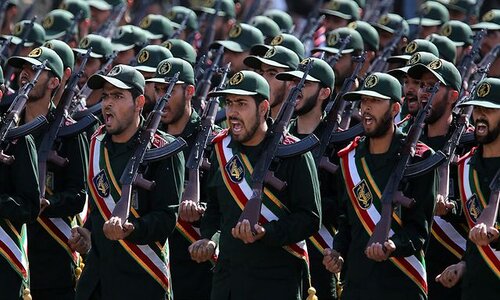
That is the central danger now hanging over Iran and the wider Middle East: not simply that Tehran remains hostile, but that many of the men increasingly exercising battlefield authority are younger, more ideologically rigid, and less politically calculating than the generation above them. Hooshang Amirahmadi's warning that second-rank revolutionary officers may now be "increasingly in charge" deserves serious attention. If he is right, then we are no longer dealing primarily with strategic state actors seeking leverage. We are dealing with a dispersed revolutionary class raised from childhood to believe that confrontation with America and Israel is not just policy -- it is destiny.
That generational point matters more than many Western analysts admit.
Older Iranians, even those who remained loyal to the regime, often still carried some living memory of what came before the 1979 revolution. They knew another Iran once existed -- flawed, certainly, but not consumed by the totalizing religious militarism that has since defined the Islamic Republic. They remembered a country that was not built around martyrdom, proxy war, anti-Western revolutionary export, and clerical absolutism.
But the younger hardliners now stepping into the breach do not remember any of that.
They were born into the revolution. Schooled in it. Sermoned by it. Militarized by it. Their political imagination was formed entirely inside the architecture of radical Shiite ideology. For them, the regime is not a detour from normalcy; it is normalcy. Endless confrontation is not a failure of the system. It is the system.
And that makes them more dangerous than the men they replace.
The old regime leadership, for all its evil, often knew when to calibrate. It knew when to posture and when to pull back. It understood that survival sometimes required tactical restraint. Younger battlefield commanders, especially those suddenly empowered by a broken hierarchy, are less likely to think that way. They are more likely to view compromise as betrayal, negotiation as cowardice, and any concession to Washington as apostasy.
That is why talk of imminent peace should be treated with deep skepticism.
Yes, there are reports that the White House has pushed peace terms and that President Donald Trump has described contacts as "productive." But Iran's public messaging has been sharply defiant, and that contradiction tells us something important: whoever may still want a diplomatic off-ramp inside the regime is either weak, divided, or afraid. Reuters reporting and public statements from Iranian officials suggest that Tehran's surviving apparatus is still functioning, but that does not mean it is unified. In fact, it may mean the opposite -- a regime still firing missiles and issuing threats precisely because no one at the center is strong enough to force discipline on the men below.
That is the nightmare scenario.
A fragmented Iran does not become harmless. It becomes harder to predict, harder to deter, and harder to negotiate with. One provincial commander can launch retaliation. Another can sabotage de-escalation. A third can decide that if higher-level officials are even thinking about peace on American terms, they are traitors worthy of elimination. Once a revolutionary system loses centralized fear, internal purges become just as likely as external attacks.
That is why the current ambiguity over leadership is so significant.
The supposed son or successor now rumored to be in control has reportedly still not been seen publicly in any meaningful way, and that silence is not a minor detail. It is a flashing red warning light. In a regime built on projection, symbolism, and authority, visibility matters. If the heir apparent cannot appear, cannot command, cannot project control, then every ambitious colonel, Guard officer, and ideological enforcer across Iran receives the same message: take initiative. And in a regime like this, "initiative" usually means escalation.
Meanwhile, the global consequences are already beginning to surface. Energy markets remain on edge, and industry leaders are openly warning about the consequences of prolonged instability around the Strait of Hormuz and broader Middle East supply routes. That matters not just for traders and governments, but for ordinary families who will feel it in fuel prices, shipping costs, inflation, and the general return of economic instability. The world does not need much imagination to understand what happens if a decentralized, revenge-driven Iranian military culture begins lashing out without coherent top-down control.
So where do we go from here?
First, we stop pretending that removing senior tyrants automatically produces peace. Sometimes it does the opposite. Sometimes it leaves behind a younger, angrier, less restrained generation convinced they have inherited a holy war.
Second, any negotiation effort must begin with a hard truth: there can be no durable peace until there is a durable authority capable of enforcing it. You cannot negotiate meaningfully with fragments. You cannot sign a deal with men who may be dead by next week at the hands of their own subordinates.
And finally, the West must understand that this is no longer just a military problem. It is a civilizational one. Iran is now confronting the fruit of decades of ideological radicalization. When a regime catechizes children into revolutionary hatred for a generation, eventually those children grow up, put on uniforms, and start making decisions.
That is the stage we may be entering now.
And if so, the fall of Iran's old masters may not be the end of the danger.
It may be the beginning of its most reckless chapter yet.