
Watched Behind the Wheel: How Our Cars Are Becoming 24/7 Surveillance Machines
 By PNW Staff March 24, 2026
Share this article:
There was a time when getting behind the wheel meant freedom. The open road symbolized independence, privacy, and the simple ability to go where you wanted--without being watched. Today, that vision is quietly fading.
In its place, a new reality is emerging: one where your car is no longer just a machine, but a data-collecting, behavior-monitoring, algorithm-driven observer. And increasingly, it may not just watch you--it may decide what you're allowed to do.
Recent reporting and federal policy developments tied to the Infrastructure Investment and Jobs Act reveal a growing push to embed advanced driver-monitoring systems into every new vehicle. Section 24220 of the law mandates the development of "advanced impaired driving technology," designed to passively monitor drivers and prevent operation if impairment is detected.
On the surface, the goal sounds noble: reduce drunk driving deaths and improve road safety. But beneath that goal lies a far more complex--and unsettling--shift in how much of our personal lives are being tracked, analyzed, and potentially controlled.
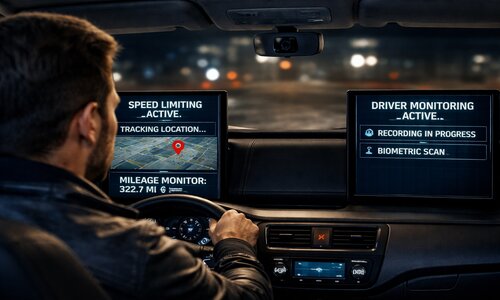
At the heart of this transformation is artificial intelligence. Modern vehicles are increasingly equipped with inward-facing cameras, biometric sensors, and software capable of tracking eye movement, facial expressions, and even subtle behavioral patterns. These systems can determine whether you're distracted, tired, or possibly impaired. Some proposals even include technology capable of detecting alcohol levels beneath the skin without requiring a breathalyzer.
Supporters argue this is a technological breakthrough. Human error, after all, is responsible for the vast majority of accidents. If AI can step in and prevent tragedy, why wouldn't we embrace it?
But that argument assumes a level of trust that many Americans are no longer willing to give.
Because once your car is watching your face, tracking your movements, and analyzing your behavior, a critical question emerges: where does all that data go?
This isn't hypothetical. Companies like Tesla and General Motors already collect vast amounts of vehicle data, from driving habits to location history. Insurance companies are increasingly offering--or pressuring drivers into--usage-based programs that monitor speed, braking, and time of travel. Drive too fast? Your premium goes up. Brake too hard? That's another mark against you.
Now imagine that system expanded--and mandated.
Your car could track how fast you drive, how often you accelerate aggressively, how alert you appear, even how long your eyes drift from the road. It could log every trip you take, every stop you make, and every mile you drive. That data could be shared with insurers, manufacturers, or even government agencies, all under the banner of "safety" or "efficiency."
And it doesn't stop there.
Several states have already explored or implemented "mileage-based taxation"--a system that charges drivers per mile instead of per gallon of gas. On paper, it's a response to declining gas tax revenues as electric vehicles become more common. In practice, it requires one thing: constant tracking of your vehicle's location and movement.
The implications are enormous. A system designed to tax mileage could easily evolve into one that enforces driving limits, restricts travel in certain areas, or penalizes behavior deemed undesirable. Combine that with AI-driven monitoring, and your car begins to look less like personal property--and more like a regulated node in a larger surveillance network.
Even more concerning is the issue of control.
The language in the federal mandate doesn't just call for monitoring--it calls for intervention. If a system determines that a driver is impaired, it may "prevent or limit motor vehicle operation." That means your car could decide, in real time, whether you are allowed to drive.
What happens when the system is wrong?
Artificial intelligence is not infallible. False positives are a documented issue across AI systems, from facial recognition to behavioral analysis. A camera misreads your expression. A sensor misinterprets fatigue. An algorithm flags you incorrectly. In a high-speed environment, even a momentary misjudgment could have serious consequences.
Yet under these emerging systems, the machine's judgment may override your own.
This is where the debate moves beyond safety and into something deeper: autonomy.
For generations, driving has been an expression of personal responsibility. You were accountable for your actions behind the wheel. Now, that responsibility is slowly being transferred to algorithms--systems designed, trained, and controlled by entities far removed from the individual driver.
And history offers a clear warning: once surveillance infrastructure is built, it rarely remains limited to its original purpose.
Data collected for safety can be repurposed for enforcement. Systems designed for assistance can evolve into tools of control. What begins as a well-intentioned effort to reduce accidents can gradually reshape the relationship between citizens, corporations, and the state.
None of this means safety doesn't matter. It does. Reducing drunk driving and saving lives is a goal everyone can support. But the method matters just as much as the outcome.
Because when privacy is sacrificed in the name of security, it is rarely returned.
The question Americans must now grapple with is not whether technology can make driving safer--it can. The real question is whether we are willing to trade away our independence, our data, and ultimately our control, for that promise.
Once your car is watching you, tracking you, and deciding for you... are you still the one in the driver's seat?