
Unthinkable: Britain Advances Law For Abortion Up To Birth
 By PNW Staff March 21, 2026
Share this article:
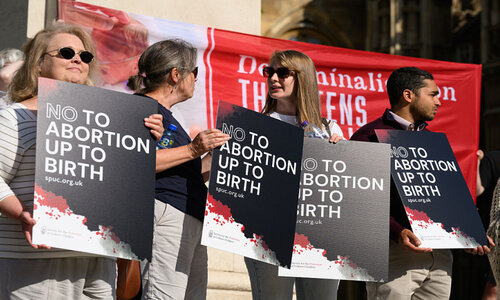
A decision made behind the historic walls of Britain's Parliament has sent shockwaves far beyond London--and for many, it feels like a line has been crossed that cannot easily be uncrossed. This week, the House of Lords advanced legislation that pro-life leaders are calling not just controversial, but catastrophic. What has unfolded is not a minor policy shift. It is, in their view, a moral earthquake--one that strikes at the very foundation of how a society defines life, dignity, and justice.
At the center of the storm is Clause 208 of the Crime and Policing Bill, a provision that states that "no offense is committed by a woman acting in relation to her own pregnancy." On its surface, it is framed as protection--shielding women from prosecution. But critics warn that beneath that language lies something far more sweeping and far more dangerous. According to Right to Life UK, this clause effectively removes any legal deterrent against self-administered abortion at any stage of pregnancy--up to and including the moment of birth--and for any reason.
Pause and consider that reality. For generations, even amid fierce debate, there remained at least some legal acknowledgment that late-term life carried weight--that it demanded caution, oversight, restraint. Now, pro-life advocates argue, that last line of defense is being erased.
"This is one of the most extreme pieces of legislation ever," said Catherine Robinson of Right to Life UK. And as stark as that claim sounds, it is being echoed across denominational lines. Christian leaders--often cautious in their public language--are speaking with unusual urgency, warning that the consequences of this moment could echo for decades.
John Sherrington did not mince words when he warned that the clause could lead to abortion being effectively decriminalized "for any reason, up to the point of birth." He called it a "radical departure" from Britain's legal tradition, particularly from the Abortion Act 1967, which--however imperfectly--placed guardrails around the practice, including a general 24-week limit and the involvement of medical professionals.
Those guardrails are now at risk of collapsing.
And when guardrails collapse, the consequences are not theoretical--they are real, immediate, and often irreversible.
Sarah Mullally issued a warning that should not be easily dismissed: even if lawmakers claim the 24-week limit remains, the removal of enforcement mechanisms "undoubtedly risks eroding the safeguards" that give that limit meaning. Laws, after all, are only as strong as their ability to be upheld. Strip away accountability, and what remains is not protection, but permission.
This is where the urgency deepens. Because this debate is not only about unborn children--though they remain the most voiceless and vulnerable--it is also about women who may now be left more isolated than ever. Without requirements for in-person medical consultation, without meaningful legal boundaries, there is growing concern that women could be pushed--by fear, by pressure, by circumstance--into making life-altering decisions alone, outside the safety of clinical care.
What is being presented as compassion may, in reality, become abandonment.
Baroness Monckton and others attempted to halt or amend the clause, warning that removing legal deterrents could expose women to coercion, abuse, and serious medical risk. Those efforts failed. Amendments were voted down. Safeguards were stripped away. And perhaps most alarming of all, this transformation of British abortion law advanced with astonishing speed--after just 46 minutes of debate in the House of Commons.
Forty-six minutes.
In less than an hour, lawmakers moved forward on a change that touches the most profound questions a society can face: When does life matter? Who is protected? And who is not?
Supporters of the bill, including groups like the College of Sexual and Reproductive Healthcare, insist the intent is limited--that the goal is simply to prevent criminalizing women. But for pro-life advocates, intent cannot outweigh outcome. If the result is a system where abortion up to birth carries no legal consequence, then the moral and legal landscape has fundamentally shifted--regardless of how carefully the language is framed.
And that shift raises a haunting question: if a society removes protection from life at its most vulnerable stage, what does that say about its understanding of human worth?
For centuries, the belief that every human life carries intrinsic value has shaped not only Christian teaching but the very structure of Western law. Leaders within the Church of England have warned that this principle is now under direct threat. When the "infinite value of human life" is no longer clearly reflected in law, something deeper begins to erode--not just policy, but conscience.
This is not a distant issue. It is not abstract. It is immediate. It is unfolding now.
The bill will continue through Parliament, and there is still time for scrutiny, for debate, for reconsideration. But that window is narrowing. And the voices raising concern are growing louder--not out of political instinct, but out of a conviction that something precious is being lost.
History will remember this moment. The only question is how.
Will it be remembered as a turning point where a nation paused and chose to protect both mother and child with greater care and compassion? Or will it be remembered as the moment when, quietly but decisively, the final safeguards for the unborn were swept away?
For those watching with shock and dismay, the answer matters deeply--because once a society redefines the value of life, the consequences are not easily contained.