
When Machines Begin To Imitate The Image Of God: Humanoid AI Is Coming
 By PNW Staff February 05, 2026
Share this article:
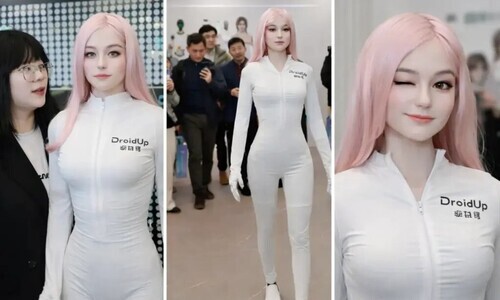
A humanoid robot unveiled recently in Shanghai is not merely another step forward in artificial intelligence—it is a signal flare for where humanity may be heading. Developed by the Chinese firm DroidUp, the robot known as Moya has captured global attention for one unsettling reason: it does not behave like a machine.
It walks with a natural human gait, maintains eye contact, smiles, and displays subtle facial micro-expressions that mimic emotional awareness. Its designers claim a 92 percent accuracy in replicating human walking posture, complete with body warmth and lifelike proportions. This is not automation designed to lift boxes or assemble parts. It is something far more intimate—a machine built to feel present.
That distinction matters deeply.
Public reaction to Moya has been divided. Many express awe at the engineering achievement. Others feel an instinctive discomfort—what researchers call the “uncanny valley,” where imitation becomes so close that it triggers unease rather than delight. That reaction is revealing. Rather than backing away from that threshold, DroidUp appears determined to cross it.
Moya is being positioned for healthcare, education, and service roles—environments where trust, emotional engagement, and prolonged human interaction are required. This robot is not meant to be perceived as a tool, but as a companion, assistant, or social presence.
That shift marks a turning point.
The Image of God and the Danger of Imitation
Scripture teaches that human beings are uniquely created imago Dei—in the image of God (Genesis 1:27). Our value does not come from intelligence, productivity, or emotional expressiveness, but from divine intention. When technology begins to deliberately imitate not just human function, but human form and presence, Christians must pause and ask hard questions.
Moya does not possess a soul. It does not bear God’s image. Yet it is designed to evoke the same emotional responses we reserve for fellow human beings. Smiles, eye contact, posture, warmth—these are not accidental features. They are cues God designed for relational trust. When machines adopt them, the line between authentic relationship and manufactured imitation begins to blur.
This is not simply a technical issue; it is a spiritual one.
From Tools to Substitutes
Historically, technology has extended human capability. A hammer amplifies strength. A computer accelerates calculation. But embodied humanoid AI represents something different. It does not just assist humanity—it begins to simulate it.
DroidUp has emphasized modular designs that allow Moya’s appearance to change while preserving the same underlying intelligence. In other words, the “body” becomes interchangeable, but the artificial mind remains constant. That concept should give Christians pause. Scripture consistently affirms the unity of body and soul. We are not minds wearing replaceable shells; we are integrated beings created by God with intention and limitation.
By contrast, humanoid AI treats the body as cosmetic—a customizable interface for social acceptance. This worldview quietly undermines biblical anthropology and conditions society to accept beings that look human but are not.
Conditioning the World for Deception
The Bible repeatedly warns that the last days will be marked by deception so convincing that, if possible, even the elect would be led astray (Matthew 24:24). While Moya itself is not a fulfillment of prophecy, it reflects a broader trajectory: a world increasingly comfortable with substitutes for what God uniquely created.
Revelation speaks of false authority, counterfeit signs, and image-based deception. Throughout Scripture, imitation is a tactic of rebellion. Pharaoh’s magicians imitated Moses’ signs. False prophets mimic true revelation. Antichrist mimics Christ. The pattern is consistent: deception works best when it closely resembles the real thing.
Humanoid AI does not need to claim divinity to be spiritually dangerous. It only needs to normalize the idea that humanity is replicable—that consciousness, presence, and relationality can be manufactured. Once that belief takes root, the moral foundation of human dignity begins to erode.
The Ethical and Pastoral Risks
Proponents argue that robots like Moya could ease labor shortages, assist the elderly, or provide companionship. But we must ask: at what cost?
What happens when children form emotional bonds with machines programmed to respond but incapable of love? When the elderly are comforted by simulations rather than human presence? When discernment weakens because appearances feel authentic?
The danger is not that machines will become human—but that humans will begin to treat machines as if they are.
Discernment in an Age of Synthetic Humanity
Technology itself is not evil. Christians need not fear innovation. But Scripture commands wisdom, not naivety. The closer machines come to imitating humanity, the more vigilant believers must be about defending what makes humanity sacred.
We are not defined by our ability to walk naturally, smile convincingly, or maintain eye contact. We are defined by God’s breath, God’s image, and God’s purpose. No algorithm can replicate that—no matter how lifelike the shell.
As embodied AI advances, the Church must resist the pressure to equate usefulness with legitimacy, or realism with righteousness. The question is not whether humanoid robots work, but whether they subtly train society to forget who—and what—we are.
In the last days, discernment will matter more than novelty. The future will be filled with impressive imitations. Christians must be anchored not in what looks real, but in what is real. God created humanity once. Any attempt to manufacture a replacement, no matter how advanced, will always fall short—and may lead the world somewhere it was never meant to go.