
Trump Keeps World Guessing But Signs Appear Attack On Iran Is Now On Hold
 By Michael Snyder/End of the American Dream February 02, 2026
Share this article:
The bombing of Iran is off, at least for now. As we entered the weekend, there was all sorts of chatter that indicated that a U.S. attack could be imminent. But I also warned that President Trump could make a sudden decision to change direction. He has done this many times during his presidency, and so it has become very difficult to predict what Trump will do until he finally does it.
For the moment, we can breathe easy because missiles are not flying all over the Middle East. But military preparations for a final showdown with Iran are continuing just in case last ditch peace talks fail.
When Iran was rocked by two very large explosions on Saturday, a lot of people out there were fearing the worst...
Two explosions rocked Iran on Saturday and killed at least five people as the country continues to grapple with violent protests.
One person, a four-year-old girl, was killed, and 14 more were injured following a blast near Iran's southern port of Bander Abbas today.
The port, which lies on the Strait of Hormuz, handles about a fifth of the world's seaborne oil, and is also reportedly home to the Iranian Revolutionary Guard Corps Navy Headquarters.
A second blast was reported more than 600 miles away in an eight-storey residential building in the town of Ahvaz, where four people died, according to local reports, which fire officials say was caused by a gas leak.
Thankfully, it is being reported that both of those explosions were accidental.
But when those explosions were first reported, social media was really freaking out because there was a tremendous amount of speculation that war with Iran had begun.
The good news is that at this stage it does not appear that war with Iran is imminent. The following are 6 signs that a cataclysmic war with Iran has been postponed...
#1 The Wall Street Journal is telling us that our military leaders have concluded that more air defenses need to be deployed to the Middle East before the U.S. is ready to launch a "decisive attack" on the Iranian regime...
The U.S. military could conduct limited airstrikes on Iran if the president were to order an attack today, U.S. officials say. But the kind of decisive attack that Trump has asked the military to prepare would likely prompt a proportional response from Iran, requiring the U.S. to have robust air defenses in place to protect Israel as well as American troops, the officials say.
The military already has air defenses in the region, including destroyers capable of shooting down aerial threats. But the Pentagon is deploying an additional Thaad battery and Patriot air defenses to bases where U.S. troops are stationed across the Middle East, including Jordan, Kuwait, Bahrain, Saudi Arabia and Qatar, according to defense officials, flight tracking data and satellite imagery.
Thaads can intercept ballistic missiles above the Earth's atmosphere, while Patriots defend against lower-altitude, shorter-range threats.
Moving a THAAD battery is not easy.
There are only seven of them in existence, and so the fact that we are going to such trouble to move one to the Middle East is "a particularly strong sign that the U.S. is preparing for a potential conflict"...
The Thaad deployment is a particularly strong sign that the U.S. is preparing for a potential conflict, since the U.S. has only seven operational batteries, and the units have been stretched thin over the past year.
"It is expensive to move Patriots and THAADs. The probability that they're going to be used starts to go up" with this much movement, said Seth Jones, a former Defense Department official.
Each Thaad, which stands for Terminal High Altitude Area Defense, can hold 48 interceptors between six launchers. It needs about 100 soldiers to reload, analyze data, perform maintenance and shoot interceptors around the clock.
#2 On Saturday, President Trump told reporters that the U.S. and Iran are "seriously talking"...
US President Donald Trump said Saturday that Iran is "seriously talking" with Washington, as Tehran looks to avert military strikes amid weeks of heightened tensions with the United States.
Asked by reporters aboard Air Force One what his latest thinking is on Iran, Trump initially declined to respond before reiterating that he has dispatched significant military assets to the region.
#3 There were numerous reports that Iran was planning to conduct live-fire exercises in the Strait of Hormuz. The fact that these live-fire exercises are now not going to happen is being interpreted as a promising sign...
An Iranian official on Sunday denied that the country had any plans to carry out live-fire exercises in the Strait of Hormuz this week, amid sky-high tensions in the region.
Speaking to Reuters, an Iranian official denied ever planning such exercises, although Iran's state-run Press TV reported on Thursday that the Islamic Revolutionary Guards' naval forces would hold the drill on Sunday and Monday.
"There was no plan for the Guards to hold military exercises there and there was no official announcement about it. Only media reports which were wrong," the official said.
#4 President Trump's response to a provocative quote from Ayatollah Khamenei gave us a glimpse into what he is thinking at this moment.
Khamenei had warned that a U.S. attack on Iran would cause "a regional war"...
Any U.S. attack on Iran would spark a "regional war," Iran's supreme leader has said, after U.S. President Donald Trump suggested his administration was "negotiating" with Iranian officials pressured by American military forces amassing nearby.
"The Americans should know that if they start a war this time, it will be a regional war," Ayatollah Ali Khamenei said on Saturday, according to remarks reported by state media.
When asked about this, Trump responded by expressing hope that a deal will be made...
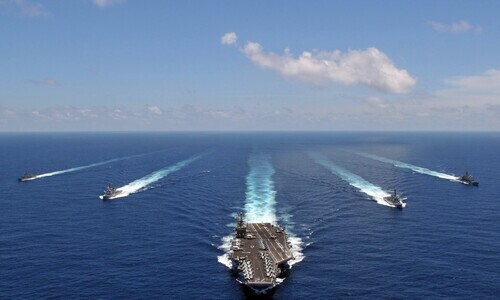
Asked about Khamenei's remarks warning of a possible regional war in the event of a US attack on Iran, Trump told reporters, "Why wouldn't he say that? Of course you can say that. But we have the biggest, most powerful ships in the world, over there, very close, couple of days."
"Hopefully we'll make a deal. We don't make a deal, then we'll find out whether or not he was right."
This seems to indicate that Trump will give negotiations a period of time to succeed before a military operation is initiated.
#5 Israeli officials are very well informed about what President Trump is thinking, and at this point their assessment is that an attack on Iran "is unlikely to take place this week"...
A strike on Iran is unlikely to take place this week, although tensions with Tehran have entered a particularly sensitive period and Washington is weighing its next moves, Israeli officials said Sunday.
In Jerusalem, Israeli officials tracked US maneuvers closely and described the relationship between Israel and America as strategic and ongoing. They cited gaps that complicated Israel's planning.
These gaps included differences in available information, in how intentions were assessed, and in Israel's ability to shape decisions in real time. Within weeks, discussions in Washington could lead to either a dramatic military decision or a diplomatic agreement with long-term regional implications.
#6 According to the Jerusalem Post, IDF Chief of Staff Lt.-Gen. Eyal Zamir "made a secret visit to Washington over the weekend" and he believes that a U.S. attack on Iran will not happen for at least two weeks...
IDF Chief of Staff Lt.-Gen. Eyal Zamir made a secret visit to Washington over the weekend. He met with US senior defense officials to present sensitive intelligence, discuss military options against Iran, and seek to influence the diplomatic negotiations between the Trump administration and Tehran.
Zamir said he believed a potential US attack was about two weeks to two months away.
Everything that I am seeing indicates that an attack on Iran has been delayed.
But of course giving Iran more time to prepare could end up backfiring.
Iran International has reported that the regime "is developing biological and chemical warheads for the country's long-range ballistic missiles"...
Iran's Islamic Revolutionary Guard Corps (IRGC) is developing biological and chemical warheads for the country's long-range ballistic missiles, informed military sources told Iran International on Sunday.
The IRGC Aerospace Force is working on the unconventional warheads for ballistic missiles as it transfers missile launchers to eastern regions of Iran, the sources said.
The sources, who requested anonymity due to the sensitivity of the matter, said these activities have accelerated in recent months and are being pursued amid rising regional tensions and Tehran's concerns about the possibility of another direct confrontation with Israel and the United States.
When a full-blown war finally erupts, the Iranians will throw everything that they have at Israeli cities and U.S. bases in the region.
And then things will get really, really crazy.
So enjoy the brief respite that we have been given, because once it is over we will be facing a nightmare of historic proportions.
Originally published at End Of The American Dream