
US Economic Weakness/Woke Policies Leads To Shifting Global Alliances
 By K.D. Hastings/The Washington Stand September 02, 2023
Share this article:
Economic weakness and radical policies are pushing nations away from the U.S. and into the arms of China and Russia, a well-known business school head stated Friday.
"The U.S. is clearly losing our authority on the world stage," former Congressman Dave Brat said on August 25's "Washington Watch with Tony Perkins." Brat is dean of the Liberty University School of Business.
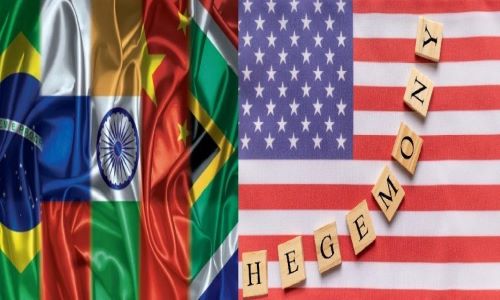
He noted that BRICS, a bloc of nations that already included China, Brazil, Russia, India, and South Africa, recently announced the group was adding Saudi Arabia, Iran, Ethiopia, Egypt, Argentina, and the United Arab Emirates as members in a concerted effort to overturn what has been a world order dominated by U.S. interests since the mid-20th century.
Russia pushed for the bloc's formation in 2009. More recently, China has been the prime driver behind the group and its growth.
"This membership expansion is historic," Chinese President Xi Jinping said in a Reuters report. "It shows the determination of BRICS countries for unity and cooperation with the broader developing countries."
This shift in alliances is a reaction against the overreach of the United States, Brat told FRC's guest host Jody Hice. "We've gone too far," Brat continued, "We're $50 trillion in debt." He noted that the rest of the world is well aware of the United States' economic woes, including higher interest rates and the likelihood the nation will never be able to pay off its debt. Brat, who served as the U.S. representative for Virginia's 7th congressional district from 2014 to 2019, said many nations are holding American dollars which are losing value.
Referencing the Bretton Woods Agreement, an economic and monetary order established in 1944 after the United States victory in World War II, Brat explained the U.S. looked to rights enshrined in the U.S. Constitution and Declaration of Independence in building a world order aimed at blunting the spread of communism.
"We protected the world as long as they would help us fight against the Soviet Union back then," he continued. "The world has changed significantly now. China is our biggest threat, and we are just ill-equipped," Brat added.
Adding insult to injury, Hice noted the U.S. Agency for International Development (USAID) announced an LGBTQ policy earlier this month. According to an agency press release, the first-ever policy "guides USAID's commitment to advancing LGBTQI+ Inclusive Development and the human rights of LGBTQI+ people as part of a coordinated, whole-of-U.S. government effort with our partners on the ground."
"So it's not just the horrendous shape of our economy, but the United States keeps pushing this wokeness on other countries," Hice continued. "These other countries don't want our woke ideology, and we're really pushing away countries that otherwise ought to be our allies."
Citing "woke stuff" in the military, growing national debt, the nation's "open" southern border, and the Federal Reserve's ruinous policies, Brat said the U.S. is no longer in the world's driver's seat.
While BRICS members do not have much in common on the surface, Steve Tsang, director of London's Soas China Institute, a center focused on research and teaching on China, said these nations share a common desire -- they do not want to live in a "Western-dominated world."
"What the Chinese are offering is an alternative world order for which autocrats can feel safe and secure in their own countries," Tsang said in a BBC report.
Brat insisted the U.S. must take this expanding realignment seriously, suggesting the bloc of nations is planning to develop a common currency that will be backed by gold and that threatens to replace the U.S. dollar as the basis of international trade.
"The objective, irreversible process of de-dollarization of our economic ties, is gaining momentum," Russian President Vladimir Putin told the BRICS summit.
"It is a real threat," Brat warned. "It's a signal to the U.S. to get our act together."
Yet the economist is not optimistic there will be any changes in the near future: "I don't have much confidence that we are going to get our act together. This is the natural consequence of our [nation's] dereliction of its fiscal duties over the decades."
Originally published at The Washington Stand - reposted with permission.