A Majority At Any Cost? Israel’s Coalition Crisis Puts The Country At Risk
 By PNW Staff November 12, 2026
Share this article:
Israel’s coalition crisis is exposing a dangerous question: How far will political leaders go to seize power—and what will they hand over to parties whose own words and actions challenge the Jewish state?
At the opening of the new Knesset, Benjamin Netanyahu put those words on the record. He quoted Ra’am lawmaker Walid Taha saying Palestinians are the owners of the land and that “this occupation will be set aside.” He cited Ra’am chairman Mansour Abbas calling Jews “invaders in this land,” and recalled Abbas’s vision of a “democratic caliphate,” with Palestine “from the sea to the river, on the ruins of Israel.”
These are not abstract arguments about budgets or roads. They describe a political vision in which Israel’s existence is temporary and its Jewish character is something to be overcome.
And yet the opposition is considering relying on these parties to form a government.
The anthem tells the story
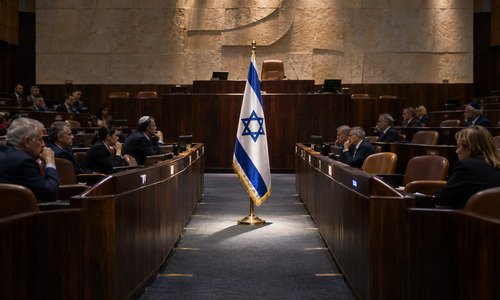
At the Knesset’s opening ceremony, lawmakers stood for Israel’s national anthem, “Hatikvah.” Joint List lawmakers walked out. Most Ra’am lawmakers also left the chamber. The anthem speaks of the Jewish people’s ancient hope to live as a free people in their own land. Their walkout was a public rejection of that national story, delivered inside the parliament of the country they seek to help govern.
Mansour Abbas remained in the chamber. But one man’s decision to stay does not erase what the other lawmakers did—or the political meaning of a walkout at the moment Israel’s elected representatives gathered under the symbols of the state.
This is the contradiction at the heart of the coalition talks: parties that reject the national symbols and challenge the Jewish character of Israel are being courted as potential partners by leaders who say they want to govern Israel.
A majority assembled on borrowed votes
The opposition bloc has 48 seats. The Arab-led parties hold 19. Together, they could provide the numbers for a majority in the 120-seat Knesset.
That is the arithmetic. The danger is what comes with it.
A government dependent on a narrow majority cannot treat its pivotal partners as spectators. Every vote becomes leverage. The parties holding that leverage can demand influence over policy, appointments, budgets, and the government’s response to national emergencies.
Israel faces threats from Iran, Hezbollah, Hamas, and other enemies committed to its destruction. In that environment, a government’s ability to act cannot rest on the fragile goodwill of parties whose leaders have questioned Israel’s right to exist as a Jewish state or refused to speak plainly about Hamas.
The Hamas test
The question is not whether political leaders can produce carefully worded statements when coalition negotiations demand them. The question is whether they will clearly identify Israel’s enemies and stand with the country when doing so carries a political cost.
Ra’am MK Yasser Hujirat recently sparked outrage when he described Hamas as having a charitable wing and refused in an interview to plainly call the group a terrorist organization. He later said his remarks had been edited and that he condemns terrorism. But Israelis heard the original exchange. A party seeking influence over Israel’s government cannot expect the public to ignore the difference between a direct answer and a later clarification.
After October 7, hesitation over Hamas is not a minor communications problem. Hamas murdered, raped, kidnapped, and burned its way into Israeli communities. Any party seeking a role in Israel’s government should be expected to speak about that plainly.
The Joint List has its own record and political agenda. These parties are not identical, but both are now central to the opposition’s path to power. Their votes may determine who governs, while their positions raise urgent questions about the government they would help sustain.
What will the opposition concede?
Gadi Eisenkot called Netanyahu’s Knesset speech “delusional, divisive, hate-filled and shameful.” But outrage at Netanyahu’s words does not answer the question facing the opposition: What will it concede to secure the support of parties whose leaders have made statements like these and whose lawmakers walked out on Israel’s anthem?
A coalition cannot be judged only by the number of seats behind it. It must also be judged by the commitments and compromises required to keep it alive. If the price of replacing Netanyahu is giving pivotal influence to parties that reject Israel’s national story and resist clear condemnation of its enemies, Israelis deserve to know that before the deal is done.
The same political leaders who once condemned Netanyahu for allegedly empowering dangerous partners now appear willing to make their own bargain. Their standard seems simple: an alliance is unacceptable when it helps their opponent, but acceptable when it helps them take power.
Israel cannot afford that kind of moral and political double standard. A narrow majority built on partners who reject the state’s defining symbols and challenge its Jewish identity could leave the country weaker at the very moment it needs unity and resolve.
The question is not whether 61 votes can be assembled. It is what Israel will be asked to surrender to get them—and whether the leaders pursuing power are willing to put the country’s security ahead of their own political ambitions.