
The Democrats Won The Election - But Are Socialists Winning The Future?
 By PNW Staff November 05, 2026
Share this article:

The Democratic Party emerged from Tuesday's midterm elections celebrating a remarkable political comeback. Republicans suffered significant losses, Democrats regained control of Congress, and party leaders began preparing for a new era of political power in Washington.
But beneath the celebration, another political movement was celebrating a victory of its own. And unlike the Democratic establishment, its ambitions extend far beyond the next two years.
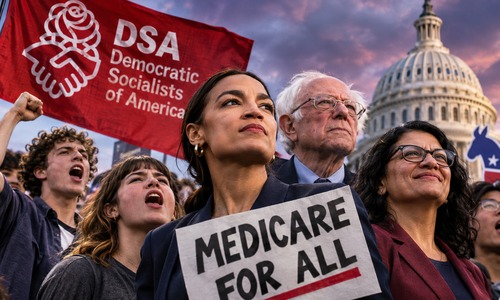
The Democratic Socialists of America (DSA) announced more than 50 electoral victories nationwide, including at least five new members heading to the House of Representatives. Combined with returning socialist lawmakers, the movement will have its largest congressional presence in generations.
Seven members in a House of 435 hardly constitute a revolution. In fact, with Democrats enjoying a larger congressional majority, socialist lawmakers may have less immediate leverage than they would in a narrowly divided chamber.
But that may be missing the bigger picture.
The real question isn't how much power socialists possess in Congress today. It's whether they are gradually reshaping the ideological future of the Democratic Party itself.
And this movement is playing a much longer game.
The Establishment Has The Numbers, But Socialists Have Momentum
Consider what happened during the Democratic primaries. Socialist-backed candidates didn't simply defeat Republicans in November. They first defeated established Democrats who had represented their districts for years.
In Colorado, Melat Kiros defeated longtime Congresswoman Diana DeGette, who had served since 1997. Similar challenges elsewhere demonstrated that even entrenched Democratic politicians are vulnerable to organized opposition from their left.
This is the DSA's strategy in action.
Rather than building a third party that struggles to win elections, socialists are operating inside the Democratic Party, using its political infrastructure and reliably Democratic districts to advance their candidates.
Once they win the primary in a heavily Democratic district, the general election is often little more than a formality.
Socialists don't necessarily need to persuade the entire country to embrace their agenda. They need to persuade enough Democratic primary voters to replace establishment politicians with candidates committed to their movement.
And every successful primary challenge sends another message to Democratic incumbents: move left, or risk being replaced.
The Generational Shift That Could Change Everything
Perhaps the most consequential development isn't happening in Congress at all. It's happening among younger Americans.
Recent polling reveals a striking contradiction. A Fox News Voter Poll found that 54% of Americans viewed socialism unfavorably, compared with 33% favorably. Yet an Economist/YouGov survey found that 50% of registered voters would consider voting for a democratic socialist candidate, even though only 20% preferred socialism over capitalism as an economic system.
The generational divide is particularly revealing. A September New York Times/Siena poll found that voters 44 and younger were nearly twice as likely as older voters to view socialism favorably.
For older Americans who remember the Cold War, socialism often evokes memories of failed economies, authoritarian governments and lost freedoms.
For many younger Americans, however, socialism is increasingly associated with affordable housing, government-funded healthcare, reduced student debt and promises of economic fairness.
Young adults struggling with soaring housing costs and uncertain economic futures are receptive to politicians promising sweeping structural change. Socialist organizers have become effective at translating those frustrations into political activism.
And unlike traditional campaigns that mobilize voters every few years, the DSA emphasizes continuous organizing through local chapters, labor activism and electoral challenges.
Today's college activists could become tomorrow's congressional candidates. Today's socialist city council members could become tomorrow's governors. And today's controversial policy proposals could become tomorrow's Democratic Party platform.
The Democratic establishment may control the party today. But who will control it in 2032 or 2036?
Israel Could Become A Major Battleground
For Christians who understand the biblical significance of Israel, one of the most consequential aspects of this political transformation involves America's relationship with the Jewish state.
The DSA has made opposition to American military assistance to Israel a prominent part of its political agenda. Several socialist lawmakers have campaigned against continued military support, while established figures such as Rashida Tlaib have long been among Israel's fiercest congressional critics.
This represents a significant departure from the bipartisan support Israel historically enjoyed in Washington.
Consider Michigan's newly elected Senator Abdul El-Sayed. Although neither a DSA member nor an endorsed candidate, he supports several policies associated with the socialist movement, including ending American military assistance to Israel.
His victory demonstrates that these positions are not confined to a small congressional faction.
What happens when the next generation of Democratic lawmakers views Israel not primarily as a strategic ally and democratic partner, but through an ideological framework centered on oppression, colonialism and revolutionary politics?
The concern is not that seven socialist representatives will suddenly end America's alliance with Israel.
It is that their worldview could gradually become increasingly influential within one of America's two major political parties.
The Socialist Agenda Goes Far Beyond Healthcare
Supporters frequently present democratic socialism as a commitment to helping struggling Americans. But the DSA's ambitions extend considerably further.
Its broader agenda includes expanding public control over essential sectors of the economy, aggressive redistribution of wealth, sweeping changes to immigration enforcement, stronger union power and significant reductions in military spending.
These proposals raise fundamental questions about economic freedom, personal responsibility, government authority and the proper relationship between citizens and the state.
Not every proposal for affordable healthcare or assistance to the poor is socialism. Americans have long debated the appropriate role of government in providing a social safety net.
But there is a difference between helping those in genuine need and embracing an ideology that increasingly looks toward government intervention and collective economic control as solutions to society's problems.
The movement's greatest challenge may ultimately be persuading Americans outside progressive strongholds to embrace that vision.
After all, the DSA's major congressional victories came in reliably Democratic districts. Its candidates did not demonstrate an ability to flip Republican-held congressional seats.
That exposes a critical limitation. Socialists may be getting better at defeating establishment Democrats without necessarily becoming more appealing to the broader American electorate.
The 2028 Presidential Election Could Accelerate The Divide
The next major test may arrive sooner than many expect.
Alexandria Ocasio-Cortez has become one of the most recognizable progressive politicians in America. Whether she seeks the presidency in 2028 remains uncertain, but her national profile demonstrates how politicians associated with democratic socialism can gain influence far beyond their congressional districts.
A presidential campaign by Ocasio-Cortez or another candidate embracing similar policies could force establishment Democrats into an uncomfortable position.
Do they resist the socialist movement and risk alienating younger activists? Or do they adopt increasingly progressive positions to maintain party unity?
Even an unsuccessful socialist presidential campaign could influence the party's platform, much as Bernie Sanders helped move debates over healthcare, college tuition and economic inequality into the Democratic mainstream.
Political movements don't always need to win the presidency to reshape the country. Sometimes they simply need to change what their opponents are willing to promise.
What Christians Must Understand About This Political Shift
For Christians, this debate should extend beyond political labels and campaign slogans.
Scripture repeatedly commands believers to care for the poor, defend the vulnerable and practice generosity. But biblical compassion is not synonymous with any particular economic ideology, nor does Scripture teach that government can replace the moral responsibilities of individuals, families, churches and communities.
The Bible also recognizes the dangers of concentrated human power, the corrupting influence of greed and the temptation to look toward earthly institutions for the kind of redemption only God can provide.
Christians should evaluate political proposals against biblical principles rather than assuming promises of economic equality automatically represent justice.
And when political movements embrace positions that conflict with biblical convictions concerning Israel, religious liberty, family or human dignity, believers have a responsibility to recognize those conflicts.
The Democratic Party may have won a decisive political victory in 2026. Its establishment leaders may still possess overwhelming numerical advantages over the socialist faction.
But elections are snapshots. Ideological movements operate across generations.
The socialist movement does not need to take over the Democratic Party tomorrow. It only needs to keep winning the argument over what the Democratic Party should become.
And if the next generation of Democratic voters increasingly embraces that argument, today's small socialist faction could become tomorrow's political establishment.
The Democrats may have won the election. But the battle over who owns their future may only be beginning.