
"Boys and Girls" Out, "Comrades" In At A Megachurch's Children's Ministry
 By PNW Staff October 29, 2026
Share this article:

There are few places left in American life where children can reliably hear that they were made by God as male or female, and that this is good. The church ought to be one of them. Church of the Resurrection in Kansas has decided otherwise.
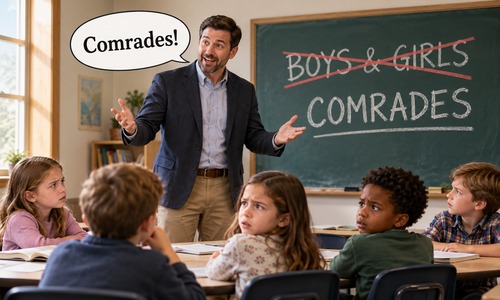
Children’s ministry workers at the large United Methodist congregation have been given guidance to avoid the words “boys” and “girls.” Suggested replacements include “kiddos,” “folks,” “niblings,” “peep-a-doodles,” and “comrades.” The stated aim is to make every child feel welcome. The actual result is to teach children that the most basic facts about their bodies are awkward, potentially harmful, and best left unsaid in the house of God.
Formation by Another Name
This is not a minor adjustment in pastoral sensitivity. It is a quiet but deliberate act of formation. When a church treats the ordinary language of creation as a problem to be managed, it is no longer merely trying to be kind. It is shaping children in the assumptions of the sexual revolution.
The accompanying materials cited, among other influences, Mila Jam, a transgender activist known for promoting nonbinary identity. A church’s children’s ministry is not supposed to take its cues from activists whose project is the destabilization of sexual distinction. Yet that is what has occurred. The linguistic preferences of the cultural left are being offered as guidance for how Christian adults should speak to children. The word “comrades” only makes the shift more obvious. It is not the natural speech of Christian nurture. It is the vocabulary of ideology.
Many children are already absorbing confusion from social media, schools, and peers. The church’s responsibility is to clarify reality, not to deepen the fog. True kindness does not require adults to pretend that biological sex is optional or that children benefit from linguistic evasion. It requires them to speak truthfully and refuse to participate in the culture’s demand that we treat sexual distinction as oppressive or imaginary.
Creation Is Not a Problem to Manage
Scripture is not unclear on the matter. “Male and female He created them” (Genesis 1:27). Jesus Himself appealed to that creation order when teaching on marriage (Matthew 19:4). A child’s body is not an embarrassment the church must carefully talk around. It is the purposeful work of God. By training its workers to erase the language of sex, the church is training children to distrust both their own bodies and the Word that names them. That is not compassion. It is a failure of discipleship conducted in the name of welcome.
For generations, Christian parents and teachers have spoken to boys as boys and girls as girls without apology, recognizing that these are not social constructs to be negotiated but gifts to be received with gratitude. To treat those words as liabilities is to imply that God’s design itself requires correction. Children do not need the church to protect them from the truth of their own creation. They need the church to receive that truth with confidence and to pass it on without shame.
When Pastors Lose Their Nerve
The episode fits a larger pattern of accommodation. Adam Hamilton founded Church of the Resurrection and remains its senior pastor. The congregation reports more than 24,000 active members and is the largest United Methodist church in the country. Hamilton is also the Democratic nominee for the U.S. Senate in Kansas. On his podcast he has expressed doubt about the Virgin Birth, suggesting that people need only “follow Jesus” rather than affirm the historic confession.
Both the Apostles’ Creed and the Nicene Creed state without qualification that Jesus was born of the Virgin Mary. For nearly two thousand years the church has regarded this as non-negotiable. When a pastor treats a central article of the creeds as optional, the decision to treat the binary of male and female as negotiable in the children’s ministry becomes far less surprising.
Pastors are not free to revise the faith according to cultural fashion or political alignment. They are stewards of a deposit they did not invent and are not authorized to edit. Jesus welcomed children. He also issued one of the sternest warnings in the Gospels against those who cause them to stumble. False teaching rarely arrives with open hostility. More often it comes wrapped in the language Christians already prize—welcome, compassion, inclusion—while quietly setting biblical truth aside.
A church that cannot bring itself to say “boys” and “girls” has already revealed what it fears more than it loves. It fears the disapproval of the age more than it loves the children in its care. And once a church begins editing the language of creation for the sake of cultural approval, it will not stop at vocabulary. The same instinct that softens “boys” and “girls” will eventually soften everything else that the culture finds inconvenient. Parents who still believe the Bible would do well to notice the pattern—and to decide whether this is the kind of formation they want for their children.