Methodist Church Promotion Says Hell Isn't Real - But What Does The Bible Say?
 By PNW Staff October 14, 2026
Share this article:
Halloween is approaching, and across America, haunted houses are preparing to terrify visitors with images of demons, fire, death, and the horrors of hell.
But at one California church, the message this Halloween season is something very different: Hell isn't real. And apparently, believing that makes you a more faithful Christian.
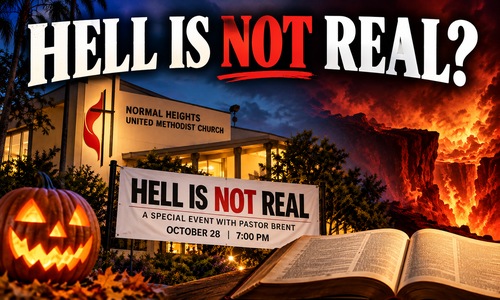
Normal Heights United Methodist Church in San Diego is advertising a special October 28 event titled "Hell Is Not Real," just three days before Halloween. Pastor Brent will explore the history of hell, why Christians have supposedly been taught the wrong understanding of it, and why rejecting the doctrine is, in the church's words, "far more faithful to God."
The timing is striking. While secular culture turns hell into seasonal entertainment, a church is preparing to challenge one of Christianity's most sobering historic teachings.
But there is an enormous problem with eliminating hell from Christianity: Jesus Christ Himself repeatedly warned about divine judgment.
And if Jesus believed those warnings were important enough to deliver, what gives modern churches the authority to explain them away?
The Jesus Who Warned About Hell
One of the most popular arguments against hell is that a loving Jesus would never teach such a frightening doctrine. The gentle, compassionate Savior who welcomed sinners and forgave His enemies supposedly could not also warn of eternal punishment.
Except that He did.
In Matthew 25:46, Jesus declares that the wicked "shall go away into everlasting punishment: but the righteous into life eternal." The same Greek word describing the duration of eternal life also describes the punishment.
In Mark 9:43-48, Jesus warns about Gehenna and unquenchable fire. In Matthew 10:28, He warns His followers to fear the One who can destroy both soul and body in hell. In Luke 16, He describes a rich man experiencing torment after death.
These warnings are not isolated passages open to convenient reinterpretation. They reflect a consistent biblical teaching found throughout both the Old and New Testaments: God is holy, sin has consequences, and a day of final judgment is coming. From Daniel's warning of everlasting shame and contempt to the teachings of Jesus and the visions of Revelation, Scripture repeatedly affirms the reality of divine judgment and eternal consequences.
While some debate the precise imagery used to describe hell, the Bible gives us no reason to dismiss its reality or soften its warnings. Jesus spoke of everlasting punishment, unquenchable fire, and a final separation between the righteous and the wicked. These are not warnings Christians have the liberty to simply explain away because they conflict with modern sensibilities.
The same Jesus who welcomed children, healed the sick, and forgave sinners also warned of the terrible consequences of rejecting God. His love and His warnings were never contradictory. Indeed, it was precisely because He loved humanity that He spoke so plainly about the judgment to come.
Five Arguments Used To Explain Away Hell
The first argument is that a loving God would never condemn anyone to hell.
But this assumes that love and justice are incompatible. Scripture presents God as both perfectly loving and perfectly holy. A God who never judges evil would not be perfectly just. We rightly demand accountability for murderers, abusers, and those who commit terrible atrocities. Why should divine justice be considered incompatible with divine goodness?
Revelation 20:12 describes the dead standing before God and being judged according to their works. The Bible does not portray judgment as a contradiction of God's character, but as an expression of His righteousness. God's love offers forgiveness through Christ; His holiness does not make sin inconsequential.
A second argument claims that hell was invented by medieval religious authorities to frighten people into obedience.
Certainly, medieval art, literature, and preaching shaped popular images of hell. Dante's Inferno influenced generations, and some religious leaders undoubtedly exploited fear. But abusing a doctrine does not establish that the doctrine itself is false.
Centuries before medieval Christianity, Jesus warned about Gehenna, unquenchable fire, and final judgment. Revelation describes the lake of fire, while Daniel 12:2 speaks of resurrection to everlasting life or shame and everlasting contempt. The imagery may be debated, but the biblical foundations of final judgment cannot simply be dismissed as medieval inventions.
A third argument suggests that the original biblical languages do not actually support the traditional doctrine.
It is true that Sheol, Hades, Gehenna, and the lake of fire are distinct concepts, and translating them all simply as "hell" can obscure important differences. But recognizing those distinctions is not the same as proving that final punishment does not exist.
In Matthew 25:46, Jesus contrasts "everlasting punishment" with "life eternal." The same Greek adjective, aiōnios, describes both. Some interpreters dispute what this means for the duration or nature of punishment, but the parallel presents a serious challenge to claims that Jesus taught no enduring consequences for rejecting God.
A fourth argument insists that eternal punishment would be disproportionate to sins committed during a finite lifetime.
This is one of the more serious theological objections, and Christians have long debated it. Some defend eternal conscious punishment, others believe the wicked will ultimately be destroyed, and still others advocate universal reconciliation.
Yet Scripture does not measure the seriousness of sin simply by the time required to commit it. A murder may take seconds while its consequences last generations. That analogy does not, by itself, prove eternal punishment is proportionate, but it challenges the assumption that duration alone determines moral seriousness.
Hebrews 9:27 declares that people are appointed to die once and afterward face judgment. Whatever one's understanding of hell's precise nature, the Bible repeatedly presents final accountability as a reality, not an outdated religious scare tactic.
The fifth argument may be the most revealing: modern people simply find the doctrine of hell morally unacceptable.
For many, the objection is less about ancient languages or biblical history than about the belief that a compassionate God would never permit such a fate. But Christianity has never taught that truth is determined by whether a particular generation finds it comfortable.
Jesus warned that the road to destruction is broad and that the way leading to life is narrow (Matthew 7:13-14). He also called people to repentance rather than simply affirming every belief and behavior.
If Scripture is authoritative only when it agrees with contemporary values, then contemporary values—not Scripture—have become the final authority.
It Rarely Stops With Hell
The upcoming San Diego event is hardly an isolated theological departure. Normal Heights United Methodist Church openly identifies as progressive and LGBTQ-affirming, celebrates Pride Month, incorporates inclusive language into worship, and has adapted worship music to reflect its priorities.
And therein lies a troubling pattern increasingly visible in progressive Christianity. Once biblical authority is set aside in one area, it becomes easier to set it aside in others. Traditional teachings on marriage and sexuality are reinterpreted, abortion is defended as a matter of personal choice, biblical morality becomes relative to modern culture, and now even the reality of hell is called into question.
Not every progressive congregation holds identical positions, but the broader concern remains: when Scripture conflicts with contemporary cultural values, which one is expected to change?
The danger is not simply disagreement over individual doctrines. It is the gradual replacement of biblical authority with human preference. Once the church assumes the right to rewrite what God has revealed, there is little left that cannot eventually be explained away.
The question is no longer which biblical teachings a church accepts, but whether Scripture itself is still the final authority.
If There Is No Judgment, What Are We Being Saved From?
Perhaps the greatest consequence of eliminating hell is what it does to the Christian understanding of salvation.
Romans 3:23 declares that all have sinned and fallen short of God's glory. Romans 6:23 explains that the wages of sin is death. Romans 5:8 reveals God's extraordinary love: Christ died for us while we were still sinners.
The cross is not merely an inspirational example of self-sacrifice. In historic Christian teaching, it is God's answer to the terrible reality of human sin.
Jesus did not come simply to make people feel accepted, improve their self-esteem, or assure them that their moral choices carry no eternal consequences. He came to seek and save the lost.
If humanity faces no ultimate accountability, no divine judgment, and no danger from which it must be rescued, the urgency of repentance and salvation is dramatically diminished.
That does not mean everyone who questions eternal conscious torment rejects salvation. But a theology that eliminates sin's ultimate consequences must explain why Scripture speaks so urgently about repentance, forgiveness, and rescue through Christ.
John 3:16 is perhaps the most beloved verse in the Bible because it promises everlasting life to those who believe in God's Son. Yet the following verses also speak of condemnation and judgment.
The promise of salvation cannot be fully understood while ignoring the warnings surrounding it.
Compassion Does Not Mean Concealing The Truth
No Christian should take pleasure in the thought of anyone facing divine judgment. Scripture itself declares that God takes no pleasure in the death of the wicked but calls them to turn and live.
The proper Christian response to hell is not cruelty, arrogance, or delight in condemnation. It is humility, urgency, compassion, and a desire to share the gospel.
But compassion cannot mean telling people what they want to hear regardless of whether it is true.
A doctor who conceals a deadly diagnosis to avoid frightening a patient is not demonstrating love. Neither is a pastor who dismisses biblical warnings merely because they make modern audiences uncomfortable.
Every Halloween, millions of Americans encounter frightening images of demons, darkness, and eternal punishment. Most understand them as entertainment, exaggerated symbols designed to produce a momentary scare.
But according to Scripture, the reality of divine judgment is not entertainment. It is a warning serious enough that Jesus repeatedly addressed it, even when His words made listeners uncomfortable.
The church was never commissioned to make every teaching of Jesus comfortable. It was commissioned to proclaim the whole counsel of God, including the truths that modern culture would prefer to forget.
And perhaps that is the greatest irony of this Halloween season. While the world dresses up as demons and pretends hell is frightening, some churches are increasingly telling their congregations there is nothing to fear at all.
If Jesus believed judgment was important enough to warn people about, what gives today's pastors the authority to tell their congregations they have nothing to fear?