Chipotle's Ouija Board Ad Sparks Backlash - But The Real Danger Goes Much Deeper
 By PNW Staff October 13, 2026
Share this article:
A fast-food chain wants to bring back its margaritas. So naturally, it turns to a Ouija board and tells customers that the spirits have spoken.
That is the premise behind Chipotle's Halloween marketing campaign, which has drawn criticism from Christians who see something far more troubling than a questionable advertising gimmick.
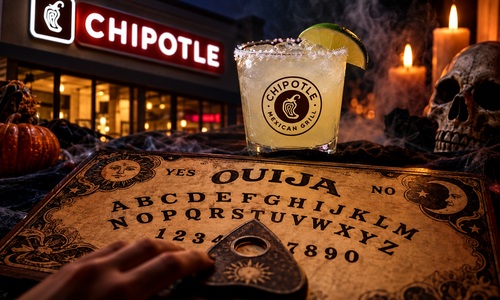
The restaurant chain's limited-time "Summon the Spirits Tour" celebrates the return of its discontinued margarita, complete with promotional imagery featuring a Ouija board and social media messaging about summoning spirits.
To corporate marketers, it's clever wordplay. To many consumers, it's another seasonal joke. But to Christians who take Scripture seriously, it raises a much bigger question: **When did attempting to communicate with spirits become harmless entertainment?**
The concern isn't that Chipotle has literally summoned demons through an advertisement. It's that the imagery of contacting spirits has become so ordinary that many people no longer recognize why Christians should object to it.
And Chipotle is hardly the whole story.
The Bible Doesn't Treat The Occult As A Game
Ouija boards have long been associated with séances, mediums, and attempts to communicate with the dead. Today, they appear in movies, games, social media challenges, and Halloween promotions.
But changing the packaging doesn't change the biblical warning.
Deuteronomy 18:10–12 explicitly condemns divination, sorcery, consulting mediums, and seeking communication with the dead. God describes these practices as detestable because they represent a forbidden pursuit of supernatural knowledge and power.
Leviticus 19:31 warns, "Regard not them that have familiar spirits, neither seek after wizards, to be defiled by them."
Isaiah 8:19 asks a question that remains relevant today: "Should not a people seek unto their God? for the living to the dead?"
These aren't isolated Old Testament warnings. In Acts 19, those who turned to Christ publicly renounced their involvement in magical practices, with many destroying books associated with their former activities.
The biblical pattern is unmistakable: God's people are instructed to seek Him, not attempt to access the spiritual realm through mediums, divination, or occult rituals.
Opening Doors You Were Never Meant To Open
One of the most dangerous assumptions about occult practices is that participation is harmless as long as the person involved doesn't take it seriously.
It's only a game. It's just curiosity. Nobody really believes anything will happen.
But since when has ignorance of spiritual danger made that danger disappear?
The movement of a Ouija board's pointer can often be explained through the ideomotor effect, in which participants make unconscious muscular movements. Not every strange experience is supernatural, and Christians should avoid attributing every unexplained event to demonic activity.
But the central concern isn't whether every Ouija board produces a supernatural encounter. It's the deliberate attempt to communicate with spirits in the first place.
Scripture never suggests that occult experimentation becomes acceptable when participants are laughing, skeptical, or merely curious.
First John 4:1 instructs Christians to test the spirits, while Ephesians 6:12 reminds believers that their struggle includes spiritual forces of evil.
The question isn't whether every Ouija board actually connects someone with a spirit. The question is why anyone would willingly participate in something God has repeatedly warned His people to avoid.
When The Occult Becomes Mainstream Entertainment
The Chipotle controversy reflects a much larger cultural shift.
Tarot readings are increasingly presented as tools for self-discovery. Astrology promises insight into relationships and destiny. Psychic consultations offer supposed contact with deceased loved ones. Spirit guides are promoted in some wellness circles as sources of wisdom.
What previous generations of Christians recognized as occult practices are now frequently repackaged as empowerment, entertainment, or spiritual exploration.
And the marketing is inviting. There is nothing particularly frightening about colorful tarot cards, a fashionable psychic influencer, or a Ouija board appearing in a humorous commercial.
That is precisely why discernment is necessary.
Christians need not believe every Halloween decoration is demonic or that watching a fictional supernatural story constitutes occult participation. There is a meaningful distinction between portraying something and deliberately practicing it.
But when society treats divination, spirit communication, and supernatural guidance as recreational activities, Christians should recognize the danger.
The concern is not simply that people become comfortable with occult imagery. It's that they may eventually become comfortable with the practices themselves.
The Spiritual Battle Most People No Longer Believe Exists
Perhaps the greatest irony is that our increasingly secular culture dismisses biblical warnings about demons while embracing practices built around communicating with unseen spiritual forces.
People who laugh at the suggestion that demonic deception is real may still consult tarot cards, pay psychics for guidance, or attempt to contact deceased relatives.
Second Corinthians 11:14 warns that Satan can disguise himself as an angel of light. Spiritual deception does not always announce itself as evil. Something that appears comforting, enlightening, or benevolent is not necessarily from God.
This is especially important when people seek supernatural reassurance during grief or uncertainty. The desire to hear from a deceased loved one may be understandable, but Scripture directs believers toward God for comfort and truth.
Christians are not called to live in terror of demonic forces. They are called to recognize spiritual danger, resist deception, and remain grounded in Christ.
James 4:7 provides the proper response: "Submit yourselves therefore to God. Resist the devil, and he will flee from you."
Scripture doesn't encourage believers to experiment with spiritual darkness. It tells them to resist it.
A Warning Worth Taking Seriously
Ultimately, the question isn't whether Christians should boycott Chipotle. Individual believers can make that decision according to their convictions.
The bigger issue is what happens when practices explicitly condemned in Scripture become jokes, games, and marketing opportunities.
Parents should be concerned about what children learn from this normalization. Churches must teach clearly about spiritual warfare and discernment rather than leaving believers to learn about the spiritual realm from entertainment and social media.
Chipotle may have intended nothing more than a clever way to sell margaritas. But the broader issue deserves more serious consideration than another round of online outrage.
The occult does not become spiritually harmless simply because someone puts it on a game board, turns it into a social media trend, or uses it to sell a product.
For Christians, the question has never been whether the world considers these things entertaining. The question is whether God considers them acceptable.
And on the subject of seeking contact with spirits and the dead, Scripture has already spoken.