From One Nation Under God To Hail Satan: America's Spiritual Reversal
 By PNW Staff October 08, 2026
Share this article:
Imagine telling Americans fifty years ago that a government meeting in the heartland would one day open with an invocation ending in "Hail Satan"—and that officials would defend the speaker's right to deliver it.
They might have thought you were describing a dystopian novel about America's future.
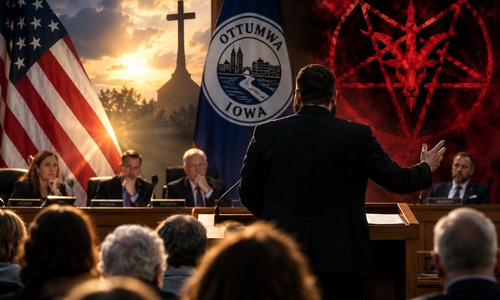
Welcome to Ottumwa, Iowa, in 2026.
On October 6, former city council member Matt Dalbey stood before elected officials and delivered an invocation associated with The Satanic Temple, concluding with those two words: "Hail Satan."
Pastor Rick Bick of New Life Center immediately objected, declaring that the invocation amounted to a curse upon the city. But the city defended its policy of allowing diverse religious viewpoints, explaining that it could not discriminate against particular denominations.
And there, in one extraordinary moment, was a snapshot of America's spiritual transformation.
A nation that once took public acknowledgment of God for granted is now debating whether invoking Satan at city hall is simply another expression of religious diversity.
The controversy isn't really about one invocation in one Iowa town. It's about how far America's spiritual foundations have eroded—and how easily Christians have become accustomed to watching it happen.
The Revolution Didn't Happen Overnight
Nobody woke up one morning and decided America should replace Christianity with Satanism. That isn't what happened, and it isn't necessary for understanding the danger.
The transformation has been slower, more subtle, and arguably more effective.
For decades, Americans have watched battles over prayer in schools, Ten Commandments displays, nativity scenes, and public expressions of biblical morality. Religious traditions once considered ordinary have increasingly become subjects of litigation, controversy, and demands for government neutrality.
Meanwhile, Christianity's influence over American culture has steadily weakened.
Biblical teachings about marriage, sexuality, human life, and moral responsibility are now frequently portrayed as outdated, intolerant, or even harmful. In many influential institutions, the question is no longer whether Christian values should guide society, but whether those values should have any privileged place in public discussion.
And into that vacuum have stepped competing philosophies, ideologies, and spiritual movements.
The result isn't necessarily a society without religion. It's a society increasingly willing to embrace almost anything except the idea that biblical Christianity possesses unique authority.
That's what makes Ottumwa so revealing.
The controversy wasn't over whether the invocation was spiritually appropriate. The official question was whether the city had followed its religious inclusion policy.
A prayer invoking Satan had become an administrative matter.
Satan Doesn't Have To Be Real To Them For The Message To Be Real
Defenders of The Satanic Temple frequently point out that its members generally don't believe in a literal Satan.
That's true. The organization describes itself as nontheistic, presenting Satan as a symbol of rebellion against arbitrary authority.
But consider the implications.
Of all the symbols available to represent freedom, independence, or resistance, the organization deliberately chose the figure Christianity identifies as the enemy of God.
That choice is not accidental.
The Satanic Temple has pursued campaigns involving public invocations, religious displays, and After School Satan Clubs, frequently seeking access to spaces where Christian religious expression has already been permitted.
Its strategy uses the language of religious equality to challenge Christianity's historic position in public institutions.
The objective is not necessarily to persuade Americans to worship a literal devil. It is to force a confrontation over whether Christian expression deserves any special standing in public life.
And the symbolism is powerful precisely because Christians understand what Satan represents.
For Christians, Satan is not a mascot for individual liberty. Scripture describes him as a deceiver, a destroyer, and the adversary of God.
Calling him a metaphor does not erase the meaning of deliberately invoking his name.
Imagine a society so disconnected from its Christian heritage that the invocation of Satan is treated as harmless symbolism while biblical teachings are increasingly regarded as dangerous.
That is the cultural contradiction worth examining.
Religious Freedom Is Not The Same As Spiritual Neutrality
There is an important constitutional reality here.
The First Amendment protects the religious freedom of Christians, atheists, Satanists, and everyone else. A city that opens its invocation program to diverse beliefs generally cannot exclude someone simply because officials find the message offensive.
Christians should defend that principle. Government power used to silence an unpopular religious viewpoint today can be used against biblical Christianity tomorrow.
But something deeply troubling happens when legal neutrality becomes the measure of a society's spiritual health.
A government may be required to permit an invocation without endorsing it. That does not mean citizens must pretend every invocation carries the same spiritual meaning.
The law can recognize equal rights without declaring all beliefs equally true.
And Christians should not confuse the two.
America's founders established protections against government-imposed religion. They did not establish a moral universe in which truth and falsehood, good and evil, and God and Satan become interchangeable simply because the government must protect freedom of conscience.
Yet that is the temptation of modern secular culture: to treat every religious claim as a personal preference that must never be judged against any higher standard.
The Christian response cannot be to demand that government impose biblical faith. But neither can it be to surrender the conviction that biblical truth is actually true.
The Real Crisis Is Bigger Than Satanism
Here is the uncomfortable question churches need to confront:
How did America become a country where the public invocation of Satan can generate less institutional concern than the possibility of offending someone by condemning sin?
Consider the larger cultural environment.
Christian beliefs about marriage and sexuality are increasingly challenged in schools, workplaces, and public institutions. Biblical convictions are frequently labeled discriminatory. Churches face pressure to adapt their teachings to contemporary social expectations.
At the same time, Satanic imagery has become familiar in entertainment, fashion, and public activism. What once would have shocked mainstream audiences can now be defended as satire, art, or political expression.
These developments are not identical, and they do not prove some coordinated campaign to make America Satanic.
They reveal something more fundamental: a culture losing confidence in the moral framework that once helped define it.
And perhaps the most dangerous part is how ordinary it has become.
Yesterday's outrage becomes today's controversy. Today's controversy becomes tomorrow's accepted practice.
Eventually, people stop asking whether something is right and begin asking only whether it is permitted.
That is not spiritual progress.
It is what happens when a society becomes increasingly unwilling to distinguish between moral freedom and moral truth.
Isaiah's Warning Is Becoming Harder To Ignore
The prophet Isaiah issued a warning that should make modern Christians deeply uncomfortable:
"Woe unto them that call evil good, and good evil; that put darkness for light, and light for darkness." — Isaiah 5:20
Those words were not written specifically about America, and they should not be manipulated into a prediction about an Iowa city council meeting.
But the principle is unmistakable.
A society can become so confused about morality that it no longer recognizes the seriousness of what it once condemned.
Romans 1 describes humanity exchanging the truth of God for a lie. Second Timothy 3 warns of people who possess a form of godliness while denying its power.
For Christians, these passages are not merely descriptions of an unbelieving world. They are warnings about the consequences of rejecting God's authority.
And the danger is not confined to city halls or secular institutions.
It reaches into churches that have become reluctant to preach repentance, pastors who avoid difficult biblical teachings, and Christians who increasingly measure truth by cultural acceptance.
If the church itself loses confidence in Scripture, why should anyone be surprised when the surrounding culture does the same?
The greatest threat to Christianity in America may not be the growing boldness of its opponents.
It may be the growing timidity of its defenders.
America Doesn't Need More Outrage. It Needs Conviction.
Pastor Rick Bick refused to let the invocation pass without objection. His timing sparked controversy, but his reaction reflected a conviction increasingly absent from American public life: that spiritual matters are not merely symbolic exercises.
Not every Christian needs to respond as he did. But every Christian should understand why the moment was significant.
The early church confronted a Roman world filled with competing religions, false gods, and practices fundamentally opposed to biblical teaching.
The apostles did not respond by demanding that every pagan temple be shut down. They proclaimed Christ, exposed falsehood, called people to repentance, and accepted the consequences of refusing to compromise.
That is a model worth remembering.
Christians do not need government protection from every offensive expression. They need the courage to defend religious liberty while refusing to surrender biblical truth.
They need pastors willing to preach the whole counsel of God, parents willing to teach their children what Scripture says, and believers willing to stand against cultural pressure without abandoning love for their neighbors.
Because America's spiritual decline did not begin when someone said "Hail Satan" at a city council meeting.
It began long before that, as biblical authority was increasingly pushed aside, Christian convictions became negotiable, and cultural acceptance replaced faithfulness as the measure of what churches were willing to say.
Ottumwa didn't create America's spiritual crisis.
It exposed it.
The words "Hail Satan" may have lasted only a few seconds inside that council chamber. But the question they raise will remain long after the controversy fades.
America still prints "In God We Trust" on its currency. It still pledges allegiance as "one nation under God."
But when the nation can hear "Hail Satan" from the podium of a government meeting and treat it as simply another acceptable invocation, Christians must ask whether those familiar references to God still reflect the nation's convictions—or have become little more than echoes of a faith it is leaving behind.