More Than Entertainment: Who You Support Matters
 By PNW Staff September 03, 2026
Share this article:
For most people, buying a concert ticket or streaming a favorite song doesn't feel like a political act. You like the music, enjoy the artist and pay for the entertainment. End of story.
Except increasingly, it isn't.
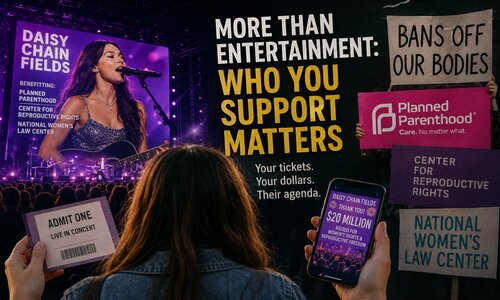
Pop superstar Olivia Rodrigo provided a striking example when her Daisy Chain Fields festival reportedly raised $10 million for organizations including Planned Parenthood, the Center for Reproductive Rights and the National Women's Law Center. Melinda French Gates then matched the funds, bringing the total to an astonishing $20 million.
Rodrigo wasn't hiding the purpose. The festival combined entertainment with activism, giving organizations an opportunity not only to receive money but also to communicate their causes to a massive audience of predominantly young music fans.
That raises an uncomfortable question Christians don't often ask:
Where do our entertainment dollars ultimately go?
More Than Just Olivia Rodrigo
It would be easy to dismiss this as one celebrity using her fame for causes she believes in. But Rodrigo is hardly alone.
Ariana Grande donated roughly $250,000 in proceeds from an Atlanta concert to Planned Parenthood during the battle over Georgia's abortion restrictions. Billie Eilish and Megan Thee Stallion have used prominent festival appearances to support Planned Parenthood's abortion-rights campaigns, while artists including Lady Gaga, Miley Cyrus, Dua Lipa, John Legend and others have publicly joined campaigns opposing abortion restrictions.
More recently, Planned Parenthood partnered with Florence + the Machine affiliates at multiple U.S. tour stops, providing opportunities to interact directly with concertgoers.
This represents something larger than celebrities occasionally making political statements.
The modern entertainment industry has become one of America's most powerful engines for cultural activism. Concert stages, festivals, merchandise, social-media accounts and celebrity fan communities can all become vehicles for advancing political and moral causes.
And the people financing that enormous cultural machine are the fans.
Your Entertainment Dollars Have A Destination
Christians understand this principle in other areas.
We carefully consider which ministries we support. Many Christians investigate charities before donating because they want to know how their money will be used. Churches examine organizations before forming partnerships, while parents may scrutinize schools and programs before financially supporting them.
Yet entertainment often receives a cultural exemption.
We may spend hundreds or thousands of dollars on concert tickets, subscriptions, merchandise and entertainment without giving much thought to what the artists and corporations receiving that money actively promote.
This doesn't mean that purchasing one song makes someone personally responsible for everything an artist believes. Christians live and conduct business in a fallen world, and attempting to create a perfectly ideologically pure economy would be impossible.
But there is a difference between incidental participation in the marketplace and knowingly pouring money, attention and influence into people who openly use those resources to advance causes directly contrary to biblical convictions.
That distinction deserves consideration.
When Pop Stars Become Political Missionaries
Money, however, may not even be the biggest issue.
Influence is.
Today's celebrities aren't simply selling albums. They are selling identities, values and worldviews to millions of young people who may feel deeply connected to them.
A politician standing behind a podium telling teenagers to support Planned Parenthood may have limited influence. A beloved singer delivering that same message between songs to thousands of cheering fans can have an entirely different effect.
Celebrity culture creates emotional connections. Fans follow what stars wear, what they eat, whom they date, what products they use and increasingly what causes they support.
That makes celebrities extraordinarily effective cultural missionaries.
The message doesn't arrive as a sermon or political advertisement. It comes wrapped in music, fashion, entertainment and belonging.
For Christian parents especially, that reality deserves attention. The question isn't simply, "Are there bad words in this song?" We should also be asking what worldview surrounds the artist our children admire and whether admiration for that person is gradually creating openness to ideas we would never intentionally teach them.
The New Activists Are On Stage
Political activism once revolved primarily around political parties, advocacy organizations and demonstrations. Those institutions still matter, but cultural influence increasingly travels through entertainment.
Abortion is only one example. Celebrities routinely weigh in on sexuality, gender, climate policy, race, immigration, Israel and virtually every other major cultural controversy.
This is why Christians need discernment rather than panic.
Scripture doesn't provide a list of approved musicians, actors or streaming services. It gives us something more demanding: principles requiring believers to exercise wisdom.
Paul wrote, "All things are lawful for me, but all things are not expedient" (1 Corinthians 10:23).
That principle forces us beyond asking merely, "Am I allowed to do this?"
A more mature question is, "What am I helping build?"
Who You Support Matters
Christians rightly complain about the direction of American culture, but culture doesn't develop in a vacuum. It is built through billions of individual choices about what we watch, buy, celebrate, normalize and financially support.
Olivia Rodrigo has every legal right to support Planned Parenthood, just as other celebrities have the right to promote the causes they believe in.
Christians likewise have the right--and responsibility--to decide whether they want to help finance and amplify those voices.
Entertainment isn't always just entertainment anymore.
Sometimes your concert ticket helps fund a movement. Sometimes your favorite celebrity becomes an activist. Sometimes the stage becomes a political platform, and sometimes the audience becomes the target of a cultural campaign.
We don't need to retreat from culture, but neither should we consume it blindly.
Because in an age when entertainment, politics and activism increasingly overlap, who you support really does matter.