
After Trump - Middle East Nations Already Plotting Next Moves
 By PNW Staff September 01, 2026
Share this article:
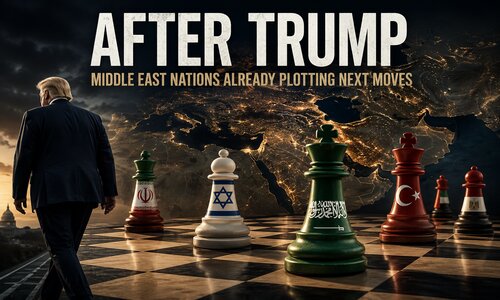
Donald Trump may be the most powerful player on the Middle Eastern chessboard today, but virtually every government in the region understands something that could ultimately prove more important: Trump has an expiration date.
January 20, 2029.
Israel knows it. Turkey knows it. Saudi Arabia knows it. Qatar knows it. Iran knows it. Hamas certainly knows it.
That reality may help explain some of the seemingly contradictory maneuvering now taking place across the Middle East. Governments are negotiating with Trump, accommodating Trump and attempting to extract concessions from Trump. At the same time, they are positioning themselves for the possibility that America's next president could dramatically change the rules of the game.
They don't necessarily have to defeat Trump's policies.
Some may simply have to survive them.
Everyone Is Playing The Clock
This is particularly important because the Middle East Trump inherited has become even more volatile.
The war with Iran has shaken confidence in traditional security arrangements, while Turkey, Saudi Arabia and Pakistan have now established the Mecca Joint Defence Agreement. Their first high-level meeting under the pact is taking place as all three countries reassess their security requirements in an increasingly unstable region.
Meanwhile, Gaza remains unresolved.
The original promise was that Hamas would be disarmed and a new governing structure would emerge. Yet the process has dragged on, while Turkey, Qatar and Egypt have become increasingly important intermediaries in determining Gaza's future.
For Hamas, delay may itself represent victory.
Hamas does not necessarily need to defeat Israel militarily. If it can preserve enough fighters, weapons, financial networks and political influence to remain relevant until America's political environment changes, its prospects could look considerably different.
Iran may be calculating similarly.
Tehran has suffered enormously during its confrontation with America and Israel, yet the regime remains standing. Fighting erupted again this weekend when U.S. forces struck Iranian rocket launchers near the Strait of Hormuz.
Iran therefore has every reason to watch the American calendar.
Why make concessions today if Tehran believes a future administration might offer negotiations on more favorable terms?
Then There Is Erdogan
Turkey may be playing the longest game of all.
President Recep Tayyip Erdogan can maintain his relationship with Trump while strengthening Turkey militarily, expanding its influence in Syria, participating in Gaza diplomacy and building new strategic relationships with Saudi Arabia and Pakistan.
The critical point is that these relationships could survive Trump.
The original article raises exactly this concern regarding the possibility of Turkey eventually receiving American F-35s. Presidents come and go. Advanced fighter aircraft don't.
The same principle applies to Saudi Arabia's nuclear ambitions. Nuclear infrastructure constructed during Trump's presidency could remain for decades.
That means Washington isn't simply negotiating agreements for 2026.
It may be constructing the strategic environment of 2036.
The Democratic Wildcard
Then comes the variable every Middle Eastern capital will increasingly be watching: America's 2028 presidential election.
It would be foolish to assume that every Democratic president would abandon Israel or return automatically to Obama's Middle East policies. Democrats themselves remain deeply divided over Israel.
But the direction of the debate is unmistakable.
Forty-five members of the Senate Democratic caucus recently signed a letter sharply criticizing Israeli policies in the West Bank, while some Democrats have advocated restrictions or an outright halt to American military assistance to Israel.
Potential 2028 Democratic presidential contender Rahm Emanuel has gone further. Although he argues Democrats can remain pro-Israel, Emanuel recently warned Israelis that the current U.S.-Israel relationship cannot continue unchanged and proposed ending what he described as America's subsidy of Israel's defense budget.
Meanwhile, the Democratic grassroots are shifting as well. Candidates associated with the movement that protested Democratic support for Israel during the Gaza war have scored notable victories in 2026 Democratic primaries.
Turkey, Qatar, Iran and Hamas don't need to know who the Democratic nominee will be to recognize the possibilities.
A Democratic victory could potentially mean greater pressure for Palestinian statehood, restrictions on Israeli military operations, renewed diplomacy with Iran and greater willingness to pressure Jerusalem.
That possibility has strategic value right now.
Israel Has The Opposite Problem
For Israel, the clock runs in the other direction.
Jerusalem cannot assume it will enjoy the same freedom of action indefinitely.
That creates powerful incentives to resolve as many strategic threats as possible while Trump remains president: Hamas in Gaza, Iranian military capabilities, Hezbollah's remaining infrastructure and Turkey's expanding presence in Syria.
Everyone else can potentially wait.
Israel may believe it cannot.
And that could make the next two years considerably more dangerous.
Trump wants to remake the Middle East before he leaves office. Erdogan wants Turkey positioned for whatever comes afterward. Saudi Arabia wants maximum strategic independence. Iran wants to survive. Hamas wants to endure. Qatar wants to remain indispensable.
Israel wants threats removed while Washington is still willing to let it remove them.
All of them are watching the same clock.
Because the most important question shaping the Middle East may no longer be what Donald Trump does next.
It may be what everyone else intends to do when he is gone.