
The Coming Education Crisis: Welcome To The Age Of Artificial Education
 By PNW Staff August 27, 2026
Share this article:
School has just started--or is about to start--in many parts of America, and over the next several months we may discover just how deeply artificial intelligence has changed the next generation of students. By virtually every early warning sign, the news is not encouraging.
For the past few years, educators have worried primarily about students using ChatGPT and other AI systems to cheat. Would teenagers have AI write their essays? Would college students use it to complete homework? Could professors determine whether an assignment was actually written by the person whose name appeared at the top?
Those problems haven't disappeared, but an even more troubling question is emerging: If artificial intelligence increasingly does the work required to earn an education, what exactly does an education certify anymore?
For generations, a diploma theoretically demonstrated that a student had learned how to read difficult material, research a subject, organize information, solve problems, construct an argument and communicate ideas. Artificial intelligence potentially disrupts that entire arrangement.
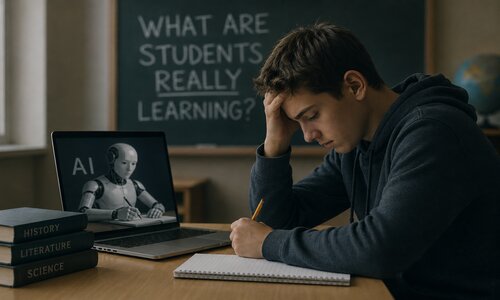
A student can now ask AI to summarize the book he didn't read, explain the historical event he didn't study, solve the problem he didn't understand, construct the argument he didn't develop and write the paper he never really thought about. The final product might look excellent, but who was actually educated?
The Struggle Was The Education
This is where the AI revolution is forcing educators to confront an uncomfortable reality: the difficult part of education was never an inconvenience technology needed to eliminate. The difficult part was the education.
Students struggle to find the right words because doing so teaches them how to communicate. They wrestle with conflicting evidence because that teaches them how to evaluate information. They rewrite paragraphs because rewriting forces them to clarify what they actually believe.
Cognitive psychologist Ronald Kellogg has described writing as a technology for thinking. Writing isn't simply transferring fully formed thoughts onto paper. Very often, we discover what we think while attempting to explain it. Remove that struggle and you may remove part of the thinking.
Research from MIT has provided an unsettling glimpse of what that could mean. Researchers studying essay writers found that participants using large language models demonstrated substantially weaker brain connectivity than those writing without technological assistance. AI users also had greater difficulty accurately recalling or quoting what they had supposedly written.
The researchers cautioned against drawing sweeping conclusions from one study, but the findings raise an obvious question parents and educators cannot afford to ignore: What happens when millions of children routinely outsource the mental exercises their developing minds are supposed to be practicing?
Imagine sending a teenager to the gym every afternoon but allowing a robot to lift the weights for him. The weights still went up, but nobody would expect the teenager to become stronger. Something remarkably similar may be happening academically.
Schools Are Already Retreating
Schools and universities increasingly recognize that something has changed. Some educators are returning to handwritten assignments, oral examinations, restricted devices and supervised testing because instructors need some reliable way of determining what students themselves actually know.
Princeton University provides a striking example. For more than a century, its famous Honor Code allowed students to take examinations without faculty proctors. In 2026, faculty voted to begin proctoring in-class examinations amid concerns about modern forms of cheating, including generative AI and electronic devices.
Individual courses are going further. Some professors prohibit AI precisely because they want students to develop the ability to reason through problems themselves. That gets to the heart of the issue: an AI system can produce an impressive answer that a student may be completely incapable of explaining.
And that creates a much bigger problem than cheating.
What Does The Diploma Mean?
Suppose a student completes high school and college while routinely using AI to research, outline, compose, edit and solve assignments. That student may graduate with impressive grades, but what abilities actually belong to the graduate and what abilities belonged to the machine?
Employers may eventually begin asking the same question.
A college degree traditionally functions partly as a signal that someone has demonstrated a certain level of competence. But that signal becomes weaker if employers cannot determine how much of the graduate's academic performance was AI-assisted.
Ironically, the AI revolution could therefore produce a return to decidedly old-fashioned methods of proving competence. Employers may increasingly rely upon supervised testing, live problem-solving, in-person writing, technical demonstrations and extensive interviews.
Instead of trusting a diploma or résumé, employers may essentially say: Don't tell me what your credentials say you can do. Show me what you can actually do while I'm watching.
Education could then face an extraordinary credibility crisis. Americans have spent decades debating whether college degrees justify their soaring price. Artificial intelligence introduces another question entirely: What exactly are universities certifying?
The Consequences Go Far Beyond School
Today's students will eventually become tomorrow's doctors, engineers, teachers, journalists, lawyers, pastors, military officers, business executives and government leaders. Those professions require far more than access to information. They require judgment.
A doctor must evaluate competing possibilities. A lawyer must recognize weaknesses in an argument. An engineer needs to understand why something works rather than merely obtain an answer. A pastor must wrestle carefully with Scripture rather than simply request an instant interpretation from an algorithm.
The danger isn't that artificial intelligence knows too much. It is that human beings may gradually decide they don't need to know very much because a machine will always be available to provide the answer.
We could conceivably create the most information-rich and technologically empowered generation in history while simultaneously producing one of the most intellectually dependent.
Christians Should Pay Attention
None of this means Christians should reject artificial intelligence. AI can assist research, explain difficult concepts, improve communication and provide capabilities that would have seemed impossible only a few years ago. The question is whether AI remains a tool that assists human thought or becomes a substitute for it.
Scripture repeatedly calls believers to wisdom, understanding and discernment. Christians are instructed to test what they hear and distinguish truth from error. Those abilities cannot simply be outsourced to an algorithm.
Parents therefore need to ask more than whether their child's school permits ChatGPT. Can their children still read something difficult and explain it? Can they defend an opinion, identify a weak argument, write coherently without assistance and solve a problem when AI isn't available?
Perhaps most importantly, can they determine what they actually believe before asking an algorithm what they should believe?
As students return to classrooms this fall, America is conducting an educational experiment on an enormous scale. Artificial intelligence can provide our children with more information and more answers than any previous generation possessed, but education was never simply about obtaining answers. It was about developing human beings capable of finding, understanding and evaluating them.
If we lose that distinction, we may eventually produce beautifully written assignments, impressive transcripts and expensive degrees while quietly discovering that something essential disappeared along the way.
We will have perfected artificial education--and forgotten to educate the human mind.