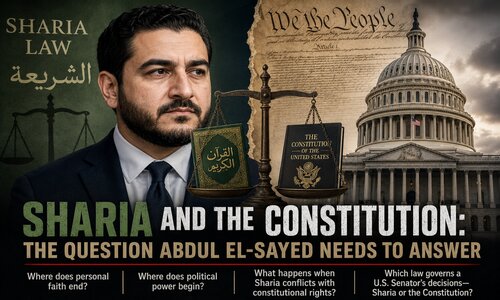
Sharia And The Constitution: The Question Abdul El-Sayed Needs To Answer
 By PNW Staff August 20, 2026
Share this article:
Abdul El-Sayed has attracted national attention after invoking Jesus Christ while defending political ideas critics describe as radical.
“Jesus, peace and blessings be upon him, was considered radical in his time too,” the Democratic nominee for Michigan's U.S. Senate seat recently said.
But whether a Muslim politician accurately understands Jesus is not the most consequential question surrounding El-Sayed's faith.
There is another question that reaches directly into the responsibilities of public office:
What role does Sharia play when a politician who considers it an obligation before God is making laws for Americans who do not believe in it?
That question deserves an answer because El-Sayed has previously described his adherence to Sharia in unusually serious terms.
While discussing his decision to obtain Sharia-compliant financing in a 2009 interview, El-Sayed explained:
“When I die, and I stand before God and go through everything I did in my life, I don't want to say I did it the easy way instead of the Sharia-compliant way.”
Then came the important part:
“Not because of fear but because of obligation.”
That isn't casual cultural identification.
It describes a religious conviction El-Sayed believes he will ultimately answer to God for.
Americans therefore have every right to ask what happens when that conviction enters the United States Senate.
Sharia Isn't Just About Prayer And Diet
This is where the discussion needs to become more serious.
Many Americans hear “Sharia” and imagine something roughly equivalent to Christian rules about prayer, fasting or personal morality.
For millions of Muslims, much of Sharia observance is indeed personal: prayer, fasting, dietary restrictions, charitable giving and financial practices.
But historically, Islamic jurisprudence has also addressed matters that Western societies place firmly within civil and criminal law.
Depending upon the country and interpretation, Sharia-based legal systems have addressed marriage, divorce, inheritance, financial transactions, sexual conduct, blasphemy, apostasy, criminal punishment and the legal status of religious minorities.
That doesn't mean every Muslim supports every such application.
But it does explain why asking a prospective United States senator exactly what he means by following Sharia isn't prejudice.
It is basic democratic accountability.
Because the question isn't whether El-Sayed should be allowed to practice Islam.
The question is whether any portion of Islamic jurisprudence could influence how he exercises governmental power.
America Has Seen What Happens When The Line Moves
Around the world, countries incorporating Sharia principles into their legal systems demonstrate why that distinction matters.
Pakistan has notoriously used blasphemy laws against religious minorities, including Christians. Iran's Islamic system imposes religiously grounded restrictions touching everything from public morality to conversion and political dissent. Saudi Arabia's legal system has historically drawn extensively upon Islamic jurisprudence.
Egypt's constitution declares Islam the state religion and identifies the principles of Islamic Sharia as the principal source of legislation.
These countries aren't identical. Neither are their interpretations of Islam.
They illustrate something Americans cannot afford to ignore:
Once religious doctrine moves from voluntary personal conviction into governmental authority, the rights of people who reject that doctrine can become vulnerable.
That is precisely why America's constitutional system matters.
El-Sayed Says He Supports Church-State Separation
El-Sayed has publicly said that he believes in the separation of religion and government.
General assurances about religious liberty are easy.
The difficult questions concern specific conflicts.
Would El-Sayed oppose any restriction on speech simply because Muslims regard that speech as blasphemous?
Would he unequivocally defend the right of a Muslim American to leave Islam and convert to Christianity?
Would he protect Christians who publicly preach that Islam is false and that salvation exists only through Jesus Christ?
Would he reject any attempt to give Islamic religious principles governmental authority over marriage, inheritance or family law?
Would he defend the same freedom for criticism of Muhammad and the Quran that Americans possess to criticize Christianity and the Bible?
And most importantly:
If his understanding of Sharia conflicted with the constitutional liberties of another American, which one wins?
Those are the questions that reveal where the boundary actually lies.
The Constitution Must Come First In Government
America doesn't require politicians to abandon their faith.
But there is an enormous difference between allowing faith to inform someone's moral worldview and granting a religious legal system governmental authority.
The Constitution protects El-Sayed's right to follow Sharia.
The same Constitution protects another American's right to reject Sharia, criticize Sharia, leave Islam, evangelize Muslims and proclaim beliefs Islam considers profoundly offensive.
That distinction cannot become negotiable.
And this is where Christians especially should pay attention.
Religious liberty isn't merely the freedom to worship quietly inside a building.
It includes the freedom to preach doctrines others consider offensive, change religions, evangelize, criticize competing religious claims and refuse religious requirements one does not believe.
Once government begins protecting religious doctrines from criticism—or allowing religious law to determine another person's civil liberties—the foundation has shifted.
This Is The Question El-Sayed Needs To Answer
El-Sayed's statement that Sharia represents an “obligation” before God may demonstrate sincere religious commitment.
But sincerity isn't the issue.
Political power is.
A senator doesn't merely live according to his own convictions. He votes on laws affecting more than 330 million Americans of radically different beliefs.
That makes the dividing line between personal religious conviction and governmental authority critically important.
El-Sayed should therefore be asked something far more substantial than why he called Jesus radical:
Which parts of Sharia do you believe are binding only upon yourself, and are there any principles of Sharia that you believe should influence American law or governmental policy?
Then comes the question that matters most:
If Sharia and the constitutional rights of an American ever come into conflict in your exercise of public power, will the Constitution always prevail?
America's experiment in religious liberty depends upon the answer.