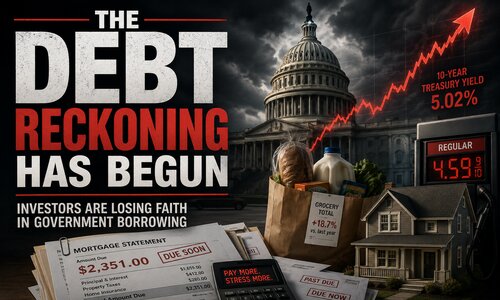
The Debt Reckoning Has Begun: Investors Are Losing Faith In Government Borrowing
 By PNW Staff August 19, 2026
Share this article:
For years, governments around the world have behaved as though there were almost no consequences for borrowing more money.
When revenues fell short, they borrowed. When economies weakened, they borrowed. When wars erupted, they borrowed. When voters demanded new programs that governments could not afford, they borrowed again.
The assumption was simple: someone would always be willing to lend the money at a manageable interest rate.
That assumption is beginning to look increasingly dangerous.
Global bond markets were rocked this week as the cost of long-term government borrowing surged across the United States, Britain, France, Japan and other major economies. In America, the yield on the 30-year Treasury briefly climbed above 5.33 percent, its highest level since 2007, while the benchmark 10-year yield approached 4.75 percent. Japan's 10-year government borrowing cost reached a 30-year high.
The immediate triggers include renewed inflation fears, higher oil prices stemming from the conflict with Iran and an extraordinary wave of corporate borrowing associated with the artificial-intelligence boom.
But those may simply be exposing a much deeper problem.
Governments have accumulated enormous amounts of debt, and investors increasingly want to be paid more for the risk of lending to them for decades.
What The Bond Market Is Actually Saying
For people who do not follow financial markets, "bond yields" can sound like something that only matters on Wall Street.
It is actually much simpler.
When the government needs money, it borrows by selling Treasury securities. Investors lend Washington money, and Washington promises to pay them interest.
The question is: How much interest will investors demand?
When investors feel highly confident about inflation, government finances and the future value of their money, they may accept relatively low returns.
When they become less comfortable, they demand more.
That is what makes today's movement significant.
Investors are not refusing to lend governments money. Instead, they are effectively saying:
If you want to borrow our money for the next 20 or 30 years, it is going to cost you more.
Reuters reports that mounting U.S. debt and persistent deficits are increasingly contributing to investors demanding higher returns to hold long-term government bonds.
That can become a serious problem when the borrower is already deeply in debt.
America Is Approaching $40 Trillion
The United States entered 2026 with federal debt already measured in the tens of trillions. Treasury and Federal Reserve data showed total federal debt above $39 trillion earlier this year, putting the psychologically significant $40 trillion threshold within reach.
But the amount of debt is only half the story.
The other half is what America must pay to carry it.
Imagine a homeowner with an enormous mortgage. If the interest rate is 2 percent, the payments may be manageable. Refinance that enormous balance at 5 percent, however, and suddenly interest consumes much more of the household budget.
Governments face the same basic mathematics.
Washington does not refinance all of its debt overnight. But old Treasury securities constantly mature and new ones must be issued. As more debt is refinanced at today's higher rates, federal interest expenses can continue climbing.
That means more taxpayer dollars must be devoted simply to servicing yesterday's borrowing before government pays for defense, Social Security, Medicare, infrastructure or anything else.
And that creates a dangerous cycle:
More debt leads to larger interest payments.
Larger interest payments contribute to larger deficits.
Larger deficits require more borrowing.
And if investors become increasingly worried about that borrowing, they may demand even higher interest rates.
Why Should The Average Family Care?
This is where the bond market leaves Wall Street and enters your living room.
Treasury yields act as a foundation for borrowing costs throughout the economy. When long-term Treasury rates rise sharply, mortgages and many other types of credit tend to become more expensive as well.
Mortgage rates have already been under renewed upward pressure. Earlier this month, average 30-year mortgage rates were around 6.8 percent after climbing sharply from June levels.
For a family trying to buy a house, even a one-percentage-point difference in a mortgage rate can mean hundreds of dollars more every month.
Higher borrowing costs can also affect:
Car loans and consumer credit. Banks must price loans according to the broader interest-rate environment.
Businesses. Companies borrowing money to build factories, purchase equipment or open new locations face higher costs.
Jobs. When financing becomes too expensive, businesses may delay expansion, reduce hiring or cut costs.
Retirement accounts. Rising bond yields can pressure stock valuations because investors suddenly have a more attractive alternative to stocks. That can create volatility in 401(k)s and retirement portfolios.
Housing prices. If fewer families can afford mortgages, housing demand can weaken.
Taxes and government services. The more Washington spends paying interest, the less flexibility it has elsewhere. Eventually politicians face unpleasant choices: higher taxes, spending cuts, still more borrowing--or some combination of all three.
There is another indirect danger: inflation.
If governments become trapped between enormous debts and high interest costs, political pressure inevitably grows for central banks and policymakers to make financing easier. History repeatedly shows how tempting it can become to tolerate inflation rather than impose painful fiscal discipline.
Either way, ordinary citizens eventually pay.
What Happens When The Next Crisis Arrives?
Perhaps the most troubling question is not what happens today.
It is what happens during the next emergency.
Governments responded to the 2008 financial crisis with enormous intervention and borrowing.
They responded to COVID with trillions more.
Wars, recessions and energy crises routinely produce still more government spending.
That strategy works much better when governments enter a crisis with strong finances and inexpensive access to credit.
It becomes considerably more dangerous when they enter one already heavily indebted.
The current bond-market turmoil is demonstrating precisely that vulnerability. Countries carrying heavy debt burdens and large deficits are proving especially sensitive to inflation and geopolitical shocks, while investors increasingly demand additional compensation for holding their long-term debt.
The Iran conflict may eventually cool.
Oil prices may fall.
The current bond selloff may even reverse temporarily.
But none of those developments erase the underlying debt.
For decades, politicians across the developed world discovered that borrowing allowed them to promise benefits today while pushing the cost into tomorrow.
Tomorrow may finally be arriving.
The debt reckoning does not necessarily begin with a dramatic government default or financial collapse.
It may begin much more quietly-with investors simply saying:
We will still lend you the money. But from now on, you're going to pay a lot more for it.
And ultimately, governments do not pay that bill.
Their citizens do.