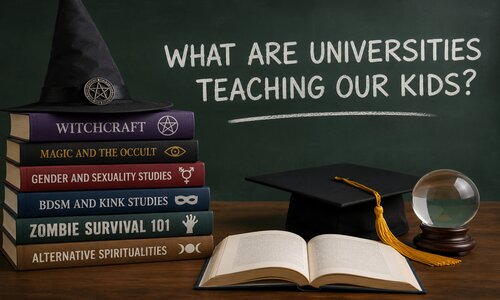
Witchcraft, Zombies & Sexual Ideology: What Are Universities Teaching Our Kids?
 By PNW Staff August 11, 2026
Share this article:
Parents preparing to send their children back to college this fall might want to spend a little less time studying dorm-room dimensions and a little more time studying the course catalog.
Because the modern university catalog can be an education all by itself.
At Arizona State University, professor Owen Anderson recently examined the Fall 2026 offerings and reported something remarkable: eight courses had witchcraft, magic, or the occult in their titles, compared with just one containing Christianity.
The obvious response is that universities study everything.
Fair enough.
A class about witch trials can be legitimate history. A course examining occult movements can tell us something important about civilization. Christianity itself cannot be understood historically without studying paganism, heresies, competing religions and the spiritual movements that surrounded it.
But that explanation becomes less convincing when you look beyond ASU and see where portions of higher education have been heading.
This is no longer simply a professor teaching the Salem witch trials.
Welcome To The New Course Catalog
Harvard Extension School has offered coursework devoted to contemporary magic, including Wicca, chaos magic, New Age spirituality and modern esotericism.
MIT has offered Magic, Witchcraft, and the Spirit World, examining spirits, mystical dangers and supernatural beliefs primarily in Europe and North America.
The University of Massachusetts Amherst has offered coursework examining witches and witchcraft that included contemporary Wiccan practices and readings approaching witchcraft from feminist and neo-pagan perspectives.
Michigan State University's catalog has included Magic and Mysticism: An Introduction to Esoteric Religion, surveying alchemy, magic, mysticism and secret or semi-secret organizations.
And in 2026, students at Onondaga Community College in the SUNY system can take Magic, Witchcraft and Religion, studying witchcraft, sorcery, shamanism, magical systems and indigenous religious practices for general-education credit.
Then things get considerably more explicit.
Princeton has offered Black Queer Leather: Black Leather/BDSM Material Culture, focusing on Black queer BDSM communities and their material culture.
California State University, Stanislaus lists Pornography and Human Sexuality, asking students to analyze pornography in relation to modern society, family and sexuality.
Rutgers has listed Gender and the Body: Representation and Pornography* among its Women's, Gender and Sexuality Studies offerings.
Other universities have offered coursework examining subjects such as public sex, pornography, hooking up, kink, BDSM, polyamory and consensual non-monogamy.
Again, the issue is not that universities must never discuss these things.
The question is why these things have become such significant objects of academic specialization.
And Then There Are The Courses That Sound Like Satire
Some university offerings leave ideology behind altogether and enter territory that sounds like something invented by a comedian.
Stony Brook University is offering a three-credit course in 2026 called Zombiology: What the Walking Dead Can Teach Us About Real Humans.
Stanford has listed How to Avoid the Walking Dead: Understanding Biosafety.
But perhaps the prize belongs to the University of Central Florida, whose course Mummies, Zombies and Vampires: Anthropology of the Undead included among its stated learning outcomes the ability to demonstrate knowledge of survival techniques in the event of "vampire nesting, a zombie-pocalypse, or mummy resurrection."
Yes, apparently somewhere along the road to earning a university degree, preparing for mummy resurrection became an academic learning objective.
At some point, parents writing tuition checks are entitled to ask a very basic question:
Are we preparing the next generation for adulthood--or for an exceptionally well-credentialed zombie apocalypse?
Universities Don't Just Transfer Knowledge
Every curriculum makes judgments.
There are only so many professors, classrooms, credit hours and millions of dollars available. When a university creates a course, hires specialists, establishes departments and allows classes to satisfy degree requirements, it is declaring that a subject deserves institutional attention.
And increasingly, American higher education appears fascinated with overturning boundaries.
Traditional morality becomes something to interrogate.
Traditional sexuality becomes something to deconstruct.
Gender becomes fluid.
Pornography becomes a field of inquiry.
BDSM becomes material culture.
Witchcraft becomes an alternative spiritual tradition worthy of extensive examination.
And zombies apparently require contingency planning.
Christianity, meanwhile, is frequently approached not primarily as the civilization-shaping faith that produced many of the institutions and assumptions underlying Western education, but through categories such as power, patriarchy, colonialism, gender, sexuality and oppression.
That imbalance matters.
Christianity profoundly shaped Western law, ethics, literature, art, music, philosophy, concepts of human dignity, charitable institutions and the development of the university itself.
One could easily justify entire departments devoted simply to understanding its influence on Western civilization.
Yet parents increasingly encounter catalogs offering astonishingly specialized explorations of marginal sexual identities, occult traditions and pop-cultural curiosities while foundational knowledge of Christianity, the Bible and Western civilization steadily retreats.
This Is About Formation
Universities will insist that education is about exposing students to different ideas.
Good.
Then expose them to all of them.
Discuss modern sexual ideology--but let students encounter the strongest intellectual arguments for marriage, family, chastity and biblical sexual ethics rather than presenting those beliefs chiefly as prejudices that modern society has supposedly outgrown.
Because university students are not merely collecting facts.
They are being formed.
The courses a civilization teaches its young reveal what that civilization finds fascinating, what it considers respectable and, increasingly, what it considers normal.
That is why parents should pay attention.
The controversy isn't that a university library contains a book about witchcraft or that anthropology students study unusual sexual practices.
Nor is the argument that every unusual-sounding course has no educational value. Creative professors can use strange subjects to teach legitimate disciplines.
But when the exceptions become a pattern, the pattern deserves scrutiny.
Parents are paying tens of thousands of dollars--sometimes far more--for institutions that claim to be preparing young adults for citizenship, careers and intellectual maturity.
They are therefore entitled to ask what those institutions believe an educated person actually needs to know.
And that brings us back to Arizona State University.
If a major American university can offer a collection of classes explicitly centered on witchcraft, magic and the occult while Christianity receives comparatively little attention in the same catalog, that tells us something.
Not necessarily that professors are secretly recruiting witches.
Something more important.
It tells us what modern academia finds intellectually fashionable.
Occult spirituality is intriguing.
Radical sexual experimentation is worthy of specialization.
Traditional boundaries are meant to be questioned.
Christian orthodoxy is often treated as something requiring explanation, criticism or deconstruction.
And somewhere along the way, even surviving a zombie apocalypse can become credit-worthy.
Perhaps the strangest course in the modern university catalog isn't any single class.
It is the direction of the university itself.