
Jerusalem’s Cup Is Trembling Again: The Battle For The Temple Mount
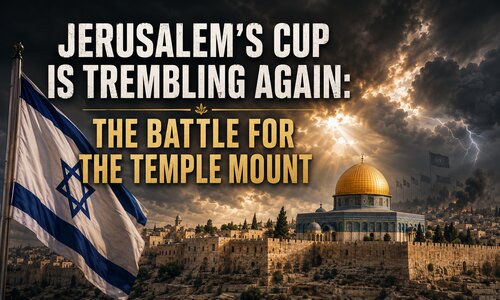 By PNW Staff August 07, 2026
Share this article:
The Middle East is burning. Wars are spreading, oil routes are under threat, and nations are struggling to contain chaos from Gaza to the Persian Gulf.
Yet nearly 20 Muslim nations have found time to unite around one urgent concern: Jews praying on the Temple Mount.
That fact alone should tell us something.
A few Jewish worshippers quietly praying on a hilltop in Jerusalem can provoke emergency meetings, diplomatic threats and warnings of regional upheaval. Turkish Foreign Minister Hakan Fidan recently described a gathering in Amman as "historic," as Islamic governments discussed coordinated action against Israel over developments at Al-Aqsa.
Why does this small piece of land create such fear and fury?
Because the Temple Mount is not merely another disputed location. It is the spiritual heart of Jerusalem, the place where the First and Second Jewish Temples stood, and the place where the Jewish people believe their biblical history is anchored.
It is also the place where the question of Jerusalem's sovereignty can no longer be avoided.
For decades, Israel has exercised extraordinary restraint on the Temple Mount. After regaining Jerusalem's Old City in 1967, Israel left day-to-day religious administration of the site in the hands of the Islamic Waqf.
Muslims were allowed to worship freely. Jews were generally permitted to visit, but open Jewish prayer was restricted.
Think about that for a moment.
Israel controlled Jerusalem, yet Jews were told they could not openly pray at the holiest site in Judaism. The threat of riots and terrorism became the unwritten rule governing Jewish religious freedom.
That arrangement is now beginning to crack.
More Jewish visitors are ascending the Mount. Some are praying openly. Israeli officials are speaking more boldly about Jewish rights there. Israeli security authorities are becoming more visibly involved.
No formal takeover has been declared. No dramatic announcement has been made.
But the reality is changing.
And the Muslim world sees it.
That is why governments are gathering. That is why Turkey is issuing warnings. That is why Jordan is sounding the alarm. They understand that every Jewish prayer offered on the Mount weakens the idea that the site belongs exclusively to Islam.
This is no longer simply about maintaining order. It is about who has the right to stand before God in Jerusalem.
The international reaction reveals a glaring double standard.
Western governments constantly speak about freedom of religion. They defend the right of Muslims to build mosques, wear religious clothing and worship publicly throughout Europe and North America.
But when Jews seek to pray at Judaism's holiest place, their worship is treated as an act of aggression.
Jewish prayer becomes an "incursion." A Jewish visitor becomes a "provocation." An Israeli flag becomes a threat to world peace.
There is no serious proposal to prevent Muslims from worshipping at Al-Aqsa. The issue is whether Muslims should possess an exclusive right to a place that is central to Jewish history and faith.
Should threats of violence determine whether Jews may pray?
Should Israel permanently restrict its own people because foreign governments warn that allowing Jewish worship could produce unrest?
Israel must act with wisdom. The Temple Mount is one of the most sensitive places on earth, and careless actions could carry terrible consequences.
But caution is not the same as surrender.
For too long, Israel has been expected to prove its commitment to peace by denying Jews basic religious rights in their own capital. Meanwhile, the threat of Muslim violence has been rewarded with greater control.
That is not coexistence. It is intimidation disguised as diplomacy.
Turkey's reaction is especially important.
President Recep Tayyip Erdoğan has spent years presenting himself as a defender of Jerusalem and a leader of the Islamic world. By declaring Al-Aqsa to be one of Turkey's own sacred places, his government is claiming a direct stake in what happens on Israeli territory.
Jordan claims custodianship over the Islamic holy sites. Saudi Arabia guards Mecca and Medina. Iran claims to lead the armed struggle against Israel.
Now Turkey increasingly wants to lead the political and religious battle for Jerusalem.
These nations disagree on many things. They compete for influence, fight proxy wars and pursue rival ambitions.
But Jerusalem can unite them.
That is what makes the Temple Mount so dangerous--and so prophetically significant.
The prophet Zechariah warned that Jerusalem would become "a cup of trembling" to the surrounding peoples and "a burdensome stone" for the nations.
What other city creates this kind of reaction?
Jerusalem has no enormous oil reserves. The Temple Mount controls no global shipping lane. It is a relatively small hilltop.
Yet Jews praying there can summon foreign ministers from across the Islamic world.
That is not ordinary geopolitics.
The Bible said Jerusalem would become an obsession for the nations.
Today, it is becoming exactly that.
The coming struggle will not merely be about prayer schedules or security procedures. It will be about who owns Jerusalem, who controls its holiest place and whether the Jewish people will continue to be treated as outsiders on the mountain where their Temples once stood.
Israel may move slowly. International pressure may delay further changes. Political leaders may temporarily restore the old arrangements.
But the question will not go away.
Who truly controls the Temple Mount?
Who decides who may worship there?
And how long will the Jewish people accept being forbidden to pray at the holiest place in their own faith?
Jerusalem's cup is trembling again.
And the nations are already gathering around it.