The New Orthodoxy: Why Biblical Truth Is Becoming A Career Liability
 By PNW Staff August 05, 2026
Share this article:
For generations, Americans assumed the greatest threats to religious freedom would come from laws banning churches, confiscating Bibles, or preventing people from worshipping. Instead, the pressure has arrived in a quieter—and arguably more effective—form. Increasingly, Christians are discovering that faithfully holding to biblical convictions can carry a professional cost.
A recent federal appeals court ruling in Oregon illustrates just how dramatically the cultural landscape has shifted.
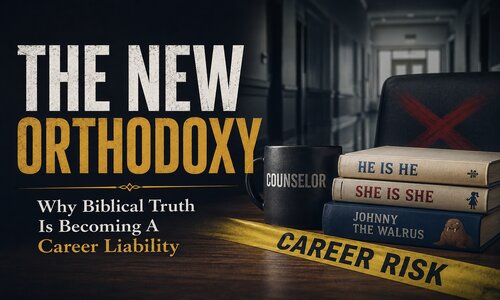
Roderick Theis, a public school counselor and Christian, lost his job after refusing to remove books from his office affirming the biblical understanding that human beings are created male and female. Among the books were He Is He, She Is She, and Johnny the Walrus, a satirical children's book addressing gender ideology by well known Conservative columnist Matt Walsh.
After students asked about the books and Theis shared them outside of formal counseling sessions, school officials terminated his employment. This month, the Ninth Circuit Court of Appeals upheld that decision, concluding that because he was acting as a government employee, his speech was not protected under the First Amendment.
On one level, this is a dispute over workplace policies. On another, it reveals something far more significant.
The issue is no longer simply whether Christians are free to believe what the Bible teaches. Increasingly, the question is whether those beliefs can be expressed in certain workplaces without risking one's career. What was once regarded as a widely accepted understanding of human nature is now, in some settings, viewed as inappropriate—or even harmful.
That should concern far more people than Christians alone.
This Isn't Really About Three Books
At first glance, this appears to be another dispute over transgender ideology in the public schools. But if that's all we see, we'll miss the much bigger story.
Rod Theis wasn't accused of mistreating students. He wasn't fired for incompetence, harassment, or neglecting his responsibilities. According to the school district, the problem was that he quietly displayed books affirming the belief that people are created male and female—a view shared not only by Christians, but by virtually every civilization throughout history until only the past few years.
That should give us pause.
The real question isn't whether someone agrees with Theis' beliefs. The question is why those beliefs are increasingly treated as unacceptable in places where other viewpoints are openly celebrated.
Something fundamental has changed.
For decades, Christians were told they were free to believe whatever they wished—as long as they didn't force those beliefs on others. Today, in many institutions, simply expressing those beliefs can itself be viewed as harmful. The issue is no longer coercion. The belief itself has become the problem.
That represents a profound cultural shift.
When Truth Becomes Harm
Perhaps the most remarkable change isn't that biblical beliefs are being challenged. Christians have always expected opposition. What's different today is how those beliefs are increasingly being reclassified.
The progression has been subtle but unmistakable.
First came the call for tolerance.
"You don't have to agree."
Then came the expectation of silence.
"Keep those beliefs private."
Then came the demand for affirmation.
"Use the preferred language. Celebrate every identity."
Now, in a growing number of workplaces, schools, and professional settings, simply affirming what the Bible teaches about humanity may itself be considered harmful.
That is far more than a cultural disagreement. It is a complete reversal of how truth is understood.
The debate is no longer merely over biology or psychology. It is over authority. Who has the right to define reality? Scripture? Nature? Government agencies? Professional organizations? Or each individual for themselves?
Increasingly, the answer to that question determines not only what people are allowed to say—but whether they can keep their jobs.
A Pattern That Is Becoming Difficult To Ignore
Viewed in isolation, the Oregon case might appear to be an unfortunate workplace dispute. Viewed alongside other developments, however, it begins to look like part of a much broader pattern.
Across North America and Europe, Christian parents have faced investigations after declining to affirm a child's transgender identity. Teachers and public employees have been disciplined over pronoun disputes. Healthcare professionals have encountered pressure to participate in practices that conflict with deeply held religious convictions.
Military chaplains in Canada have recently been instructed to avoid explicitly Christian language during official ceremonies. Foster and adoptive parents in several jurisdictions have been denied opportunities because they would not affirm prevailing views on gender and sexuality.
Individually, each of these stories can be dismissed as an isolated controversy. Collectively, they tell a different story.
Traditional Christian convictions are increasingly treated not as one legitimate viewpoint among many, but as obstacles to institutional goals that must be managed, restricted, or removed. The message may not always be explicit, but it is becoming increasingly difficult to ignore: certain biblical beliefs are no longer simply unpopular—they are increasingly viewed as incompatible with participation in parts of public life.
Whether one agrees with those convictions is almost beside the point. A genuinely pluralistic society should be able to tolerate peaceful disagreement without requiring ideological conformity.
The New Definition Of Neutrality
Supporters of these policies often argue that public institutions must remain neutral. Yet neutrality itself appears to be undergoing a remarkable redefinition.
Displaying symbols or messages that affirm contemporary gender ideology is frequently regarded as expressing inclusion. Diversity statements and approved social messaging are often welcomed as signs of compassion and progress. Displaying books that affirm biological sex, however, may be viewed as inappropriate advocacy.
The question is not whether every viewpoint belongs in every workplace. Employers have long established reasonable standards for professional conduct.
The deeper question is why one set of moral assumptions is increasingly treated as neutral while another is considered unacceptable.
Neutrality once meant making room for differing convictions. Increasingly, it means affirming one particular moral framework while restricting competing beliefs.
That is not the absence of ideology. It is the elevation of one worldview over another.
A Warning Beyond One Court Case
Christians should avoid both panic and naïveté.
The New Testament never promised believers cultural approval. Jesus Himself warned that His followers would often find themselves at odds with the prevailing values of their age. Faithfulness has never been measured by popularity.
At the same time, Christians should recognize the significance of what is unfolding. The issue extends far beyond debates over gender identity. At stake is a much larger question: Can citizens continue to live and work according to convictions rooted in Scripture without being regarded as professionally unfit?
That question will not remain confined to one issue. If society increasingly decides that biblical teaching on human identity is too harmful to tolerate in public life, there is little reason to believe the pressure will stop there. The same reasoning could eventually be applied to biblical teachings on marriage, sexuality, the sanctity of life, parental authority, religious liberty, or any number of convictions that increasingly conflict with prevailing cultural norms.
The Oregon counselor was not accused of abusing students or neglecting his responsibilities. He lost his position because he quietly displayed books affirming a view of humanity that Christians have held for two thousand years.
Whether one agrees with his actions or not, his case raises a question that deserves careful consideration far beyond the courtroom.
History shows that every society develops an orthodoxy—a set of beliefs considered beyond question. The question facing Christians today is not whether such an orthodoxy exists, but whether biblical truth will increasingly find itself outside its boundaries.
If that happens, the greatest challenge facing believers will not be the loss of cultural influence. It will be the growing expectation that faith remain confined to Sunday morning while every other institution embraces a competing moral vision.
The Oregon ruling may ultimately be remembered for far more than the fate of one school counselor. It may mark another step in a cultural transformation where the greatest liability is no longer poor performance or misconduct—but quietly holding to truths that much of civilization once considered self-evident, and that Scripture has proclaimed from the very beginning: "Male and female He created them."