
When Every Streetlight Becomes A Surveillance Tower
 By PNW Staff July 21, 2026
Share this article:
For years, Americans were told that the greatest privacy battles would happen online. The debate centered around social media, smartphones, and internet tracking. Few imagined that one of the most controversial surveillance technologies would instead appear quietly on neighborhood streets, mounted atop poles at busy intersections and neighborhood entrances.
Today, those poles have become a flashpoint in a much larger debate over technology, artificial intelligence, and the future relationship between citizens and government.
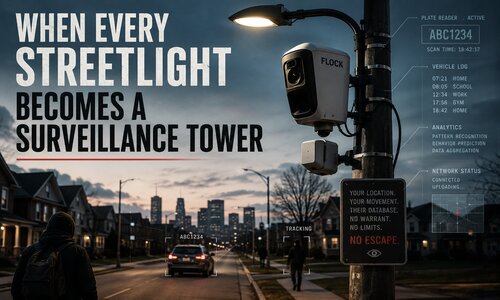
The growing controversy surrounding Flock Safety cameras illustrates that Americans are becoming increasingly uneasy with the rapid expansion of surveillance technologies. The company's recent decision to cancel its experimental "human distress detection" audio feature following overwhelming public backlash demonstrates something important: there are still limits to what many citizens are willing to accept in the name of public safety.
That debate is only beginning.
A Victory--But Only A Small One
Flock announced it would discontinue its pilot program that used always-listening microphones designed to detect sounds such as screaming or other signs of potential distress. According to the company, the feature had only been tested with a limited number of customers and never received a broad rollout.
Civil liberties advocates nevertheless viewed the technology as crossing a dangerous line.
Unlike a traditional security camera that captures events after they occur, an always-active audio system begins listening for specific sounds, deciding which noises deserve government attention. Critics argued that such technology could become an invitation for unnecessary police responses while normalizing constant public monitoring.
The cancellation represents a rare instance where organized public opposition appears to have influenced the direction of an emerging technology.
Yet it also highlights a larger concern.
The microphones may be gone--for now--but the surveillance infrastructure remains.
Today's Cameras. Tomorrow's AI Observers.
Most people understand surveillance cameras as devices that simply record video.
Modern AI systems are becoming something entirely different.
License plate readers can already document where vehicles travel, how frequently they visit particular locations, and reconstruct travel histories. Artificial intelligence increasingly allows computers to identify unusual movement, recognize patterns, search enormous databases in seconds, and correlate information gathered from multiple sources.
Today's system may identify a license plate.
Tomorrow's could identify every vehicle regularly parked outside a church, every attendee at a political rally, or every person who visits particular organizations on a recurring basis.
The technology itself is largely neutral.
How it is used is not.
History repeatedly demonstrates that powers created for one purpose often expand well beyond their original justification.
Governments rarely surrender surveillance capabilities once they exist.
The Expansion Problem
One of the greatest concerns surrounding technologies like Flock is not necessarily what they do today.
It is what they could do after the next software update.
Facial recognition can be integrated.
Behavior prediction can be added.
Real-time AI tracking can be expanded.
Private camera networks can be linked together.
Government databases can be cross-referenced.
Insurance companies, financial institutions, advertisers, and countless third parties could someday seek access to similar information if legal barriers weaken.
Every technological capability tends to invite new uses.
What begins as finding stolen vehicles can gradually evolve into tracking outstanding warrants.
Then identifying protest participants.
Then monitoring political gatherings.
Then locating individuals who have committed no crime whatsoever but simply fit a government watch list.
The history of surveillance is filled with examples where "temporary" powers quietly became permanent.
Public Patience Is Wearing Thin
The remarkable aspect of the Flock controversy is not simply that citizens objected.
It is the intensity of the resistance.
Across America, reports of cameras being vandalized, spray-painted, disabled, or cut down have become increasingly common. Online communities dedicated to opposing surveillance networks continue to grow, treating those who disable the devices as symbols of resistance rather than criminals.
Whether one agrees with vandalism or not, the public reaction reveals something deeper.
Americans are growing suspicious of technologies that appear to be imposed without meaningful public debate.
The same frustration has emerged elsewhere.
Artificial intelligence data centers have sparked fierce opposition from local communities concerned about enormous electricity demands, water consumption, environmental impacts, property values, and the rapid industrialization of rural landscapes. In some areas, opposition has escalated beyond town hall meetings into lawsuits, organized protests, sabotage allegations, and increasingly hostile rhetoric directed at technology companies.
These controversies are connected by a common thread.
Many people feel that technological change is accelerating faster than democratic oversight.
Safety Versus Freedom
None of this means surveillance technology has no legitimate value.
License plate readers have helped recover stolen vehicles.
They have assisted investigations involving missing children.
They have contributed to solving violent crimes.
These are genuine public safety benefits.
But societies face an enduring question: how much liberty should be exchanged for greater security?
Benjamin Franklin's oft-quoted warning that those willing to trade essential liberty for temporary safety deserve neither remains relevant because each generation must answer it anew.
The challenge is not merely deciding whether technology works.
It is deciding who controls it.
Who audits it?
Who limits it?
Who prevents future abuse when political winds inevitably change?
Those questions become even more pressing as artificial intelligence grows more capable.
A Glimpse Of Tomorrow
The debate over Flock cameras extends far beyond one company or one discontinued audio feature.
It offers a preview of the conflicts likely to define the coming decade.
Artificial intelligence will increasingly blur the line between observation and prediction. Cameras will become smarter. Sensors will become cheaper. Computing power will become faster. Governments and corporations alike will possess unprecedented abilities to monitor movement, behavior, and human activity in real time.
The real danger may not arrive through one dramatic announcement.
It may emerge gradually, one software update, one pilot program, one emergency authorization, and one "temporary" expansion at a time.
The cancellation of Flock's audio surveillance pilot demonstrates that public pressure can still influence the direction of technology. But it also serves as a reminder that citizens are no longer debating hypothetical futures.
The infrastructure is already being built.
The question is no longer whether surveillance technology will become more powerful.
It is whether free societies will establish meaningful limits before those capabilities become impossible to reverse.