Pride Themed Hymns Now Fill The Sanctuaries Of Woke Churches
 By PNW Staff July 21, 2026
Share this article:
If you walked into many mainline churches today after being away for 40 years, the first thing you would likely notice isn't the sermon.
It's the sanctuary itself.
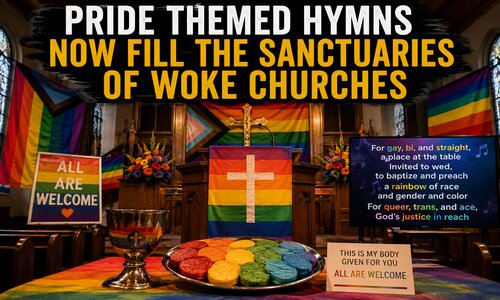
Rainbow flags hang where banners proclaiming Christ once stood. Pride colors decorate the chancel. In some congregations, even clergy wear rainbow stoles or vestments as visible declarations of affirmation before a single word is preached.
The architecture may still be familiar. The stained glass still depicts biblical scenes. The pews remain in place.
But the message has changed.
What is being taught, celebrated, and proclaimed from many pulpits today often bears little resemblance to the church many Christians grew up in--or to the priorities found throughout Scripture.
This transformation did not happen overnight. There wasn't a single dramatic moment when churches suddenly abandoned historic Christian teaching. Instead, it unfolded slowly, almost imperceptibly, one cultural accommodation at a time.
Each step was presented as an isolated issue. Each change was described as an act of compassion, inclusion, or simply keeping pace with modern society. Those who objected were assured they were overreacting.
But looking back over several decades, a clear pattern emerges.
First came the blessing of same-sex marriages.
Supporters argued the church was simply extending Christ's love to people who had long felt excluded. Opponents warned that the issue wasn't compassion but authority. If Scripture's consistent teaching on marriage could be redefined, they asked, what doctrine could not?
Next came the ordination of openly gay pastors.
For centuries, church leaders were expected to model biblical standards of holiness and repentance. Increasingly, however, many denominations shifted from calling people to transformation through Christ to affirming identity as something to be celebrated rather than surrendered to God.
Then came new Bible translations and reinterpretations designed to soften or redefine passages that conflicted with contemporary understandings of sexuality and gender. Whether through changes in wording, explanatory notes, or interpretive frameworks, the effect was often the same: difficult passages became less difficult by changing how they were understood.
Once the authority of Scripture became flexible, other historic Christian practices were soon reimagined as well.
Some churches began holding "trans-baptism" or renaming services. Baptism, which Christians have historically understood as symbolizing death to sin and new life in Christ, was adapted in these ceremonies to affirm a person's chosen gender identity and new name.
Then came rainbow communion bread.
Communion is one of Christianity's holiest observances, remembering Christ's broken body and shed blood for the forgiveness of sins. Yet in some congregations, even the Lord's Table became another canvas for cultural messaging, with rainbow-colored bread presented as a symbol of inclusion and Pride.
Now the transformation has reached the music itself.
Throughout church history, hymns have taught doctrine as much as they have inspired worship. They have proclaimed God's holiness, Christ's saving work, humanity's need for redemption, and the believer's hope in eternity.
Increasingly, however, some churches are replacing that focus with songs celebrating identity politics and modern social movements.
One recently circulated hymn contains these lyrics:
"For gay, bi, and straight, a place at the table
Invited to wed, to baptize and preach
A rainbow of race and gender and color
For queer, trans, and ace, God's justice in reach."
Compare those words with one of Christianity's best-known hymns, A Mighty Fortress Is Our God.
Martin Luther's hymn speaks of God's sovereignty, the battle against evil, and the triumph of Christ. It directs attention heavenward.
The newer hymn directs attention inward--to identity categories, social inclusion, and contemporary cultural causes.
The contrast is striking.
One centers on God's glory.
The other centers on our identities.
One calls sinners to the foot of the cross.
The other invites people to celebrate themselves as they are.
That difference represents far more than changing musical tastes. It reflects a fundamentally different understanding of what the church exists to do.
Historically, the church proclaimed truths that often challenged the surrounding culture. Christians were called to deny themselves, take up their cross, and follow Christ. Repentance was not viewed as oppressive but liberating because it pointed people toward forgiveness and new life.
Today, many progressive churches have reversed that direction.
Rather than asking culture to conform to Scripture, Scripture is increasingly interpreted through the values of contemporary culture. Instead of transforming the world, the church risks being transformed by it.
Ironically, many of these same denominations continue to experience steep membership declines year after year.
Perhaps that shouldn't surprise us.
If a church simply echoes the moral convictions already embraced by society, eventually people begin to wonder why they need the church at all. When the gospel becomes nearly indistinguishable from modern political activism, the unique message of Christianity is diminished.
The New Testament repeatedly warned this would happen.
The Apostle Paul wrote that a time would come when people "will not endure sound doctrine," but would seek teachers who tell them what they want to hear. Jesus Himself warned that His followers would often stand apart from the world rather than reflect it.
Those warnings were never intended to encourage fear, but faithfulness.
Throughout history, movements have risen and fallen, cultures have shifted, and churches have sometimes drifted. Yet God's truth has endured every generation.
The question facing today's church is not whether it can remain culturally relevant.
The question is whether it will remain biblically faithful.
Because once a church begins reshaping its theology to keep pace with every cultural trend, there is no obvious place to stop. One accommodation naturally leads to another until, almost unnoticed, the faith being practiced no longer resembles the one that built the church in the first place.
The greatest danger facing Christianity today may not be persecution from outside the church.
It may be the quiet transformation taking place within it.