America's Greatest Threat Isn't Foreign-It's Forgetting Who We Are
 By PNW Staff July 09, 2026
Share this article:
As America prepares to celebrate its 250th birthday, a remarkable new survey offers both hope and a sobering warning. On one hand, Americans still overwhelmingly love their country. They remain proud of its heritage, grateful for their freedoms, and convinced that the Constitution matters.
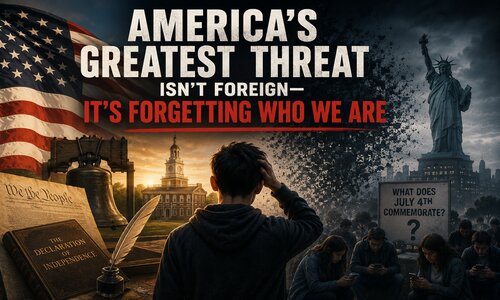
On the other hand, millions of Americans cannot explain the very event the nation is celebrating.
That contradiction may be the defining challenge facing America today.
According to a new Cato Institute and Morning Consult survey, 46% of Americans don't know what America's 250th anniversary commemorates. Among Generation Z, that number climbs to an astonishing 61%. Less than four in ten young Americans correctly identified the anniversary as marking the adoption of the Declaration of Independence in 1776.
Think about that for a moment.
Imagine celebrating Christmas without knowing who Jesus is. Or celebrating Independence Day without understanding independence itself. That's increasingly where America finds itself--a nation attempting to preserve freedoms that many citizens no longer understand.
And history shows that's a dangerous place for any republic.
The Good News: Americans Still Love Their Country
Before dwelling on the negatives, it's important to recognize just how encouraging many of the survey's findings are.
Despite years of relentless cultural pessimism, 86% of Americans say they are grateful to be Americans. Seventy-nine percent are proud of their country. Seventy-six percent feel positively about America's founding, and 70% believe its founding principles remain relevant today.
Those are remarkable numbers considering the constant stream of negativity surrounding America's history.
For years Americans have been told that their nation was founded primarily on oppression, exploitation, racism, and injustice. School curricula, entertainment media, university classrooms, and countless political activists have increasingly portrayed America's founding as something to apologize for rather than celebrate.
Yet the public has largely resisted that narrative.
Most Americans still recognize that while the nation's history contains undeniable flaws, its founding principles remain extraordinary.
The Declaration of Independence's assertion that all people are created equal.
The Constitution's division of governmental power.
The Bill of Rights' protection of individual liberty.
These ideas transformed human history.
Equally encouraging is that 86% believe the Constitution protects their freedoms, while 82% say it has enabled America's prosperity.
Even after decades of political polarization, Americans still understand--at least instinctively--that constitutional government matters.
The Bad News: Civic Ignorance Is Exploding
But affection without understanding is fragile.
The same survey found that 58% of Americans don't know the primary purpose of the Constitution.
Fifty-seven percent don't understand why America declared independence from Great Britain or why the founders intentionally created a government with limited powers.
Nearly half don't know what the nation is celebrating this year.
This isn't simply a trivia problem.
It's a survival problem.
The American system was never designed to operate on autopilot.
America's founders repeatedly warned that constitutional self-government requires an informed, virtuous citizenry.
Thomas Jefferson argued that liberty depended upon an educated public capable of holding government accountable.
James Madison warned that "a people who mean to be their own governors must arm themselves with the power which knowledge gives."
If citizens no longer understand why government power was intentionally limited, they become far more willing to surrender those limits whenever a political crisis arises.
Ironically, the survey demonstrates exactly that.
Freedom Is Popular--Until It Gets In The Way
Most Americans say constitutional limits matter.
Fifty-five percent believe the Constitution should firmly limit government even if doing so makes solving problems more difficult.
Seventy-two percent believe presidents should obey Supreme Court rulings even when they disagree.
Fifty-eight percent believe no political party should hold too much power.
Those are healthy instincts.
But then comes one of the survey's most troubling findings.
Four in ten Americans believe it's acceptable for a president they support to stretch the Constitution to achieve political goals.
Notice the qualifier.
Not just any president.
A president they support.
That's where constitutional government begins to unravel.
The Constitution was never intended merely to restrain political opponents.
It exists primarily to restrain those we agree with.
Liberty survives only when principles matter more than personalities.
If constitutional limits only apply when "the other side" is in power, they eventually cease to exist altogether.
The Socialism Warning
Another finding should give policymakers pause.
Capitalism still enjoys greater overall support than socialism, but the margins are narrowing dramatically.
Perhaps most concerning, Generation Z now favors socialism (53%) over capitalism (45%).
That shift isn't occurring because socialism suddenly developed an impressive historical track record.
History says precisely the opposite.
From the former Soviet Union to Venezuela, socialist systems have repeatedly produced economic decline, shortages, corruption, and authoritarian government.
Instead, this generational shift likely reflects an education system that increasingly teaches students what capitalism's imperfections are while spending far less time explaining why America's founders distrusted centralized government in the first place.
When students learn grievances without history, they become susceptible to promises that bigger government can fix every problem.
History consistently demonstrates otherwise.
Americans Sense Something Is Wrong
Perhaps the survey's most revealing finding isn't what Americans know.
It's what they feel.
Nearly six in ten believe America has drifted away from its founding principles.
More than half fear the nation could cease being a free country within fifty years.
Why?
Respondents pointed to corruption, abuse of governmental power, and abandonment of constitutional principles.
Those concerns span political parties.
Americans increasingly recognize that something foundational is slipping away.
The irony is that many cannot fully articulate what has been lost because they were never taught it in the first place.
It's difficult to defend principles you've never learned.
The Church Cannot Ignore This
Christians have an important role to play here.
Scripture teaches believers to honor governing authorities while also recognizing that governmental power must never become ultimate. Human nature is fallen. Power always requires restraint because sinful people inevitably abuse unchecked authority.
America's founders understood that biblical reality remarkably well.
Their system of separated powers, checks and balances, and limited government reflected a profoundly realistic view of human nature--not that people are basically good, but that concentrated power eventually corrupts.
That understanding aligns far more closely with the Bible's teaching about the human heart than with modern political utopianism.
As America celebrates 250 years of independence, the greatest threat may not be foreign adversaries or economic competition.
It may be historical amnesia.
The encouraging news is that Americans still love their country.
The concerning news is that too many no longer know why it deserves defending.
Freedom cannot be preserved by nostalgia alone.
Each generation must understand the principles that produced it, cherish the sacrifices that secured it, and possess the courage to defend it when those principles come under attack.
As America enters its 250th year, perhaps the most patriotic act isn't simply waving the flag.
It's teaching the next generation what that flag--and the extraordinary experiment in liberty it represents--actually stands for.