
Every Camera Knows Your Name: The Surveillance Future Is Already Here
 By PNW Staff July 07, 2026
Share this article:
Imagine walking through your local downtown.
You haven't broken the law.
You aren't fleeing police.
You're simply buying a cup of coffee, meeting a friend for lunch, or taking your children to the park.
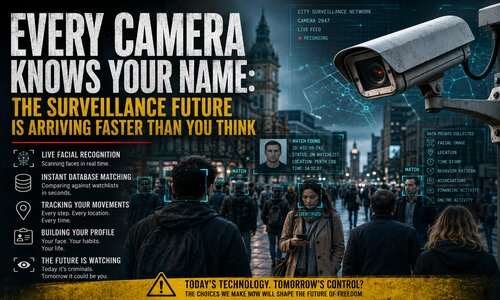
As you walk past a police vehicle, a camera silently scans your face. Within seconds, artificial intelligence compares your image against government databases. Another camera identifies your vehicle. Your smartphone quietly confirms your location. Computers can now connect where you've been, who you've met, and perhaps one day what you've purchased.
No officer approaches you.
Nothing happens.
Because this time... you're on the right list.
The unsettling question isn't what happens when governments use technology to catch dangerous criminals.
It's what happens when they eventually decide to watch everyone.
That future moved one step closer this month as Western Australia became the first police agency in the country to deploy live facial recognition technology in public spaces. Police vans equipped with AI now scan faces in real time, comparing them against a watchlist of roughly 4,000 individuals that includes serious offenders, registered child sex offenders, people with outstanding warrants and missing persons.
Police Commissioner Col Blanch has stressed that the system is narrowly targeted, that faces which do not generate a match are immediately discarded, and that the trial "is not about mass surveillance."
There is every reason to believe those overseeing the program genuinely want to make their communities safer. Finding dangerous criminals and vulnerable missing persons is an objective few would oppose.
That isn't what should concern us most.
History offers a far more sobering lesson.
Governments rarely abuse new powers on the first day.
They simply keep them.
Then they expand them.
History calls this mission creep--the gradual expansion of a program far beyond the purpose originally used to justify it.
We've watched it happen repeatedly.
Security cameras were introduced to protect banks and businesses. Today, countless cities are covered by networks of cameras monitoring nearly every major intersection and public space.
License plate readers were sold as a way to recover stolen vehicles. Today they can quietly build detailed records showing where ordinary citizens have driven for months or even years.
Smartphones revolutionized communication. They also became perhaps the most effective personal tracking devices ever invented, constantly transmitting location information, movement patterns and behavioral data.
Social media promised to connect the world. Instead, it evolved into one of history's largest systems for collecting personal information, preferences and relationships.
Then came COVID-19.
Regardless of where one stands on the public health response, the pandemic demonstrated something remarkable: governments can dramatically expand surveillance and emergency powers with astonishing speed when enough fear exists. Measures that once seemed unimaginable suddenly became accepted as temporary necessities.
The problem is that temporary powers often have a habit of becoming permanent infrastructure.
Nobody intentionally designed today's surveillance society in one grand plan.
It emerged one reasonable decision at a time.
One camera.
One database.
One emergency.
One new technology.
One "common sense" expansion.
Until suddenly we find ourselves living in a world where privacy has quietly become the exception instead of the expectation.
Facial recognition is simply the next chapter.
Supporters argue--and often correctly--that the technology can save lives. It can identify violent offenders, locate missing children, and assist officers responding to dangerous situations. Those are legitimate benefits that deserve recognition.
But infrastructure has a way of outliving the politicians who build it.
Today's watchlist contains serious offenders.
Tomorrow it could include repeat offenders.
Then individuals accused of violating court orders.
Then those under investigation.
Then perhaps those identified as "persons of interest."
Governments change.
Political priorities change.
Definitions change.
The surveillance infrastructure remains.
Now consider how rapidly artificial intelligence is advancing.
AI can already analyze millions of images faster than humans ever could. Cameras continue multiplying throughout cities. Digital identity systems are expanding around the world. Financial transactions are increasingly electronic. Smartphones constantly report location data. Vehicles generate enormous amounts of travel information.
Individually, each technology appears useful.
Collectively, they create something previous generations could scarcely imagine.
A society where every face can be recognized.
Every movement recorded.
Every purchase documented.
Every relationship mapped.
Every digital interaction connected.
No single invention creates such a world.
Together, however, they make it entirely possible.
For Christians, these developments deserve thoughtful attention--not because Western Australia's facial recognition trial fulfills biblical prophecy, but because it demonstrates how rapidly the technological foundations are being assembled.
For centuries, skeptics dismissed the book of Revelation because they could not imagine how any government could ever exercise worldwide economic and societal control.
How could authorities possibly monitor billions of people?
How could buying and selling ever be regulated on such a scale?
Today those questions no longer sound impossible.
Facial recognition.
Artificial intelligence.
Digital identity.
Biometric authentication.
Digital currencies.
Always-connected smartphones.
Global data networks.
No one technology is the fulfillment of Revelation 13.
But together they reveal something remarkable: humanity now possesses technological capabilities unlike anything in history. The infrastructure for unprecedented surveillance and centralized control is no longer science fiction. It is being built piece by piece before our eyes.
Christians need not respond with panic.
Neither should we respond with indifference.
Scripture calls believers to be watchmen--to observe the times with wisdom, discernment and sobriety.
Technology itself is not evil. It has solved countless problems and improved millions of lives. Law enforcement should have effective tools to protect innocent people and stop violent criminals.
But every new power deserves careful scrutiny.
Who decides when the watchlist expands?
Who determines which behaviors justify inclusion?
Who audits the algorithms?
Who protects innocent citizens from false identifications?
Most importantly...
What happens when less trustworthy governments inherit extraordinarily powerful surveillance systems built by more trustworthy ones?
Tyranny has changed.
It no longer requires watchtowers on every hill or secret police standing on every street corner.
Artificial intelligence can do the watching.
Cameras never sleep.
Algorithms never blink.
Computers never forget.
Perhaps the greatest danger isn't Western Australia's facial recognition trial itself.
Perhaps the greatest danger is that ten years from now we won't even remember what it felt like to live in a society where simply walking down the street did not mean someone--or something--might already know exactly who we are.
Freedom is rarely lost in one dramatic moment.
It disappears through thousands of small compromises, each one sounding perfectly reasonable when viewed in isolation.
Today's watchlist may indeed be limited to dangerous criminals.
The real question is whether future generations will still remember there was ever a time when it wasn't everyone's face being scanned.