
How America Traded Self-Reliance For Convenience
 By Dr. Ashley Lucas/The Washington Stand June 30, 2026
Share this article:
As we celebrate the 250th anniversary of the signing of the Declaration of Independence, one of the greatest documents ever penned by man, we would do well to not only celebrate our accomplishments, but also to look back to our Founders and the America they envisioned. As we do this, we should ask ourselves: Are we living up to their ideals? Are we the people and nation they hoped we would become?
George Washington, the father of our nation, considered himself primarily a farmer and devoted his life to agricultural innovation. At his Mount Vernon estate, he pioneered sustainable practices like crop rotation and cover cropping, shifting from tobacco to wheat to preserve soil health. For the first 100 years, the U.S. was overwhelmingly agrarian. Around 80-90% of Americans lived on farms, and most people grew, raised, or preserved their own food. Diets were local, seasonal, and minimally processed.
The Industrial Revolution brought about automation, factories, products, and packaging that Washington could only dream of. Inventions like canning, refrigeration, and milling scaled up food production to match the demand of our growing nation. Companies began mass-producing staples like flour, sugar, and canned goods. Urban populations grew rapidly. By 1900, only 40% of Americans were farmers. People still cooked at home, but they used industrially-produced, rather than homegrown, ingredients.
During World War II and its aftermath, supermarkets spread nationwide. Thanks to both automation and refrigeration, frozen meals, boxed foods, and preservatives became common. Items like mass-produced white bread and ready-made meals dominated the tables of America. By 1950, fewer than 15% of Americans were farmers. Food shifted from something you grew to something you bought.
By the time we celebrated our 200th anniversary, the United States had shifted from an agrarian economy to an industrial economy. From a homegrown food culture to a processed food culture. There is no denying the many benefits of modernization. Yet now, as we celebrate America 250, we find ourselves sicker and more dependent on those inventions than ever.
Certainly, this is not what Washington envisioned.
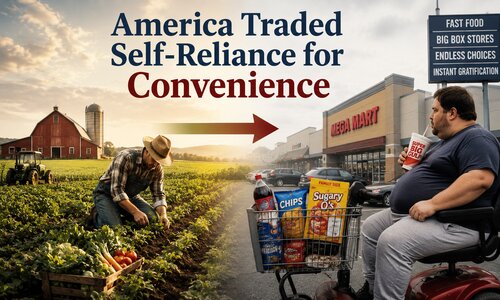
Today, fewer than 2% of Americans are farmers. Most of us are several steps removed from the source of our food. Not just geographically, but mentally and nutritionally. We no longer eat from the land; we eat from packages, drive-thrus, and shelves lined with products engineered for convenience, shelf life, and taste. But not for health.
And the consequences are difficult to ignore.
More than 70% of American adults are now overweight or obese. Over 40 million Americans are living with diabetes or prediabetes. Heart disease remains the leading cause of death. Even more concerning, we are seeing these conditions appear earlier in life. Children are facing diagnoses that were once reserved for adults.
This is not a failure of willpower. It is the predictable outcome of a culture that has drifted too far from the basics.
I often tell my clients that weight loss is not just physical. More importantly, neither is health. It is mental. We have normalized habits that work against us: constant snacking, consuming ultra-processed foods, sedentary routines, and the belief that we are too busy to care for ourselves well. We are fighting a daily battle against convenience, and too often, convenience wins.
But what if the path forward is not found in the next trend, app, or pharmaceutical breakthrough, but in remembering?
The America of our founding was not perfect, but it was rooted in rhythms we have largely lost: growing food, preparing meals at home, eating whole ingredients, moving our bodies as part of daily life, and living in closer connection with our neighbors. A return to this kind of lifestyle does not mean we must abandon modern life or romanticize the past. It means we can choose, deliberately, to reclaim a lifestyle that we know works.
We can cook more meals at home using real, whole foods, prioritizing protein, fresh produce, and ingredients our great-grandparents would recognize (think whole eggs over egg whites in a carton, real cream over processed flavored coffee creamer). We can plant a garden, even if it's just a few herbs on a windowsill. We can shop the perimeter of the grocery store instead of the aisles. We can move our bodies not as punishment, but as a return to how we were designed to live.
And perhaps most importantly, we can change the conversation in our own minds. Health is not about perfection. It is about direction. It is about choosing, again and again, to move closer to the life we were meant to live.
As we celebrate 250 years of American independence, we would do well to consider a different kind of freedom: freedom from the habits and systems that are quietly undermining our well-being.
George Washington longed to return to Mount Vernon not simply because it was home, but because it represented a way of life. A life grounded in stewardship, discipline, and connection to the land. He set that life aside in service to a greater calling. Perhaps now, in a very different way, we are being called back. Not backward, but forward. Forward toward a healthier, more sustainable, more intentional way of living.
One small choice at a time.
Originally published at The Washington Stand