First Adults. Now Children. The Slippery Slope of Euthanasia
 By PNW Staff June 26, 2026
Share this article:
There was a time when the phrase "slippery slope" was dismissed as little more than a scare tactic. Opponents of euthanasia warned that once a society accepted the deliberate ending of innocent human life under limited circumstances, those limits would not remain in place. Supporters scoffed. Strict safeguards, they insisted, would prevent abuse. The law would apply only to the rarest and most tragic of cases.
Today, those assurances ring increasingly hollow.
This week, the Netherlands confirmed that, for the first time since expanding its euthanasia policy in 2024, a child under the age of 12 has died through medically assisted death. According to Dutch Health Minister Sophie Hermans, the child was terminally ill, had no hope of recovery, and was suffering unbearably. The parents consented, physicians followed the legal process, and prosecutors will now review the case to ensure every procedural requirement was met.
The forms were completed.
The regulations were followed.
The system worked exactly as intended.
And that is precisely what should give us pause.
No decent person is indifferent to the suffering of a dying child. Every parent can only imagine the heartbreak these families endure. Christians, perhaps more than anyone, should be leading the way in providing comfort, compassionate care, and support for those walking through unimaginable pain.
But compassion and killing are not the same thing.
The tragedy of suffering does not erase the sanctity of life.
The Netherlands became the first nation to legalize euthanasia for adults in 2002. At the time, supporters emphasized that it would be carefully limited to mentally competent adults facing unbearable suffering. The public was assured that strict safeguards would prevent the practice from expanding.
Yet over the past two decades, those boundaries have steadily shifted.
First came broader eligibility for adults.
Then provisions involving minors over the age of 12.
Protocols were established allowing euthanasia for newborns with severe medical conditions.
Then, in 2024, Dutch authorities expanded the policy again--this time to include children between the ages of 1 and 12 suffering from terminal illnesses with no prospect of recovery.
Now that policy has claimed its first life.
Every expansion was described as an exceptional circumstance. Every new category was presented as compassionate. Every previous boundary quietly disappeared.
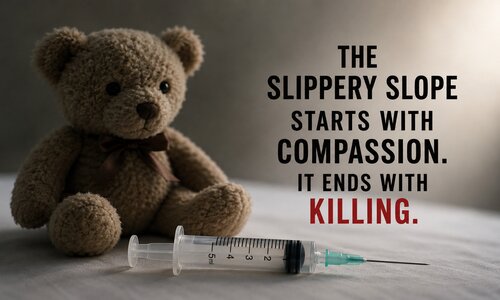
That is exactly how slippery slopes work--not through sudden leaps, but through incremental steps that, viewed individually, seem reasonable. Only when looking back do people realize how far they have traveled.
If anyone doubts that trajectory, they need only look across the Atlantic.
Canada legalized Medical Assistance in Dying (MAID) in 2016. Canadians were told it would remain a narrowly defined option for competent adults nearing the end of life.
Within just a few years, those restrictions had already begun to disappear.
The requirement that death be reasonably foreseeable was removed. Eligibility expanded to include people living with serious disabilities under broader circumstances. Today, Canada has recorded more than 60,000 medically assisted deaths, with the annual number continuing to rise. What was introduced as a rare exception has become an increasingly common part of the nation's healthcare system.
The debate has not stopped there.
Canada has repeatedly considered expanding MAID to include those whose sole underlying condition is mental illness. Although implementation has been postponed amid concerns from psychiatrists, physicians, and disability advocates, the proposal remains very much alive. There have also been ongoing discussions surrounding so-called "mature minors"--children considered capable of making significant medical decisions--even though such cases are not currently permitted nationally.
Notice the pattern.
The debate is almost never about where the line should permanently remain.
It is about where the next line should be drawn.
That should concern every society considering these policies.
The United States has not traveled nearly as far down that road, but the direction bears watching. In recent months, Delaware, Illinois, and New York have all legalized physician-assisted suicide for terminally ill adults under carefully defined circumstances, joining a growing list of states where the practice is now legal. Other legislatures continue debating similar measures.
Supporters argue these laws are fundamentally different from Canada's MAID system or the Netherlands' euthanasia policies. In many respects they are. American laws generally require a terminal diagnosis, mental competency, multiple physician approvals, and that the patient self-administer the prescribed medication.
Yet history demonstrates that nearly every expansion begins with assurances that the practice will remain narrowly confined.
Those assurances deserve careful scrutiny.
Christians approach this issue from an entirely different foundation.
Human dignity is not measured by productivity. It is not determined by physical ability, intelligence, independence, or the absence of pain. Scripture teaches that every person is created in the image of God (Genesis 1:27). That truth does not disappear in a hospital room.
We should devote ourselves to relieving pain.
We should pursue the very best palliative care medicine can offer.
We should surround suffering families with prayer, love, practical support, and hope.
But intentionally ending an innocent human life crosses a moral line that Scripture never grants us authority to cross.
One seeks to relieve suffering.
The other ends the sufferer.
That distinction matters.
The Netherlands insists this latest case is exceptional. Canada continues debating its next expansion. More American states continue legalizing physician-assisted suicide under carefully defined limits.
The question is no longer whether safeguards exist.
The question is whether those safeguards remain fixed over time.
The experience of the Netherlands suggests they do not.
Canada's experience suggests they do not.
History suggests they rarely do.
Every expansion begins with compassion.
Every expansion is presented as carefully limited.
Every expansion promises there will be no further movement.
Then another line is crossed.
A society is ultimately judged by how it treats its most vulnerable. When we begin deciding that some innocent lives are no longer worth preserving because suffering has become too great, we risk replacing the duty to care with the power to kill.
The slippery slope is no longer a hypothetical argument.
For one child in the Netherlands, it has become a heartbreaking reality.