
Why Israel Refuses To Leave Hezbollah Alone: Preventing Another October 7
 By PNW Staff June 08, 2026
Share this article:
As President Trump works to preserve a fragile peace process with Iran, the Middle East once again finds itself on the edge of a wider war.
Over the past 24 hours, Iran launched another round of missile attacks against Israel following Israeli strikes on Hezbollah targets in Beirut, threatening to unravel weeks of diplomatic efforts aimed at stabilizing the region. Israel has now retaliated destroying numerous Iranian targets across the country. Trump continues pushing for a broader agreement that could reduce tensions between Israel, Iran, and their respective allies, but the latest violence highlights a reality many outside observers fail to understand.
For Israel, the Hezbollah problem cannot simply be negotiated away.
To many diplomats, Hezbollah is merely one piece of a larger regional puzzle. To Israel, Hezbollah represents an existential threat sitting directly on its northern border--a threat that Israeli intelligence believes recently came within moments of carrying out a second October 7.
That context is critical to understanding why Israel continues to push aggressively against Hezbollah positions in Lebanon despite international pressure, ceasefire discussions, and ongoing peace negotiations. Israeli leaders are not simply fighting today's battles. They are attempting to ensure that a nightmare they believe was narrowly avoided can never happen again.
The reason is chilling.
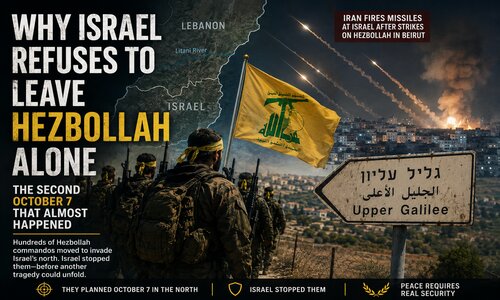
According to recent reports, hundreds of Hezbollah's elite Radwan Force fighters moved toward Israel's northern frontier during the recent conflict, advancing south of the Litani River as Israel was focused on confronting Iran. Their operational plan was reportedly known as "Conquer the Galilee"--a large-scale cross-border assault intended to overwhelm Israeli border communities, seize hostages, and inflict mass civilian casualties in a manner strikingly similar to Hamas' October 7 massacre.
This was not a theoretical exercise.
For years, Hezbollah openly trained for precisely such an operation. Videos released by the group showed commandos storming mock Israeli villages. Senior Hezbollah leaders repeatedly boasted about one day "liberating the Galilee." The Radwan Force, named after Hezbollah military commander Imad Mughniyeh, was specifically created as an elite assault force capable of penetrating Israeli territory and conducting offensive operations.
Following Hamas' October 7 attack, Israeli intelligence began taking these threats far more seriously.
Then came reports that Hezbollah fighters were actually moving toward the border.
Fortunately for Israel, this time intelligence systems worked.
The IDF reportedly identified the infiltration in real time and launched operations that eliminated the attackers before they could reach a single Israeli community. The commander allegedly involved in planning the assault, Ahmed Ali Balout, was later killed in an Israeli strike in Beirut.
Had the operation succeeded, the consequences would have been catastrophic.
The physical casualties alone could have rivaled or exceeded those of October 7.
Many of Israel's northern communities are smaller, more isolated, and located only minutes from the Lebanese border. A coordinated infiltration involving hundreds of trained commandos could have produced multiple simultaneous massacres, hostage-taking operations, and prolonged battles inside civilian neighborhoods.
But the psychological impact may have been even greater.
October 7 shattered one of Israel's most deeply held assumptions--that its intelligence apparatus, technological superiority, and border defenses could prevent a mass infiltration attack.
A second successful invasion only months later would have completely destroyed public confidence.
Imagine the message it would have sent.
The south was attacked.
Then the north was attacked.
Entire communities would have questioned whether any border region could ever be secure again.
For a nation as small and interconnected as Israel, that type of trauma would reverberate for generations. Every family knows someone serving in the military. Every community is connected through networks of friends and relatives. A second October 7 would not simply have been another terrorist attack--it would have been a profound psychological blow to the very idea that Israel could protect its citizens.
This explains why Israel's campaign against Hezbollah goes far beyond retaliation for rockets.
Israel's objective is prevention.
For years, United Nations Resolution 1701 called for Hezbollah forces to remain north of the Litani River, approximately twenty miles from Israel's border. The resolution was intended to create a buffer zone and reduce the likelihood of direct conflict.
In practice, Hezbollah steadily violated the agreement.
Weapons stockpiles expanded.
Observation posts appeared along the frontier.
Tunnels were constructed.
Elite Radwan units positioned themselves closer and closer to Israeli communities.
Many Israeli officials now believe those years of inaction helped create the conditions that nearly allowed a second October 7 to unfold.
That lesson has profoundly shaped Israeli military thinking.
The old strategy of deterrence has been replaced by a strategy of denial.
Rather than merely threatening retaliation after an attack occurs, Israel increasingly seeks to remove the capability for such attacks to happen in the first place.
This is why Israeli operations have focused heavily on dismantling Hezbollah command structures, eliminating Radwan Force leaders, destroying weapons depots, and pushing Hezbollah fighters farther north.
Critics often view these actions solely through the lens of current military operations.
Israel views them through the lens of what almost happened.
Every Radwan commander removed today may represent an attack prevented tomorrow.
Every weapons depot destroyed may eliminate the tools needed for a future massacre.
Every mile Hezbollah is pushed away from the border increases the difficulty of launching another "Conquer the Galilee" operation.
This reality also helps explain why Hezbollah remains central to any broader peace arrangement involving Iran.
Even if Trump succeeds in negotiating some form of ceasefire or regional understanding, Israel is unlikely to accept a situation where a heavily armed Iranian proxy remains positioned directly along its northern border with the capability to launch another large-scale ground invasion.
From Jerusalem's perspective, peace agreements are only meaningful if they address the threats that could shatter that peace tomorrow.
October 7 changed Israel permanently.
The assumptions that guided security policy for decades were shattered in a single day.
The belief that hostile forces could be contained through diplomacy alone evaporated.
The willingness to tolerate heavily armed enemies operating a few miles from civilian communities disappeared.
Whether one agrees with every aspect of Israel's strategy or not, understanding this reality is essential to understanding the conflict itself.
Israel is not simply fighting the last war.
It is trying to prevent the next one.
And according to recent reports, that next war nearly began when Hezbollah's fighters moved toward the border with plans to bring October 7 to the Galilee.
This time, Israeli intelligence stopped them.
The question now hanging over every ceasefire discussion, every peace proposal, and every diplomatic initiative is whether the conditions that nearly allowed it to happen will be removed permanently--or whether the region is merely waiting for another opportunity for history to repeat itself.