New York Wants To Erase "Mother" And "Father" From Law
 By PNW Staff June 05, 2026
Share this article:
There was a time when political debates revolved around taxes, infrastructure, national security, or education. Today, lawmakers in one of America's largest states are spending their time trying to redefine some of the most basic words in human civilization.
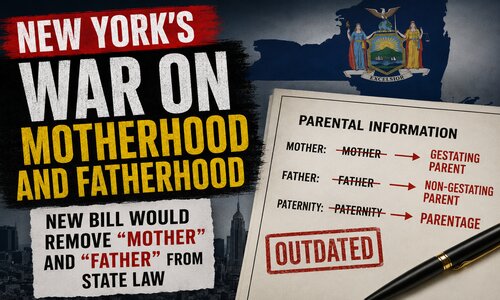
In New York, Democrats are advancing legislation that would remove the terms "mother" and "father" from portions of state law governing child custody and parental rights. Under the proposal, "mother" would become "gestating parent," "father" would become "non-gestating parent," and "paternity" would be replaced with the more generic term "parentage."
If that sounds more like a dystopian science fiction novel than a legislative proposal, you're not alone.
For millions of Americans, these words are not political labels. They are among the most meaningful titles a person can ever receive. A mother is not merely a biological function. A father is not simply a secondary participant in reproduction. These words carry emotional, relational, cultural, and spiritual significance that stretches across every civilization in recorded history.
Yet increasingly, modern governments seem determined to strip language of its humanity in pursuit of ideological goals.
Supporters argue that such changes promote inclusivity and better accommodate unconventional family structures. But critics see something very different happening. They see a deliberate effort to sever language from biological reality and replace it with bureaucratic terminology designed to accommodate gender ideology.
After all, nobody naturally refers to their mother as their "gestating parent."
No child runs into a classroom on Mother's Day excited to celebrate their "gestating parent." No greeting card company sells millions of "Happy Gestating Parent Day" cards every year. The language sounds sterile because it is sterile. It reduces one of humanity's most treasured relationships to a biological process.
And that may be precisely the point.
Language is never merely about communication. It shapes how societies think. When governments redefine words, they often seek to redefine the concepts behind them.
For decades, activists have argued that gender is entirely separate from biological sex. If that premise is accepted, terms like mother and father become problematic because they point back to biological realities that ideology seeks to blur. The solution, from this perspective, is not to adjust the ideology but to adjust the language.
What makes this movement particularly remarkable is how disconnected it appears from ordinary Americans.
Poll after poll continues to show that while most people favor treating everyone with dignity and respect, they remain deeply uncomfortable with attempts to erase biological distinctions between men and women. Most Americans still understand that mothers and fathers play unique and irreplaceable roles in family life.
Indeed, a growing number of voters appear exhausted by the constant push to redefine words that have served society perfectly well for centuries.
This frustration helps explain why many recent elections have seen significant backlash against progressive social policies. Voters facing inflation, rising housing costs, public safety concerns, and economic uncertainty often struggle to understand why elected officials devote so much energy to policing language instead of solving pressing problems.
But beyond politics lies a deeper issue.
The family is the foundational building block of civilization. Every society depends upon mothers and fathers raising the next generation. While families come in many different circumstances, the ideal of motherhood and fatherhood remains central to human flourishing.
When governments begin treating those roles as interchangeable or reducing them to clinical terminology, something valuable is lost.
From a Christian perspective, the issue goes even deeper.
Scripture repeatedly emphasizes the importance of mothers and fathers. The Fifth Commandment instructs children to "Honor your father and your mother." Throughout the Bible, parental roles are presented as gifts from God and essential components of His design for human relationships. The family structure is not viewed as a social construct to be endlessly reinvented but as part of the created order itself.
This is why many Christians view these linguistic changes as more than harmless updates to legal language. They see them as symptoms of a broader cultural movement that seeks to redefine human identity apart from God's design.
Ironically, in a supposed effort to be more inclusive, these changes often feel less human. The language of "gestating parent" and "non-gestating parent" sounds more appropriate for a laboratory report than a family photo album.
Perhaps that is why so many people instinctively recoil from it.
Words matter because reality matters. Mothers are mothers. Fathers are fathers. Children know the difference. Families know the difference. Every culture throughout history has known the difference.
The real question is whether lawmakers still do.
As governments increasingly attempt to remake language according to ideological preferences, Americans may find themselves asking a simple question: If society can no longer define what a mother or father is, what exactly is left that cannot be redefined?
And that question reaches far beyond New York. It strikes at the very heart of how a civilization understands family, identity, and ultimately, reality itself.