End Which Occupation?
 By Steve Frank/JNS.org August 22, 2019
Share this article:
It seems that just about everyone wants to "end the occupation" in Israel.
The call rings out from the editorial pages of The New York Times and The Washington Post, from pro-Palestinian NGOs, from progressive Jewish organizations, and from presidential candidates.
Ask someone at random what Israel should do to resolve the longstanding Palestinian-Israeli conflict, and perhaps the answer you're most likely to get is "end the occupation."
It sounds simple enough -- but which occupation are they talking about?
For most Westerners, the answer is obvious: the occupation of the West Bank (acquired by Israel during the 1967 Six-Day War).
As it turns out, however, it's not that simple. Contrary to the Western view, for most Palestinians, the occupation is not limited to the West Bank, but consists of "historic Palestine," which includes the whole of Israel.
For many -- if not most -- Palestinians, the occupation began in 1948 when Israel was born, and only continued in 1967 when Israel took over the West Bank. Therefore, they won't be satisfied by anything less than the elimination of the State of Israel.
Don't just take my word for it. Listen to the Palestinians themselves.
In a speech on Palestinian TV in October 2013, Palestinian Authority (PA) leader Mahmoud Abbas stated: "All Palestinian land is occupied -- Gaza is occupied, the West Bank is occupied, the 1948 lands [i.e. Israel] are occupied, and Jerusalem is occupied."
A June 2019 survey of Palestinians conducted by the Palestine Center for Public Opinion confirms the Palestinian perception of the occupation. When asked about ending the conflict with Israel permanently, only 30 percent of West Bankers would approve of a two-state solution. The majority say "the conflict should not end, and resistance should continue until all of historic Palestine is liberated."
This stunning video vividly illustrates Palestinians' understanding of the occupation. Palestinians were asked "if Israel left the West Bank and Gaza, would there be peace with Israel?"
At first, most answer in the affirmative, until it is clarified that this would mean Israel would still exist next to an independent Palestinian state. After which, respondents make it clear that by "ending the occupation," they were referring not only to the West Bank and Gaza, but to Israel proper as well.
Indeed, the symbol of the Boycott, Divestment, and Sanctions (BDS) movement, which seeks to end the "occupation," does not show a map of the West Bank, but a map of all of Israel -- the "liberation" of which is the real goal of the BDS campaign.
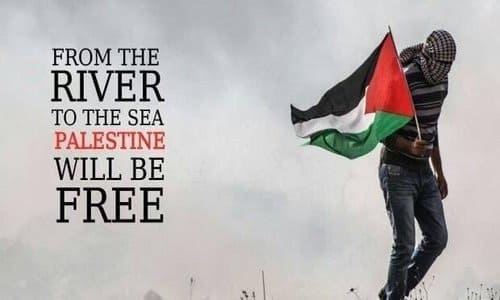
And there is no mistaking the meaning of the chant heard at virtually all pro-Palestinian rallies: "From the river to the sea, Palestine will be free." The river is the Jordan River, and the sea is the Mediterranean Sea. In other words, Palestine is Israel.
Further, the Palestinians memorialize the Nakba or "catastrophe" not to commemorate the 1967 Six-Day War, but rather to mourn the 1948 War of Independence. For a Palestinian, the real occupation began in 1948 with the creation of Israel, not in 1967. That is the occupation they seek to end.
This is nothing new. Palestinians have been vowing to destroy Israel from day one, even before the 1967 occupation of the West Bank. Prior to the 1948 war, Haj Amin al-Husseini, the mufti of Jerusalem, made it clear that the Arabs did not intend merely to prevent the birth of the Jewish state, but "would continue fighting until the Zionists were annihilated."
Prior to the 1967 war, Hafez Assad, then Syria's defense minister, declared: "The time has come to enter into a battle of annihilation."
The Palestinians have backed up these words with numerous wars and acts of terrorism.
Understanding the Palestinians' view of the occupation helps explain their otherwise inexplicable rejection of numerous offers from Israel and the international community to create their own independent state living in peace, side-by-side with Israel (1937, 1947, 1967, 2000, 2008).
As the video above makes abundantly clear, many Palestinians have no interest in living side-by-side with Israel. They are determined to end the occupation "from the river to the sea."
At the end of the day, what matters is not how Western advocates for Palestinians spin the issue, but rather what Palestinians say and do. And they have made their desires abundantly clear in word and deed for over a century.
The next time you are having a discussion of the Israel-Palestinian conflict and someone says, "If only Israel would end the occupation, there would be peace," ask them, "end which occupation"?
Originally published at JNS.org - reposted with permission.