
The Significance Of The Embassy Move
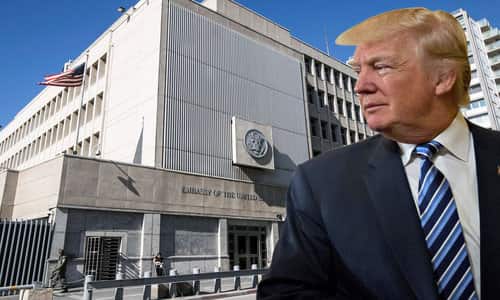 By Jonathan S. Tobin/JNS.org May 16, 2018
Share this article:
For decades, it was a consensus issue. Israel's supporters of all political stripes agreed that the refusal of the United States to recognize Jerusalem as Israel's capital was an anachronistic outrage. That's why both Democrats and Republicans included a promise to move the U.S. embassy from Tel Aviv in their platforms every four years.
But now that the moment has finally arrived, many of those who once agreed that a policy switch was both just and necessary aren't happy.
The reason is obvious: It's because of the identity of the man who finally kept his word. That Donald Trump is the one who fulfilled his vow, and gave Israel and its people a memorable 70th birthday present is a bitter pill for most American Jews to swallow.
Several presidents from both political parties promised to move the embassy, yet once they were elected, they broke that vow. The quadrennial bipartisan charade over Jerusalem had gotten so old that even most of those who ardently believed in the idea have grown so cynical about it that the mere mention of the issue sent our eyes rolling. It caused us to subsequently believe that anyone who repeated the promise was either a transparent liar or a hopeless idealist who would never have a chance to implement it.
The cynics were right to discount the promises made by some sincere friends of Israel, including Ronald Reagan and George W. Bush, as well as some less than ardent admirers of the Jewish state, like Jimmy Carter and the elder President Bush.
Indeed, the effort to pass the 1995 U.S. law to force the moving of the embassy (which included a presidential waiver that was regularly invoked by each president before Trump) was primarily the result of a transparently cynical and largely unsuccessful effort to boost the presidential candidacy of its chief sponsor Sen. Robert Dole, who up until then hadn't demonstrated much interest in Israel.
But no matter who was doing the promising, the appetite of pro-Israel activists to hear the words about the necessity of recognizing Jerusalem as the eternal capital of the Jewish state never dimmed. Or at least it didn't until it turned out that the only person who actually meant what he said about Jerusalem was someone that most of the overwhelmingly liberal American Jewish community despised.
Had a Democrat done it, Jewish liberals would have celebrated along with conservatives and Israelis. But since it's Trump, the impulse to downplay the significance of the decision has overridden any other emotion or reasoning.
That's why it's necessary to remind everyone just why Jerusalem used to be a consensus issue. It's equally important to explain that it's not an accident of history that Trump was the one who kept the promise.
It's true that moving the embassy doesn't magically transform the Israeli-Palestinian conflict. Still, the presence of a U.S. embassy in West Jerusalem doesn't foreclose the possibility of a two-state solution, assuming that's what the Palestinians actually wanted.
Moving the embassy doesn't mark the final triumph of Zionism. Nor will it compel the Palestinians to compromise and make peace if, as remains the case, they are still mired in a political culture committed to their futile century-old war on the Jews, which has left the peace process dead in the water since the second intifada.
Nor will the United Nations or the scores of nations that still refuse to recognize Israeli sovereignty over any part of the holy city change their stance as a result of Trump's decision.
But the desire to discount the importance of what he's done ignores the enormous symbolic importance of the world's sole superpower dropping the legal fiction about Jerusalem that has prevailed in the international community since 1948.
There may be a legal rationale rooted in the 1947 U.N. partition resolution that allowed nations to pretend that Jerusalem belonged to no one. But after 70 years, the double standard by which Israel is judged has more to do with lingering prejudice against the concept of a Jewish state than any desire to encourage peace talks.
The idea that Israel was a permanent addition to the Middle East--rather than a crusader state with a short shelf life--was given a huge boost by the U.S. investment in its future. For all of the credit given to President Harry Truman for recognizing the newborn state of Israel in 1948, the United States didn't begin to give it serious financial support until after it became a strategic asset--as opposed to a security basket case--as a result of its overwhelming victory in the 1967 Six-Day War.
But now Trump has gone further and made it clear that the United States will no longer pay lip service to an international consensus that still refuses to treat the Jewish state like a normal nation, entitled to decide where its capital should be and to respect the 3,000-year-old Jewish ties to the city.
Far from a technicality, the stubborn refusal of the world to treat Jerusalem as Israel's capital was important precisely because it validated Palestinian intransigence, in which the Jewish state's existence is a nakba or "disaster" that must never be treated as legitimate no matter where its borders are drawn. The embassy move is a necessary rebuke to a supposed moderate like Palestinian Authority leader Mahmoud Abbas, who continues to deny Jewish ties to Jerusalem and spew anti-Semitic inventive.
Trump's move is a message to the Palestinians that America is no longer prepared to join others in indulging their fantasies. Trump has broken the dam. Slowly, other nations will follow with the moving of their embassies, and the symbolism of these moves is another sign that their nightmare vision of Israel's destruction must be discarded.
There is one final point to be made about Trump's role. Those who feel that his involvement detracts from what would otherwise be a glorious day in Jewish history need to understand that he is almost certainly the only person who would have made this decision.
Virtually any other politician, including some with long histories as genuine friends of Israel, would have listened to the foreign-policy establishment and America's European allies and gone back on their promise, as all of Trump's predecessors did.
Only someone like Trump, who distrusts the experts and disdains the established rules of politics, would have ignored the predictions that the world would end if the embassy were moved. Say what you will about the abnormal nature of his presidency, without a genuine outsider like Trump in the White House, this important victory for Israel and the Jews would have never happened.
Originally published at JNS.org - reposted with permission.