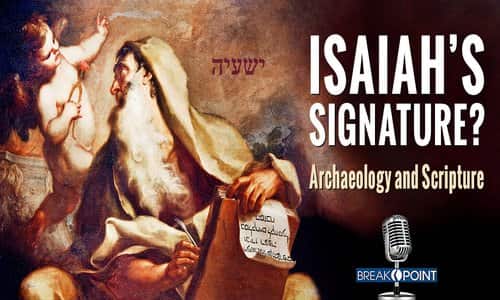
Isaiah's Signature? Archaeology & Scripture
 By Eric Metaxas/Breakpoint.org March 21, 2018
Share this article:

I will never get tired of telling you about the latest archaeological find that unearths living proof of the Bible's history.
About two years ago, I told you about an extraordinary archaeological find. Archaeologists digging "at the foot of the southern part of the wall that surrounds Jerusalem's Old City," found an ancient refuse dump dating back to the eighth century before Christ.
In the refuse dump, they found 33 clay imprints or seals, known as bullae. One of these bore the inscription "Belonging to Hezekiah (son of) Ahaz king of Judah."
That would be the Hezekiah of whom the Bible speaks so highly.
Now, those of you familiar with Hezekiah's story know that one person played an outsized role in his reign: the prophet Isaiah. It was Isaiah who reassured the king that Judah would not fall to the same Assyrian army that had taken the ten northern tribes in exile.
And it was Isaiah who told Hezekiah that he would not die and by way of proof, told the king that his sundial would reverse itself by ten steps (Is 38:7).
Given the close association between Hezekiah and Isaiah in life, it shouldn't come as a surprise to learn that they may be linked in the archaeological record, as well.
The latest issue of Biblical Archaeology Review features a piece by Eilat Mazar of Hebrew University. Mazar supervised the excavation that found Hezekiah's seal among the thirty-three recovered bullea.
Among the other clay seals was one inscribed with the name "Yesha 'yah[u]." (יְשַׁעְיָהוּ) For those of us who didn't study Hebrew, the name means "YHWH is salvation." In English, the name is rendered as "Isaiah."
You heard me, Isaiah. The obvious question is: Did the seal belong to the Isaiah?
Mazar believes it may well have. The biggest reason is that beneath the name "Yesha 'yah[u]" are the Hebrew letters rendered as "nvy." Now, a piece of that bottom line is missing, so Mazar can't be 100 percent certain, but "n-v-y" are the first letters of the Hebrew word "nabi" which means "prophet."
Still, she has technical reasons for thinking that the word was indeed nabi. But most of all, she believes that next to the actual inscription, the site of the find is the strongest evidence for concluding that we may very well be looking at, as the magazine put it, "Isaiah's signature."
She writes that "finding a seal impression of the prophet Isaiah next to that of King Hezekiah should not be unexpected." She points out that in 2008, seals belonging to two high officials, Gedeliah and Shelemiah mentioned in Jeremiah 38, were found "only few feet apart."
Thus, "it would not be the first time that seal impressions of two Biblical personas, mentioned in the same verse in the Bible, were found in an archaeological context."
She concludes that "the close relationship between Isaiah and King Hezekiah, as described in the Bible, and the fact the bulla was found next to one bearing the name of Hezekiah seem to leave open the possibility that . . . this may have been a seal impression of Isaiah the prophet, adviser to King Hezekiah."
You know what possibility is not open? Finding evidence that the Heracles of Greco-Roman mythology, or that the various heroes of Indian epics, ever existed--at least not in anything resembling the classic texts. The latter are set in mythical pre-historic times before the invention of writing.
The scriptures, as we never tire of reminding you, are set in the world you and I live in. They tell the story of a God who acts within recorded human history and ultimately enters it.
Thus, finding traces of this activity, even in ancient refuse, should not be unexpected.
Originally published at Breakpoint.org - reposted with permission.