Evangelicals, Racists And Trump
 By Michael Brown/Ask Dr Brown August 15, 2017
Share this article:

The alt-right. White supremacists. Nationalists. Trump supporters. Racists. Evangelical Christians. Is this a list of unrelated, widely disparate groups that overlap only on the fringes?
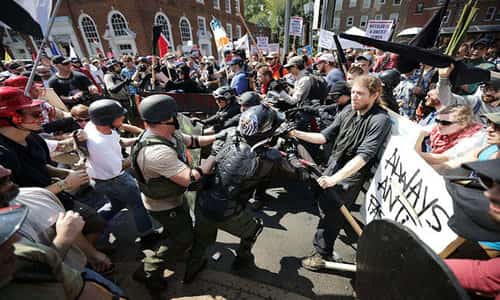
Or does this describe the inter-connected spokes of the same wheel, different in emphasis but not in kind? The tragedy in Charlottesville, which has heightened tensions and exacerbated divisions in our country, calls for clarification.
If you listen to some secular media, you'd get the impression that Donald Trump is responsible for Charlottesville and that those who voted for him are culpable as well. You'd also get the impression that unless you denounce Trump, you are guilty of racism and are likely a white supremacist.
And since Trump has support from many evangelical Christian leaders, you'd be led to believe that they are part of the alt-right, all of them racists and hyper-nationalists.
Because I was out speaking Saturday afternoon and evening, I did not post anything on social media about Charlottesville until late that night. By that time, my Twitter feed was lit up with calls for me renounce racism and distance myself from Trump.
Quite out of the blue, I was judged to be implicit in a racist cause because I did not speak out against a white supremacist rally quickly enough. And because I had voted for Trump, I was now an accomplice in racism and, by default, a member of the alt-right.
Many of you reading this have had the same experience, as if there was an explicit connection between Charlottesville and Trump voters, between racism and evangelical Christians. But is there a connection?
When I finally got around to posting on Facebook on Saturday night, I wrote: "There is nothing American about White Supremacism -- nothing heroic, nothing praiseworthy, nothing patriotic.
It is a rotten, ugly mindset full of hatred, bigotry, and pride, and every person of conscience should denounce it.
It degrades others who are also created in the image of God and takes His name in vain to further its cause. Whatever our political or racial or ethnic background, as Americans, we need to stand together against it."
All this seems self-evident, and every friend and co-worker I have would agree with this. What is there to argue with?
The response to the comment was excellent, with strong support for what was shared. Others, however, chimed in negatively, criticizing blacks (since I was criticizing white supremacists), asking me why I never renounced Black Lives Matter extremism (which, of course, I had), and claiming that anyone who voted for Trump was complicit in the Charlottesville riot.
In response to some of these comments, I wrote: "The bottom line is simple: I don't care what color your skin is and what your ethnic background is. When Neo Nazis rally, you condemn it. When the KKK rallies, you condemn it. When Black Supremacists rally, you condemn it.
And when a man plows his car into a crowd, killing one person and injuring 19, you condemn it. If you can't do that, you shouldn't be on this page. I trust we share the same heart here."
Again, this seems straightforward, yet even this comment drew negative responses, which makes one thing very clear: There are dangerous extremes on the right and on the left, and there is racism on the right and on the left. All of this is wrong and contemptible.
What about connecting all the dots on the right and drawing a coherent circle with Trump in the center? I believe that would be inaccurate for the following reasons:
1) Although there were certainly divisive aspects to Trump's campaign there's little hard evidence that he is a racist. And from the reports I hear from people close to him, he has a genuine burden to help the inner-cities, which are largely minority.
2) Although right-leaning, white nationalists overwhelmingly voted for Trump, they still make up a small part of his overall base and do not reflect the sentiments of the vast majority of his voters.
3) It is a non sequitur to argue that, because the KKK supported Trump, others who voted for Trump support the KKK. I'm sure the New Black Panthers overwhelmingly voted for Barack Obama (and Hillary Clinton), but that doesn't mean that a white California Jew who voted for Obama and Hillary supports the New Black Panthers. Let's be realistic.
4) The vast majority of evangelical Christians denounce racism and have no connection with the alt-right or with white supremacists. The fact that some white racists use Christianity as a cloak tells us one thing only: they are hypocrites.
5) Identity politics can be just as dangerous as outright racism. Both are divisive, both demean the value of others, and both make judgments based on skin color or ethnicity.
6) We should distance ourselves from the extremism of groups like Black Lives Matter and Antifa just as we distance ourselves from the extremism of white nationalism, exposing the hateful rhetoric, rejecting the violent acts, and saying with one loud voice, "As Americans, this is not who we are."
Right now, across the country, there is massive distrust, polarization, misunderstanding, and misrepresentation. And rather than bringing us together, much of the media is fanning the flames of division and fear, often in grossly hypocritical ways (in other words, finding fault with one side only when there is fault on both sides).
At volatile times like this when our blind spots only become bigger, we must determine to be part of the solution and not the problem. That means listening before speaking, understanding before opining, and caring before criticizing.
Will we be peace-makers or troublemakers, ones who build bridges or blow up bridges, those who reach out or those who push away?
Whether we like it or not, with our deep differences and strong convictions, we are one nation under God, and united we stand, divided we fall. Which will it be?
Originally published at AskDrBrown.org - reposted with permission.